Warcraft III’s Legacy: Heroes, Custom Maps and the Birth of New Genres
How Warcraft III's heroes, upkeep and creeping reshaped RTS design, and how its World Editor gave rise to DotA, the MOBA genre and tower defense.

Most real-time strategy games are remembered for their campaigns or their competitive balance. Warcraft III is remembered for that and for something stranger: a map editor that became an incubator for entirely new genres. Released by Blizzard Entertainment in July 2002, it pushed RTS design toward role-playing ideas with hero units and neutral monsters, and its toolset let players build games Blizzard never imagined. Defense of the Ancients, the map that inspired the multiplayer online battle arena (MOBA) genre, began life as a Warcraft III custom scenario.
This article looks at what Warcraft III changed in RTS design, how The Frozen Throne expanded it, how custom maps grew into new genres, and what happened with the 2020 remaster. For the wider timeline of the genre, see our short history of real-time strategy.
From Adventure Game to “Role-Playing Strategy”
Warcraft III’s development started in an unusual place. In 1998 Blizzard canceled Warcraft Adventures: Lord of the Clans, a point-and-click adventure game, and some of its story ideas fed into the next Warcraft strategy game. When Warcraft III was announced in 1999, Blizzard described it as a “role-playing strategy” game, and early showings emphasized smaller groups of units and heroes rather than large armies.
The design changed substantially during development, and the final game returned to base building and resource gathering. But the role-playing influence survived in its most important new systems, and that hybrid is what made it distinctive. It was also the first Warcraft game rendered in 3D, with a fixed, tilted camera that kept the readability of earlier top-down RTS games.
Four Factions and a Story-Driven Campaign
Warcraft II had two mostly symmetrical sides. Warcraft III offered four factions with genuinely different mechanics:
- Human Alliance: sturdy, flexible, with towers, spellcasters and knights.
- Orcish Horde: tough melee units, burrows for defense and powerful shamanistic magic.
- Night Elves: a new faction whose buildings were living “ancients” that could uproot and walk, with units that blended into the night.
- Undead Scourge: a new faction that spread blight to build on and harvested lumber with ghouls.
The single-player campaign told one continuous story across all four factions, played in a set order, following the Burning Legion’s attempt to conquer Azeroth through the Undead Scourge. The arc of Arthas Menethil, the paladin who becomes a death knight, became one of Blizzard’s most famous storylines and fed directly into World of Warcraft. Objectives were delivered through “seamless quests” inside missions rather than only through briefing screens, which gave levels a more adventure-like structure.
Critics praised the visuals, soundtrack, voice acting and multiplayer, and the game holds a Metacritic score of 92. It sold one million copies in its first month and shipped 4.4 million copies to retail, and it won several Game of the Year awards, including GameSpot’s.
The Design Ideas That Changed RTS
Heroes with levels
Heroes were Warcraft III’s signature addition. Each faction could recruit up to three heroes from its altar. Heroes gained experience by fighting, leveled up to a maximum of 10 in the base game, learned new spells and ultimate abilities, and carried items in an inventory. A single hero could swing a fight with a well-timed spell, and losing one hurt, although they could be revived at the altar.
This was a big shift. In most earlier RTS games, every unit was disposable and replaceable. In Warcraft III, the most important unit on the map was a persistent character the player invested in for the whole match.
Upkeep
Warcraft III also introduced an upkeep system that reduced gold income as an army grew past set thresholds. The intent was to discourage the “build the biggest army” approach and push players toward smaller, carefully controlled forces. It made micro, the precise control of individual units, especially important. Our guide to macro, micro and build orders explains those skills in general terms.
Creeps and creeping
The map was full of neutral monsters, called creeps, guarding gold mines, shops and item drops. Killing them (“creeping”) gave heroes experience and items. Creeping created a constant decision: spend time leveling your hero on neutral camps, or pressure the opponent directly. It also gave matches a rhythm that felt closer to an RPG than earlier RTS games.
Day and night
A day/night cycle reduced sight ranges at night and made neutral creeps sleep, which opened windows for safer creeping or surprise attacks. Night Elves had particular advantages in darkness.
The Frozen Throne (2003)
The expansion, Warcraft III: The Frozen Throne, launched on 1 July 2003 in North America (and a few days later in Australia and Europe) for Windows and Mac OS X. Rather than reinventing the game, it fine-tuned it:
- Each faction received new units, buildings and one new hero.
- Neutral heroes could be hired from a Tavern, which could also revive fallen heroes. Five launched with the expansion, and three more arrived in 2004 patches.
- Shops and item systems were expanded.
- The Naga appeared throughout the campaigns with their own units, though they were not playable in multiplayer.
- An Orc bonus campaign played like a small RPG, with heroes able to level past 10. Its first act shipped with the expansion, and the remaining acts came in a later patch.
Crucially for what came next, The Frozen Throne also upgraded the World Editor with new trigger functions, new tilesets, more global map settings and the ability to link maps together. It also added 62 multiplayer maps and custom scenarios based on popular mods, and support for up to twelve players.
The World Editor and the Custom Map Explosion
Warcraft III shipped with the World Editor, the same kind of tool Blizzard used internally. It let players change terrain and units, and its trigger system, along with the JASS scripting language underneath it, allowed for complete rule changes. Custom maps could be hosted and played online through Battle.net, so a good idea could spread from player to player without any formal distribution.
Blizzard had included a map editor with StarCraft, and its community had already experimented with custom scenarios. But Warcraft III’s combination of a more powerful editor, hero units with levels and items, and easy online hosting made it a near-perfect laboratory. Players made role-playing maps, survival maps, racing games, arena fighting games and much more.
How DotA Led to the MOBA Genre
The most influential custom map started with an idea from StarCraft. “Aeon of Strife,” a StarCraft custom map, gave each player a single hero fighting alongside waves of computer-controlled units. In 2003 a modder known as Eul built the first Defense of the Ancients for Reign of Chaos. After The Frozen Throne launched, Eul made the map’s code open, and several variants appeared.
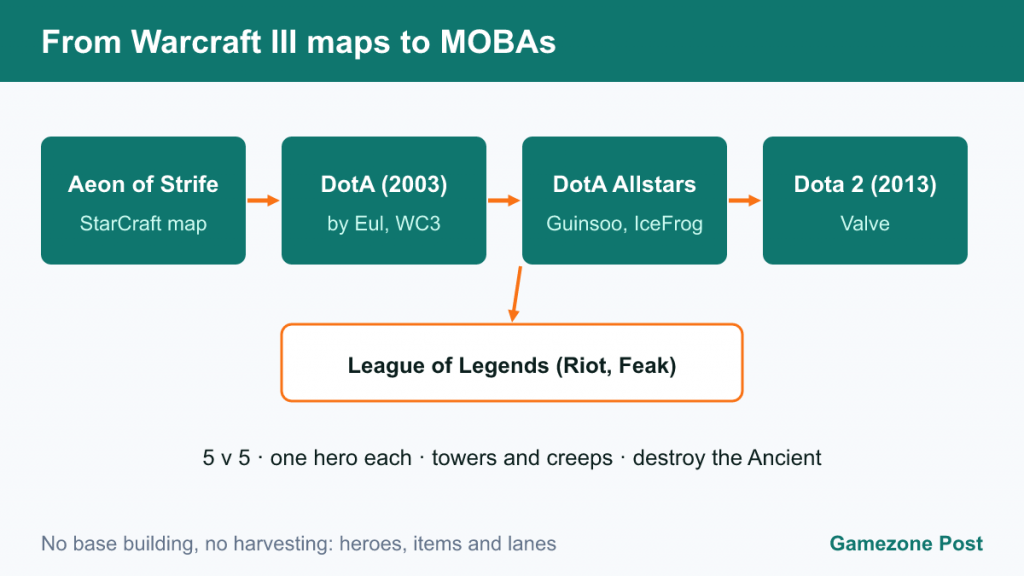
The most popular variant, DotA Allstars, was created by Meian and Ragn0r. Steve “Guinsoo” Feak took over development in 2004, and around 2005 the map passed to a developer known as IceFrog, who maintained it for years. The format was simple to describe and deep to play:
- Two teams of up to five players each, the Sentinel and the Scourge.
- Each player controls one hero, chosen from more than a hundred, who levels up and buys items with gold.
- Bases are guarded by towers and waves of computer-controlled units march toward the enemy.
- The goal is to destroy the opposing team’s Ancient.
There was no base building or resource harvesting. In effect, DotA took Warcraft III’s heroes, creeps and items, removed the economy layer and turned the result into a team game. Its influence was enormous: Feak later applied lessons from DotA to League of Legends at Riot Games, and Valve hired IceFrog in 2009 and released Dota 2 in July 2013. The term MOBA describes the genre that grew from this lineage.
Tower Defense on Battle.net
Tower defense did not begin with Warcraft III. Rampart (1990) is generally considered the prototype, and StarCraft custom maps such as Turret Defense (2000) and Sunken Defense (2001) were popular early examples. But Warcraft III maps gave the form a new boost. Its editor made it easy to define waves of enemies walking a path and towers with upgrades and special effects, and it added role-playing elements to many scenarios. The Frozen Throne even hid a tower defense scenario inside one of its campaigns.
Well-known Warcraft III tower defense maps include Element TD and Gem Tower Defense, which were created with the World Editor. The genre then spread beyond RTS games: Desktop Tower Defense (2007) became a browser hit, Bloons Tower Defense started its long-running series the same year, and Plants vs. Zombies (2009) turned the idea into a mainstream success.
Reforged: A Troubled Remaster (2020)
Blizzard announced Warcraft III: Reforged at BlizzCon 2018 and released it on 28 January 2020 for Windows and macOS, developed with Lemon Sky Studios. It added updated graphics, new Battle.net features, balance changes, campaign difficulty settings and Lua scripting alongside JASS.
The launch was badly received. Some promised features were missing, including a competitive ladder and replay saving, and existing copies of the original game were forced onto the new client. A new Custom Game Acceptable Use Policy, in which Blizzard claimed rights over custom games made with the editor, drew criticism in light of DotA’s history. Critics gave mixed reviews (a Metacritic score of 59), user reviews were overwhelmingly negative, and in February 2020 Blizzard began offering refunds on request.
Updates continued in the years after. A 2.0 update in November 2024 added the ability to switch to “Classic HD” graphics, among other changes. Much of the community’s multiplayer activity now runs through the fan platform W3Champions.
Why Warcraft III Still Matters
Warcraft III’s legacy runs in several directions at once. Within RTS, it popularized heroes and neutral creep camps, and you can see its influence in later games that mix leveling characters into armies. Its story fed World of Warcraft. And its World Editor showed that giving players powerful, accessible tools can create value far beyond the original game. Few strategy games have shaped as many genres outside their own. If you want to compare it with Blizzard’s other big RTS, our guide to StarCraft II’s races shows how differently that series approached faction design.