Frostpunk and Frostpunk 2: How the Survival City Builder Works
Heat, coal, laws, hope and discontent in Frostpunk; districts, factions and council votes in Frostpunk 2. Core priorities and common mistakes explained.
Most city builders ask how big and beautiful your city can become. Frostpunk asks whether it will survive the week. Developed by the Polish studio 11 bit studios, best known before that for This War of Mine, the series turns the genre’s usual optimism upside down: the cold is always coming, resources are always short, and every rule you pass to keep people alive costs something in return.
This guide explains how the original Frostpunk (2018) and Frostpunk 2 (2024) work, how their systems differ, and which priorities and mistakes matter most for new players. If you are new to city builders altogether, our primer on zoning, services and budgets covers the conventional genre that Frostpunk deliberately subverts.
The Premise: A Volcanic Winter
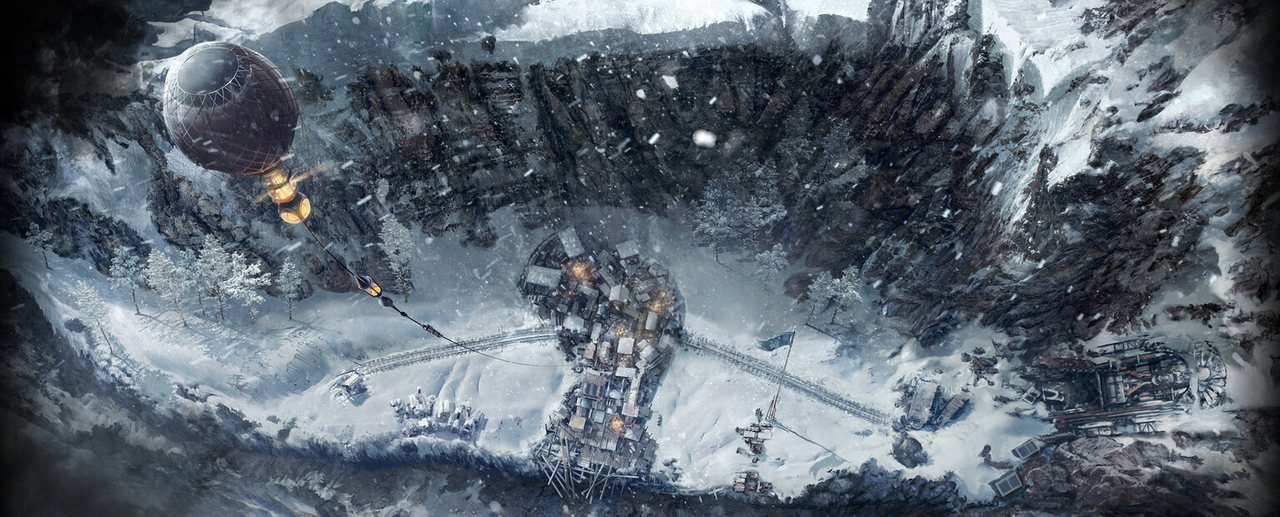
Frostpunk is set in an alternate 1886, after volcanic eruptions (Krakatoa among them) have triggered a global volcanic winter that collapses civilization. A group of survivors from London travels north to a crater where a giant coal-fired generator stands. Around that generator, they build New London.
The game was released for Windows on 24 April 2018, with console versions and later ports following. Its development team of about 60 people aimed for what they called “meaningful entertainment,” drawing inspiration from polar expeditions, survival accounts and Jacek Dukaj’s novel Ice. Critics praised its art style, crisis management and ethical choices, while some criticized limited replay value. It has sold over five million copies.
Frostpunk 2 jumps 30 years ahead to 1916. New London has survived and grown into an overcrowded city, now facing shortages of food and coal while a petroleum industry emerges. You play as the Steward, the city’s leader, and the threat has shifted from the cold alone to the people inside the walls.
Frostpunk: Heat, Coal and the Generator
The original game’s entire layout revolves around the generator at the center of the crater. It radiates heat to buildings within range; the farther a building is from the generator, the colder it is. Cold homes and workplaces cause illness, and illness drains your workforce.
Coal is the lifeblood. You gather it first from piles of scrap and coal around the map, then from coal thumpers and mines. Wood and steel come from similar sources. Food comes from hunting and gathering outposts and, later, greenhouses.
Managing heat
- Generator range and power: research and upgrades extend how far heat reaches and how much it provides.
- Insulation: research improves the insulation of homes and workplaces.
- Overdrive: the generator can be pushed harder in emergencies, but sustained overdrive risks a catastrophic failure.
- Temperature drops: scenarios include cold snaps announced in advance, so preparing coal stockpiles before they hit is critical.
The circular layout around the generator is a design statement: unlike the open grids of most city builders, your city has a clear, concentric shape dictated by survival.
Frostpunk: Workforce, Laws, Hope and Discontent
Your population is your workforce. Citizens are split into workers and engineers, with engineers needed for research, medical posts and advanced buildings. Children can attend shelters or, if you pass the law, work in safe jobs. Injured and sick citizens cannot work, so healthcare is an economic decision as much as a moral one.
The Book of Laws
Laws shape society: work routines (such as extended shifts), healthcare policies, food provision and how the dead are handled. Many laws are morally gray, offering a practical benefit at a human cost. Later in a scenario, you may follow a path toward either Order or Faith, two forms of increasingly authoritarian rule that strengthen control at the expense of freedom.
Hope and discontent
Two meters track how your people feel. Hope reflects their belief that the city has a future; discontent reflects anger at your decisions and conditions. If hope falls too low or discontent rises too high, the people may revolt and remove you, ending the game. Many laws, events and decisions affect these meters, so the challenge is balancing survival needs against morale.
Exploring the Frostland
Scouting expeditions travel outside the city to find survivors, resources and story events. Bringing back more people grows your workforce but also increases demand for heat, food and shelter. Research also unlocks steam-powered automatons that can work without human labor, which is valuable as the cold deepens.
Frostpunk’s Scenarios
The base game includes three scenarios, each with a different twist:
- A New Home: the main story of founding New London.
- The Arks: protect seed vaults with a workforce made mostly of engineers.
- The Refugees: a scenario about balancing the needs of different groups of survivors.
Later downloadable content added further scenarios, including The Fall of Winterhome, The Last Autumn and On the Edge, plus an Endless Mode for open-ended play.
Frostpunk 2: Districts, Factions and the Council
Frostpunk 2 released for Windows and macOS on 20 September 2024 and for PlayStation 5 and Xbox Series X|S on 18 September 2025. It changes scale and focus dramatically.
Districts instead of buildings
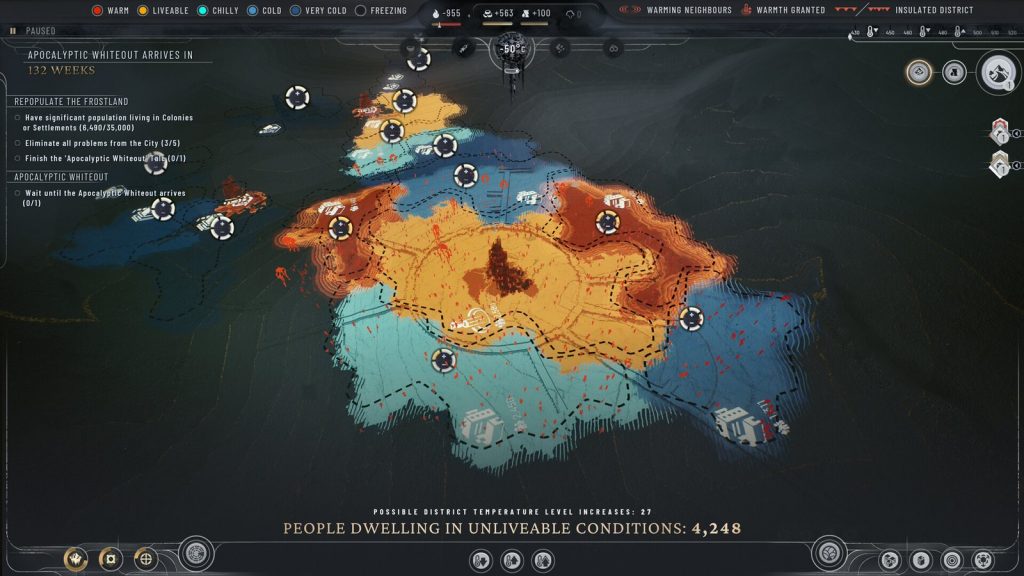
Rather than placing individual tents and workshops, you build large districts, each with a function such as food, energy or shelter. Districts cost resources, so their placement and order matter. Heat remains a key resource, now allocated across districts rather than radiating from a single central point. The game’s own description stresses tough life-and-death decisions about how to allocate heat across the city.
Factions and the Idea Tree
Research is reframed as the Idea Tree, and ideas are tied to factions with conflicting ideals. Adopting one faction’s idea can upset others. Radicals can grow within factions, raising tension that you must counter to avoid chaos.
The council
Laws are no longer simply signed by you. You propose them to a 100-member council, which votes. Most laws need a simple majority, while laws that expand the Steward’s power need two-thirds. You can negotiate with factions to secure votes, but promises made during negotiation must be kept, or the factions become angry.
This is the sequel’s biggest conceptual change: the original game asked whether the city would survive the cold, while Frostpunk 2 asks whether it will survive itself.
Comparing the Two Games
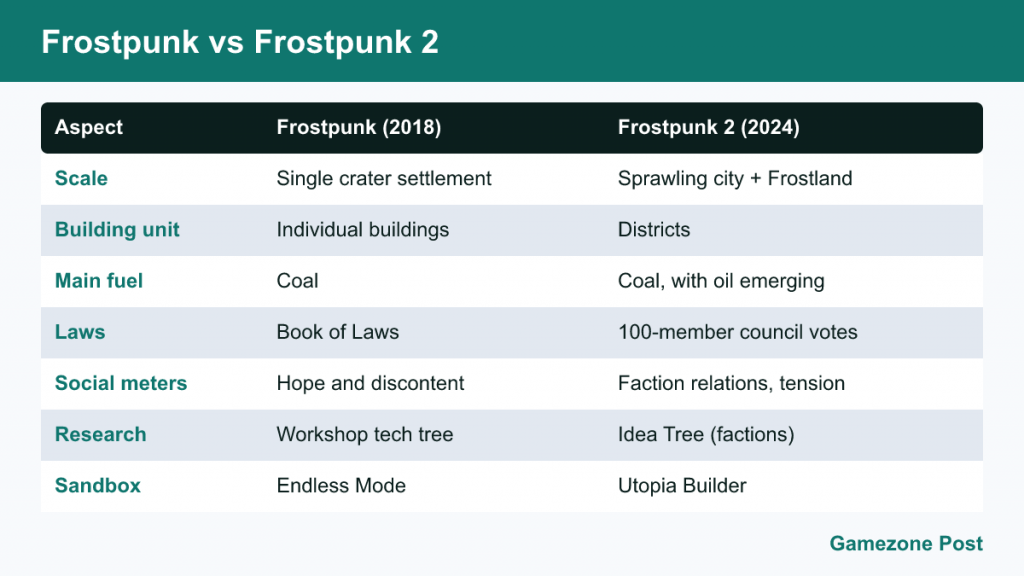
| Aspect | Frostpunk (2018) | Frostpunk 2 (2024) |
|---|---|---|
| Scale | A single crater settlement | A sprawling city and surrounding Frostland |
| Building unit | Individual buildings | Districts |
| Main fuel | Coal | Coal, with oil emerging |
| Laws | Signed directly from the Book of Laws | Voted on by a 100-member council |
| Social meters | Hope and discontent | Faction relations and tension |
| Research | Technology tree in workshops | Idea Tree tied to factions |
| Sandbox | Endless Mode (added later) | Utopia Builder |
Frostpunk 2 received generally favorable reviews (a Metacritic score of 85 on PC). Its Utopia Builder sandbox lets you choose communities, factions and goals such as building a metropolis or establishing colonies. Post-launch content includes the Fractured Utopias expansion (December 2025).
Survival Priorities for New Players
Frostpunk
- Gather coal first. Assign workers to coal piles immediately so the generator can run.
- Build shelter early. People sleeping outside get sick quickly.
- Secure food. Hunters and gathering posts plus a cookhouse keep hunger from spiraling.
- Research heat technology. Heaters, insulation and generator upgrades pay off for the rest of the scenario.
- Prepare for cold snaps. Stockpile coal and stop expanding before a major temperature drop.
Frostpunk 2
- Read the factions. Before proposing laws, check how each faction is likely to vote.
- Balance districts. Shortages in one area (food, fuel, housing) ripple through the city.
- Keep promises. Broken negotiation promises damage relations for a long time.
- Plan heat allocation. Under-heated districts suffer, especially during whiteouts.
Common Mistakes
- Expanding too fast. In both games, more people and more space mean more demand for heat and food. Growth without supply leads to collapse.
- Ignoring the sick. In Frostpunk, untreated illness becomes a downward spiral as fewer workers produce less coal.
- Passing laws without reading consequences. Many laws have follow-up effects that appear later.
- Running the generator in overdrive for too long. Short bursts help; leaving it on risks disaster.
- Treating factions as enemies. In Frostpunk 2, permanently alienating a large faction makes the council almost unworkable.
Frostpunk’s influence is notable because it showed that a city builder can be a moral drama. For the classic, optimistic tradition it reacts against, see our history of SimCity and the birth of the city builder.
Which Should You Play First?
The original Frostpunk is more focused and easier to read: one generator, one crater, clear meters. Its scenarios are also short enough to replay with different choices. Frostpunk 2 is broader and more political, better suited to players who enjoy managing interest groups and negotiating. Story-wise, playing the original first gives more weight to the sequel’s setting, but each works on its own. For other approachable strategy picks, see our list of the best strategy games for beginners.
Quick answers
Can you lose in Frostpunk? Yes. If the population dies out, or if hope collapses or discontent boils over, your people can exile you and the scenario ends. That threat is what gives each law its weight.
Is there a “good” path? Not really. The games are designed so that compassionate choices often cost resources, and harsh choices cost morale or your conscience. The endings reflect the trade-offs you made rather than a single correct route.
Do you need to play on the hardest difficulty to get the intended experience? No. The default settings are already demanding; lower difficulty is a reasonable way to learn the systems before trying harsher settings or Endless Mode and Utopia Builder.