Turn-Based Tactics Explained: XCOM and the Genre’s Core Mechanics
Action points, cover, hit chance, overwatch and permadeath: how turn-based tactics games work, using XCOM, Into the Breach, Phoenix Point and Jagged Alliance.

A soldier stands behind full cover, an alien sits in the open, the screen reads 95%, and the shot misses. Few moments in strategy gaming generate as much frustration, or as many jokes, as that one. It is also a perfect entry point into how turn-based tactics games work. Behind the drama are a handful of systems, including action economy, cover, probability, reaction fire and permanent consequences, that the best games in the genre combine in different ways.
This guide explains those core mechanics using XCOM: Enemy Unknown and XCOM 2 as the main reference, and compares them with Phoenix Point, Into the Breach and Jagged Alliance 3. It also clarifies a distinction that often gets blurred: the difference between tactics and strategy.
Tactics vs Strategy: Where the Genre Sits
In military language, strategy concerns the overall campaign (what to fight for, where and with what resources), while tactics concerns how a specific engagement is fought. Games borrow the same distinction. A turn-based tactics game focuses on small-unit combat on a grid or map: you control individual soldiers, each with their own position, health and abilities, and turns alternate between you and the enemy.
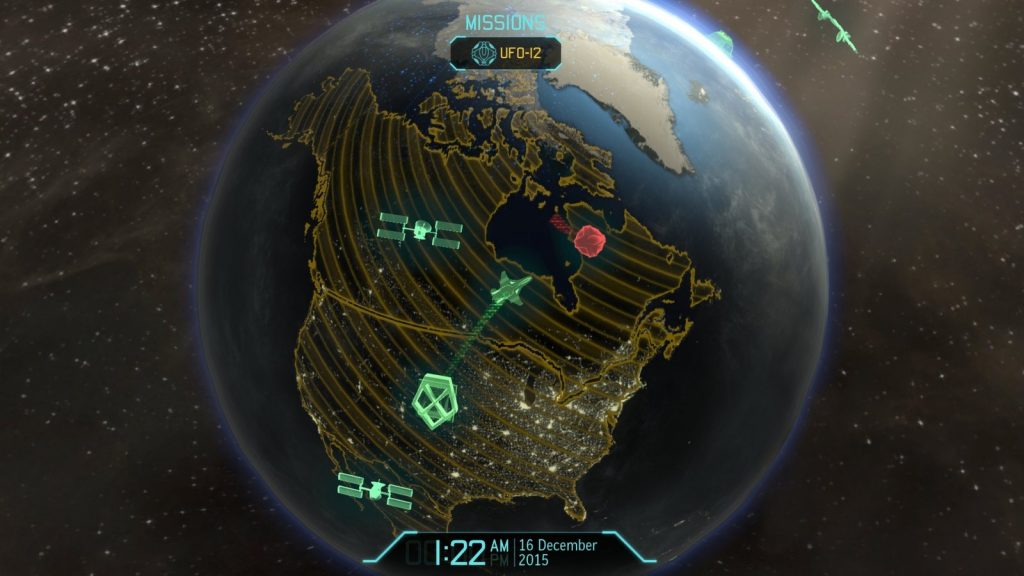
Many tactics games, including XCOM, wrap that combat in a strategic layer: a base to manage, research to pursue, money to spend and a global threat to contain. The two layers feed each other. A bad tactical mission costs you veteran soldiers; a bad strategic decision sends you into missions under-equipped. If you are mapping the wider family of games, our overview of RTS, 4X and grand strategy shows where turn-based tactics fit alongside them.
A brief lineage
XCOM: Enemy Unknown (2012), developed by Firaxis Games and led by Jake Solomon, is a reimagining of the 1994 game UFO: Enemy Unknown (released as X-COM in North America), designed by Julian Gollop’s Mythos Games. The 2012 game is widely credited with reviving interest in turn-based tactics during the 2010s. Gollop himself later returned to the genre with Phoenix Point (2019), and the Jagged Alliance series, which began in the 1990s, returned with Jagged Alliance 3 in 2023.
Action Economy: Points vs Two-Action Systems
Every tactics game must answer a basic question: what can a unit do on its turn? There are two common answers.
- Action points (AP): each unit has a pool of points, and every action costs some. Moving one tile, crouching, reloading and firing all draw from the same budget. Classic X-COM and the Jagged Alliance series use this model. It allows fine-grained choices (move a little, shoot twice) but requires more arithmetic.
- Two-action systems: XCOM: Enemy Unknown simplified this into two actions per soldier per turn. You can move twice (a “dash”), or move and shoot. Firing a weapon typically ends the soldier’s turn. This makes turns quicker to read and decisions sharper.
Phoenix Point uses a similar framework of two basic actions per turn, plus special abilities funded by a separate resource called Will Points, which are also drained by injuries and frightening enemies. Into the Breach strips things down further: each mech moves and then acts once, on a compact 8×8 grid.
The design trade-off is clarity versus granularity. AP systems simulate more, but the two-action approach made XCOM far more approachable for players new to the genre.
Cover, Flanking and Line of Sight
Cover is the heart of modern tactics games. In XCOM, objects on the map provide either half cover or full cover, shown by shield icons as you plan a move. Cover lowers the enemy’s chance to hit, and full cover lowers it more. A soldier in the open is extremely vulnerable.
Flanking is the counterpart. If you reach a position where the enemy’s cover no longer sits between you and them, the cover bonus disappears and, in XCOM, you typically gain a higher chance of critical hits. A large share of XCOM’s tactical play is a dance of these two ideas: keep your soldiers in cover facing the threat, and move someone to an angle that flanks the enemy.
Destructible cover
Cover is not permanent. Explosives and heavy weapons can destroy walls, cars and crates, stripping enemies of protection. Using a grenade to remove cover often turns a low-percentage shot into a reliable one, which is why explosives are so valuable in XCOM and similar games.
Line of sight and fog of war
Most tactics games hide enemies until your units can see them. Moving too far forward can “activate” a new group of enemies, which in XCOM often means fighting two pods at once. Careful, short moves at the front of the squad are one of the most important habits to learn.
Hit Chance: Why 95% Shots Miss
Most XCOM-style games show a percentage chance to hit before every shot, calculated from the shooter’s aim, the target’s defense, cover, distance and other modifiers. The game then rolls a random number to decide the outcome.
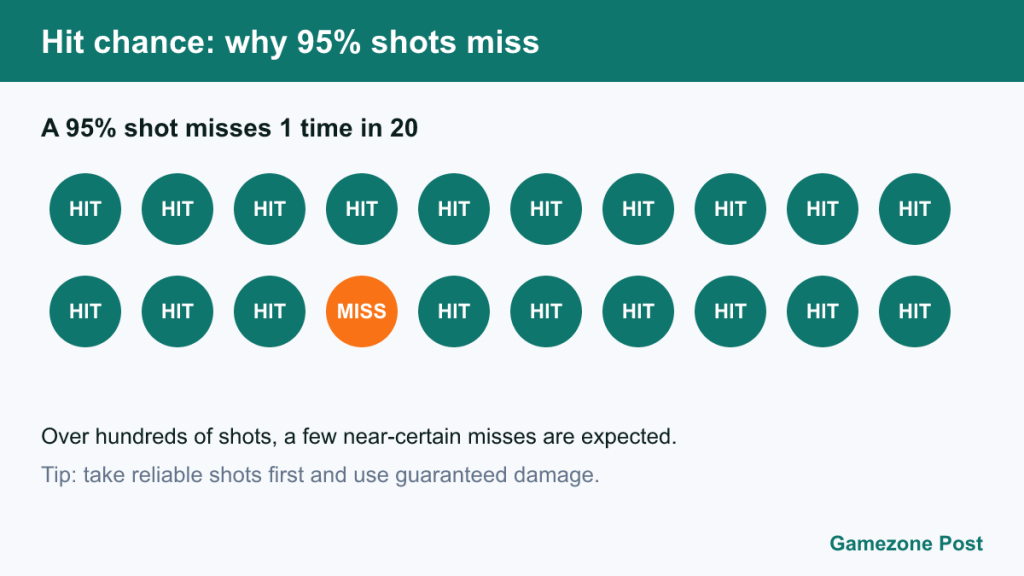
The famous complaint comes from how people perceive probability. A 95% shot misses one time in twenty. Over a campaign in which you take hundreds of shots, a handful of misses on near-certain shots is not a bug but an expected outcome. The misses are memorable because they are rare and because they often come at critical moments, while the many successful 95% shots are quickly forgotten.
Developers know this. According to Wikipedia’s article on XCOM 2, its developers said the displayed hit chance and the underlying calculation can differ slightly so the odds feel closer to what players expect. The broader lesson is that the percentages are honest guidance, not promises.
Playing around randomness
- Use guaranteed damage. Grenades and certain abilities in XCOM hit automatically, which makes them ideal for finishing important targets.
- Take the reliable shots first. Start a turn with your highest-percentage actions so you can adapt if they fail.
- Never rely on one roll. Plan a turn so that a single miss does not leave a soldier flanked and exposed.
- Change the odds before shooting. Destroy cover, flank or use abilities that boost aim.
Alternatives to percentages
Some games deliberately avoid the percentage roll. Phoenix Point uses a targeting system in which projectiles are simulated and you can aim at specific body parts, so whether a shot lands depends on what is physically in the line of fire. Jagged Alliance 3 also lets players target body parts. Into the Breach takes the opposite approach to XCOM: enemy attacks are telegraphed on the board before you act, so the game is about solving a clearly visible puzzle rather than managing uncertain rolls.
Overwatch and Reaction Fire
Overwatch lets a soldier skip their shot during your turn in exchange for firing at the first enemy that moves within their line of sight during the enemy turn. It is the main defensive tool in XCOM and its successors.
Overwatch is powerful against enemies who must cross open ground, and it allows a defensive “overwatch trap” in which several soldiers cover the same approach. It has costs, too: overwatch shots usually carry an aim penalty, and you give up a guaranteed action now for a possible one later. XCOM 2 added concealment, which lets the squad begin missions hidden and set up an ambush, an approach that pairs naturally with overwatch.
Other games use related ideas. Phoenix Point includes overwatch and return fire, and the general concept, often called reaction fire or opportunity attacks, appears throughout the genre.
Permadeath and the Strategic Layer
In XCOM, a soldier who dies is gone for good. Because soldiers gain ranks and abilities as they survive missions, losing a veteran is a real setback. This turns every mission into a risk calculation: is the objective worth exposing your best sniper?
Many players increase the stakes further with Ironman mode, in which the game saves automatically and you cannot reload to undo a bad result. It is the intended way to experience the campaign’s tension, though it is entirely reasonable to learn the game without it.
What the strategic layer adds
- Research and engineering: new weapons, armor and items change what your squad can do.
- Base building: facilities unlock capabilities and consume resources.
- Global pressure: in Enemy Unknown, funding nations can leave the program if panic rises too high. In XCOM 2, the aliens’ Avatar Project advances in the background and ends the campaign if it completes.
- Time pressure: XCOM 2 added turn timers to many missions, pushing players to advance rather than overwatch-crawl across the map.
Jagged Alliance 3 gives its strategic layer a different flavor: you hire mercenaries from a roster of 40, each with a personality and backstory, and you manage a dynamic campaign map in a fictional country. Into the Breach uses a time-travel framing; if you lose, you can send one pilot back to start again with their experience.
Comparing the Key Games
| Game | Developer / year | Action model | Signature idea |
|---|---|---|---|
| XCOM: Enemy Unknown | Firaxis, 2012 | Two actions per soldier | Cover, flanking and permadeath made approachable |
| XCOM 2 | Firaxis, 2016 | Two actions per soldier | Concealment, mission timers, the Avatar Project |
| Phoenix Point | Snapshot Games, 2019 | Two actions plus Will Points | Targeting body parts with simulated shots |
| Into the Breach | Subset Games, 2018 | Move and act per mech | Telegraphed enemy attacks on an 8×8 grid |
| Jagged Alliance 3 | Haemimont Games, 2023 | Turn-based squad combat | Mercenaries with personalities, dynamic campaign map |
Common Mistakes for New Players
- Dashing into the unknown. Using both actions to move forward can reveal enemies with no action left to respond.
- Ending turns in the open. Always check cover icons before confirming a move.
- Splitting the squad too far. Isolated soldiers get flanked.
- Hoarding grenades. Guaranteed damage and cover destruction are often the best tool available.
- Ignoring the strategic layer. Neglecting research or panic can make later missions unwinnable regardless of tactical skill.
If any of these terms are unfamiliar, our strategy and sim game glossary covers related vocabulary such as fog of war and snowballing.