Anno Series Explained: Production Chains, Population Tiers and Trade
How Anno games work: resident tiers and needs, production chains and ratios, island fertilities, trade routes and the series from Anno 1602 to Anno 117.
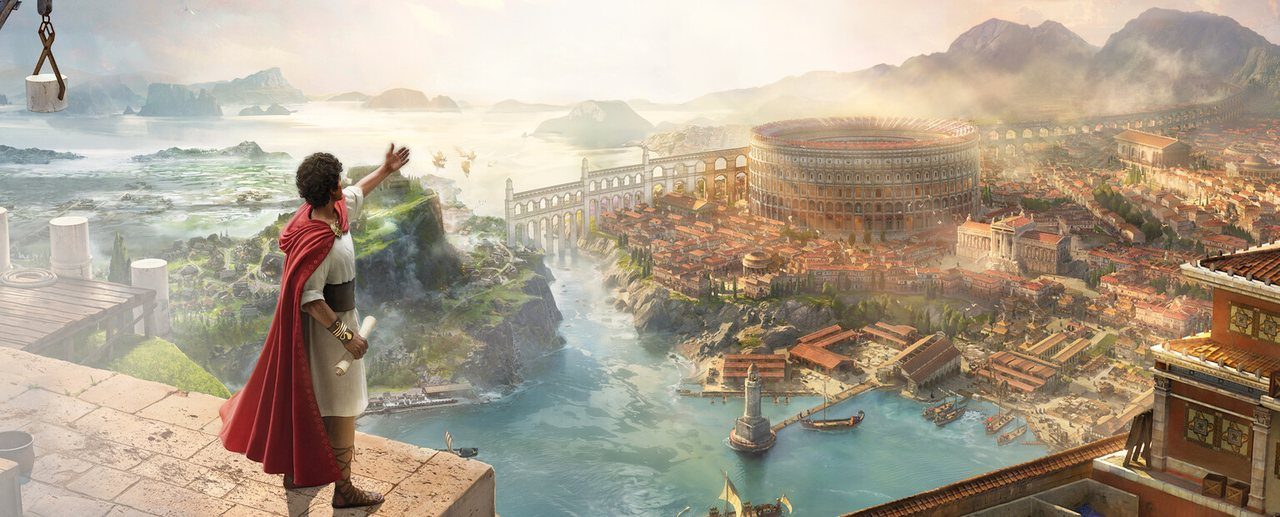
The Anno series sits at an unusual crossroads. It is a city builder, but your cities are spread across islands. It is an economic simulation, but the economy exists to satisfy residents who keep asking for more. And it is a logistics game, because the goods those residents want often come from the other side of the map. Since Anno 1602 in 1998, the series has refined that loop into one of the most satisfying in strategy gaming: build houses, satisfy needs, unlock new residents, repeat at a larger scale.
This guide explains the systems that are common across the series, with Anno 1800 and Anno 117: Pax Romana as the main examples, then walks through the main entries. For the general vocabulary of the genre, our primer on city builder basics is a good companion.
The Core Loop: Needs Drive Everything
Anno games do not use zoning in the way SimCity or Cities: Skylines do. Instead, you place residences directly, and those residents have needs. Meeting their needs makes them grow, pay taxes and, eventually, upgrade to a higher tier of citizen. Each higher tier wants new and more complex goods, which require new production chains, which require new workers, which require more housing. That spiral is the series’ engine.
Needs generally come in two flavors:
- Basic needs such as food, clothing or services like a marketplace or a church. Meeting them supports the population of a house and allows it to advance.
- Luxury needs that are not required to advance but increase happiness and income.
In Anno 1800, for example, your first farmers are content with fish and schnapps, while later engineers expect goods such as glasses and coffee as well as electricity. Services, such as schools or pubs, also matter, and houses need to be within range of them.
Population Tiers and Workforce
Every Anno game organizes its citizens into tiers. In Anno 1800, the Old World has five main residential tiers: farmers, workers, artisans, engineers and investors. The New World adds two of its own, jornaleros and obreros. Anno 117: Pax Romana starts players with Liberti and advances them toward Patricians as their needs are met.
Why tiers matter for production
Anno 1800 links tiers to its workforce system. According to the developers’ own blog, each residential tier supplies a specific workforce type, used by specific kinds of production buildings rather than simply by goods of the same tier. Farmers staff agricultural buildings, for example, and lower-tier workforce stays useful even after you advance. If you lack enough of a given workforce type, productivity drops in proportion to the share of workers missing. Workforce is also calculated per island, so a remote island with mines needs its own settlement or workers moved there.
The practical consequence: never upgrade every house to the highest tier. You need a healthy base of each lower tier to keep earlier production chains running.
Production Chains and Ratios
A production chain is the sequence of buildings needed to turn raw resources into a finished good. Simple chains have one step (a fishery produces fish). Complex chains combine several inputs: a later-tier product may need two intermediate goods, each with their own raw materials, sometimes from different islands.
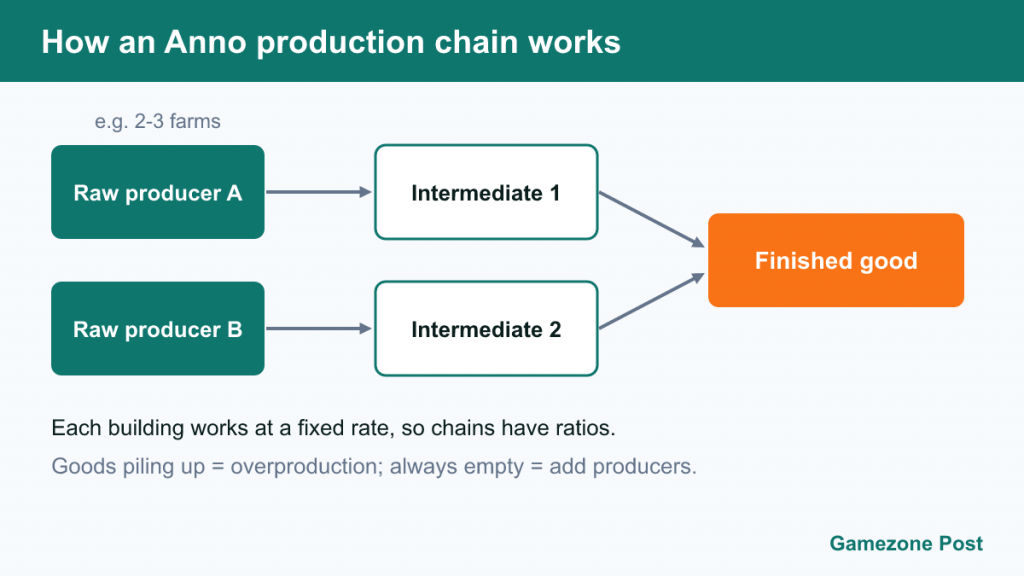
Because each building works at a fixed rate, chains have ratios. If one farm cannot supply enough input for a factory, you may need two or three farms per factory to keep it running at full speed. The exact ratios differ between games and, within a game, can change with updates, items and productivity boosts. In practice:
- Check the production rate. Building tooltips show how long a cycle takes; compare producer and consumer.
- Watch the warehouse. A good piling up means overproduction; a good that is always empty means you need more of its producers.
- Read the statistics screens. Most modern Anno games include production and consumption statistics that show surpluses and deficits per good.
- Build compact chains. Place raw producers near the processing building and a warehouse so carts travel short distances.
Players who enjoy this part of Anno often enjoy factory games too; our explainer on Factorio, Satisfactory and the logistics loop covers a genre built almost entirely around ratios.
Islands, Fertilities and Expansion
Anno’s maps are archipelagos. Each island has limited space, and crucially, islands differ in which crops they can grow. This is usually called fertility: one island might support hops and grain, another sugar cane or cotton. Some resources, like particular ores, only appear on certain islands too.
Fertility is the main reason expansion in Anno is not optional. Sooner or later your residents want something your home island cannot produce, so you must claim new islands, often by building a port and warehouse, then connect them with ships. Anno 1800 extends this further with separate regions (sessions), such as the Old World and New World, each with its own map and goods.
Choosing islands well
- Look for islands with fertilities you will need later, not just now.
- Large, flat islands are valuable for big residential districts.
- Claim key resources before AI rivals do; in many Anno games, AI players expand steadily.
Trade Routes and Shipping
Ships are the arteries of an Anno economy. Trade routes let you automate a ship’s loop, loading goods at one island and unloading them at another. As your network grows, you will run routes from farming islands to processing islands to your main city.
Common mistakes with trade routes include:
- Undersized fleets. One ship on a long route may not move goods fast enough; add ships or larger vessels.
- Unbalanced loads. Make sure the route carries enough of each good, not just the first in the list.
- Forgetting the return trip. Ships can carry goods both ways, which saves capacity.
- Unprotected routes. In games with pirates or hostile AI, unescorted trade ships can be lost.
Beyond your own islands, you can also trade with AI players and neutral traders, buying goods you cannot produce yet or selling surplus.
Diplomacy and Combat
Anno has always included rivals: AI players with their own personalities who compete for islands, trade, ally or declare war. Diplomacy usually progresses through steps such as trade agreements, peace and alliances. Combat in most entries is primarily naval, with warships attacking enemy fleets and harbors, though some games include land combat.
Anno 117 notably brings land and naval battles together. Its land units follow a rock-paper-scissors relationship among melee, ranged and cavalry, and ships can use sails, oars or both. For many players, though, the military side remains secondary to the economy; Anno can be played very peacefully on most settings.
The Main Entries at a Glance
A charming detail: the digits of every main title’s number add up to nine (1+6+0+2, 1+8+0+0, 1+1+7 and so on).

| Game | Year | Developer | Notes |
|---|---|---|---|
| Anno 1602 | 1998 | Max Design | The original island-colony economy game |
| Anno 1503 | 2002 | Max Design | Expanded scope and trade |
| Anno 1701 | 2006 | Related Designs | First fully 3D entry |
| Anno 1404 | 2009 | Related Designs, Ubisoft Blue Byte | Occident and Orient cultures; Venice expansion |
| Anno 2070 | 2011 | Related Designs, Ubisoft Blue Byte | Futuristic setting with competing factions |
| Anno 2205 | 2015 | Ubisoft Blue Byte | Future setting with multiple sessions, including the moon |
| Anno 1800 | 2019 | Ubisoft Blue Byte | Industrial Revolution, Old and New World, blueprint mode |
| Anno 117: Pax Romana | 2025 | Ubisoft Mainz | Roman setting, Latium and Albion, diagonal building |
Anno 1404 was marketed in North America as Dawn of Discovery. Anno 1800 launched for Windows in April 2019, came to PlayStation 5 and Xbox Series X|S in March 2023, and received four seasons of paid expansions adding regions and features such as the Northwest Passage, palaces, tractors, skyscrapers and haciendas. It also introduced a blueprint mode for planning buildings and tourism tied to a city’s attractiveness.
Anno 117: Pax Romana
Anno 117 released on 13 November 2025 for Windows, PlayStation 5 and Xbox Series X|S. It is the earliest historical setting in the series, placing you as a Roman governor during the Pax Romana. You can start in Latium or in Albion, the Celtic province, where you can spread Roman culture, maintain Celtic culture, or combine the two.
Several mechanics stand out as changes from earlier entries:
- Diagonal building, which frees city layouts from the strict grid.
- Area effects: production and prestige buildings affect nearby structures, and paved roads extend their range, rewarding careful placement.
- Religion: belief accumulates, and chosen gods grant scaling bonuses.
- Rival governors with distinct personalities, who can be trade partners or enemies.
Critics generally reviewed it positively for its city building and visuals, while some felt the story was overshadowed by its economic systems. It became the fastest-selling game in the series.
Tips for New Anno Players
- Grow slowly. Rapid house upgrades can outstrip your production and crash happiness.
- Keep a cash buffer. Upkeep for buildings and ships adds up; a negative balance spirals quickly.
- Leave room. Plan space for later production chains and services near your city.
- Use the campaign or easy sandbox first. Anno’s systems unlock gradually; learning them without aggressive AI rivals is easier.
- Think in islands. Specialize islands by fertility rather than cramming everything onto one.
If you like the mix of business and building, our explainer on management and tycoon games covers related titles.