StarCraft II Races Explained: Terran, Protoss and Zerg for New Players
How Terran, Protoss and Zerg differ in economy, production and unit design in StarCraft II, and how to choose the race that suits the way you play.
StarCraft II has three races, and they play like three different games. Each one gathers resources, builds structures, produces an army and recovers from losses in its own way. That asymmetry is why the game is still worth learning more than a decade after launch.
This guide explains how Terran, Protoss and Zerg actually work, which signature units and styles define each one, and which race tends to suit which kind of player. It also covers what’s free to play and how the campaign, multiplayer and co-op modes differ. If you’re new to real-time strategy in general, our primer on macro, micro and build orders covers the skills this article assumes.
What all three races have in common
Every race starts a match with a main base building and a handful of workers. Workers gather two resources: minerals, which you mine from crystal fields, and vespene gas, which you collect by building an extractor-type structure on a geyser. Minerals pay for basic units and buildings, and gas gates advanced technology. Every race also has to manage supply. That’s a population limit you raise by building a specific structure or unit, and if you forget to raise it, production stops dead. The differences are in how each race handles economy, production, technology and army control.
Terran: flexible, mobile and mechanically demanding
Terrans are the human faction, exiles from Earth. Their gameplay is built around flexibility and repair. Most of their structures can lift off and fly to a new location. A Barracks can float across the map to a new base, and a Command Center can be built safely in your main and then flown out to an expansion. Lifting buildings off also saves them from ground attacks in an emergency.
Economy
Terran workers (SCVs) construct buildings by standing next to them for the whole build time, and they can repair mechanical units and structures. The Command Center can upgrade into an Orbital Command, which can call down MULEs, temporary mining robots that give a big economic boost. Calling MULEs on time is one of the first habits a Terran player has to build.
Production and add-ons
Terran production buildings (Barracks, Factory, Starport) accept an add-on. A Reactor lets the building produce two basic units at once. A Tech Lab unlocks advanced units and research. Because buildings can lift off, players often swap add-ons by floating one structure onto a different add-on. It’s a uniquely Terran trick.
Signature units and styles
- Marine and Marauder with Medivac support, known as “bio.” Fast, cost-efficient infantry healed and transported by Medivac dropships.
- Siege Tank: a powerful artillery unit that transforms into siege mode, the backbone of positional “mech” play.
- Widow Mine, Hellion and Hellbat: harassment and area denial tools.
- Air options: Viking, Liberator, Banshee and the late-game Battlecruiser.
- Ghost: a spellcaster with abilities that counter other casters and shields.
Terran rewards multitasking: dropping Marines in two places at once, positioning tanks, and remembering MULEs and add-ons at the same time. In return, a wide range of builds is viable.
Protoss: powerful units, shields and warp-in
Protoss are an ancient, psionic, technologically advanced species. Their units are expensive and individually strong, so losing a few of them hurts more than losing a few Zerglings or Marines.
Shields
Every Protoss unit and building has a layer of plasma shields on top of its health. Shields regenerate on their own when the unit stays out of combat for a short time, while health does not regenerate. Pulling damaged units back for a few seconds can restore much of their durability, so retreating at the right moment is a core Protoss skill.
Building with Probes and Pylons
Protoss workers (Probes) don’t stay to build. They start a warp-in and immediately go back to mining, which makes Protoss construction very efficient. Most structures must be placed inside the power field of a Pylon. The Pylon also provides supply, which makes Pylons both essential and a weak point: if an enemy destroys a Pylon, the buildings it powered shut down.
Warp Gates and Chrono Boost
After a research upgrade at the Cybernetics Core, Gateways can transform into Warp Gates. Instead of producing units at the building, a Warp Gate can warp units in anywhere you have a power field. That includes a Pylon hidden near the enemy base or the power field of a Warp Prism shuttle. This lets Protoss reinforce at the front line instantly and set up surprise attacks.
The Nexus also provides Chrono Boost, which temporarily speeds up production or research in a chosen building. Deciding where to spend it, on workers early or on key upgrades later, is a recurring Protoss decision.
Signature units and styles
- Zealot, Stalker and Adept: the core Gateway units. Stalkers can Blink short distances, which makes them a favorite for micro.
- Sentry: a support caster whose Force Field can split armies or block ramps.
- Immortal, Colossus and Disruptor: the Robotics Facility units, used against armor and large groups.
- High Templar, Dark Templar and Archon: spellcasters, cloaked assassins and a powerful merged unit.
- Air fleet: Oracle, Phoenix, Void Ray, Carrier, Tempest and the unique Mothership.
Zerg: larvae, creep and swarming
The Zerg are a hive species that assimilates other life forms. Their mechanics are the least like a traditional RTS faction.
Larvae and production
Zerg don’t have separate unit-producing buildings. All Zerg units, workers included, morph from larvae that spawn slowly at each Hatchery. Tech buildings unlock unit types, but larvae are the real production bottleneck. The Queen fixes this with Inject Larva, an ability that adds extra larvae to a Hatchery after a delay. Injecting on every Hatchery, every time the ability is ready, is the single most important Zerg habit.
Because every unit comes from the same larva pool, Zerg can make dramatic economic choices: spend all the larvae on Drones to boom the economy, or all of them on army to survive an attack. Zerg can also rebuild, or “remax,” an army faster than the other races when it has banked resources.
Drones become buildings
A Zerg worker (Drone) doesn’t construct a building. It turns into one and is consumed in the process. Every building therefore costs you a worker as well as its resource price, which is a real trade-off in the early game.
Creep
Most Zerg structures must be built on creep, the organic carpet that spreads from Hatcheries and from Creep Tumors placed by Queens. Zerg units move faster on creep, and it reveals the area around it. Spreading creep across the map gives Zerg armies a speed advantage and a vision network, so constant tumor spreading is a hallmark of skilled Zerg play.
Supply and other quirks
Zerg raise supply with Overlords, flying units rather than buildings. They’re vulnerable to enemy air units, but they double as scouts. Zerg units regenerate health slowly over time, and many can burrow underground once that upgrade is researched.
Signature units and styles
- Zergling and Baneling: cheap, fast melee units, and suicide bombers that devastate clumps of infantry.
- Roach and Ravager: durable ranged units used for mid-game pressure.
- Hydralisk and Lurker: ranged damage and burrowed area denial.
- Mutalisk: fast flyers used for harassment.
- Infestor and Viper: spellcasters that disable or pull enemy units.
- Ultralisk and Brood Lord: late-game heavy hitters.
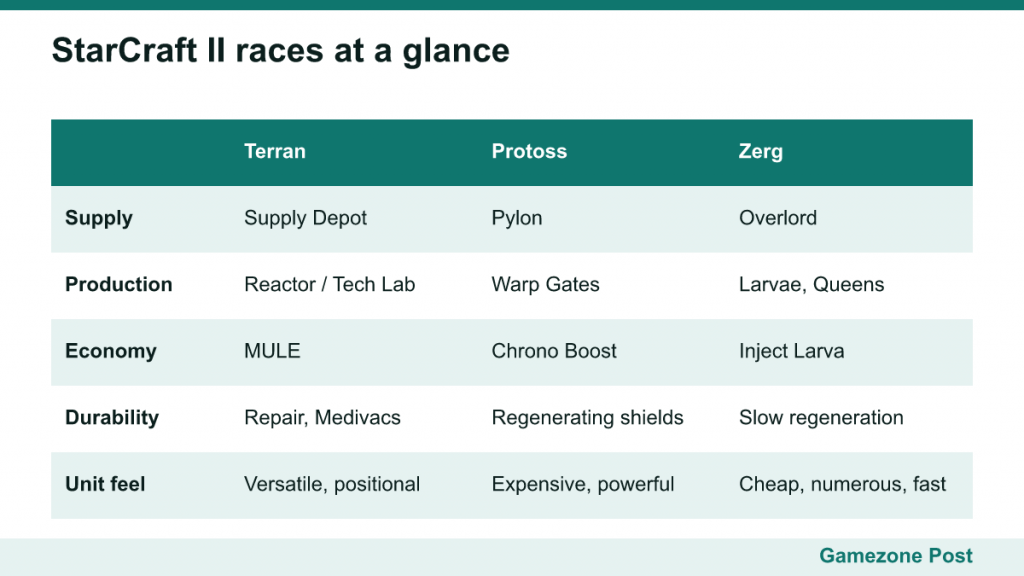
Comparing the three at a glance
| Terran | Protoss | Zerg | |
|---|---|---|---|
| Worker builds by | Staying with the structure | Starting a warp-in, then leaving | Morphing into the structure |
| Supply provider | Supply Depot (can lower) | Pylon (also powers buildings) | Overlord (flying unit) |
| Production model | Buildings with Reactor/Tech Lab add-ons | Gateways that become Warp Gates | Larvae from Hatcheries, boosted by Queens |
| Economic ability | MULE from Orbital Command | Chrono Boost from Nexus | Inject Larva from Queens |
| Durability | Repair and Medivac healing | Regenerating shields | Slow natural regeneration |
| Unit feel | Versatile, positional | Expensive, powerful | Cheap, numerous, fast |
Which race should you pick?
There’s no “easiest race” that everyone agrees on, and the balance between the three shifts with patches. Your choice should come down to which loop you enjoy repeating. Some rough guidance:
- Pick Terran if you like multitasking, harassing with drops, setting up defensive positions and trying a wide range of builds. Expect a lot of small things to remember.
- Pick Protoss if you like powerful units, careful army composition and big decisive fights. Warp-in makes reinforcing easy, but mistakes in big engagements are costly.
- Pick Zerg if you like being everywhere at once, trading aggressively and outproducing your opponent. The mechanical rhythm of injects and creep is demanding but very satisfying once it becomes automatic.
Play all three for a few games each against the AI before committing. One race’s “chores” often feel natural while another’s feel like busywork, and that instinct is a better guide than any tier list. Then stick with one race for a while.
Common mistakes new players make with each race
- Terran: forgetting MULEs, leaving add-on buildings idle, and walking Siege Tanks into enemies unsieged. Also forgetting to raise Supply Depots that act as a wall.
- Protoss: placing all buildings on one Pylon, so losing it shuts everything down. Forgetting to use Chrono Boost, and fighting with low shields instead of backing off to recharge.
- Zerg: missing Queen injects, getting supply blocked because Overlords were forgotten, and over-droning without enough army when an attack arrives.
Free-to-play: what you get
StarCraft II has been free to play since November 2017. The free package includes the full multiplayer mode with all three races, the Wings of Liberty campaign, and co-op missions. The other two campaigns, Heart of the Swarm and Legacy of the Void, are sold separately, along with the Nova Covert Ops mission pack and additional co-op commanders.
Campaign, multiplayer and co-op: three ways to learn
The campaigns
The story is told across three installments, each focused on one race:
- Wings of Liberty (July 27, 2010): the Terran campaign following Jim Raynor’s rebels.
- Heart of the Swarm (March 12, 2013): the Zerg campaign following Sarah Kerrigan.
- Legacy of the Void (November 10, 2015): the Protoss campaign led by Artanis.
The Nova Covert Ops mission pack followed in three episodes during 2016. The campaigns use units and upgrades that don’t exist in multiplayer, so they aren’t a direct tutorial for ladder play. They’re excellent for learning what units do and getting comfortable with the interface, though.
Multiplayer
Ranked play matches you against opponents of similar skill. All units are balanced around this mode, and builds and timings matter most here. Starting with games against the built-in AI is a low-pressure way to practise a build order before laddering.
Co-op missions
In co-op, two players each choose a commander, a hero character with a customized version of one race, and complete objective-based missions against AI enemies. There are 18 commanders, spread evenly across the three races. Co-op is a relaxed way to enjoy the game’s mechanics without ladder stress, but commanders have unique abilities and units that don’t carry over to multiplayer.
StarCraft II sits at the centre of the genre’s history. For the broader story of how it got there, from Dune II through Warcraft and Command & Conquer, see our short history of real-time strategy.