Transport Tycoon and OpenTTD: Building a Profitable Transport Network
What OpenTTD is, how cargo payment works by distance and time, rail signals, stations, road, sea and air, plus Transport Fever 2 and Railway Empire.
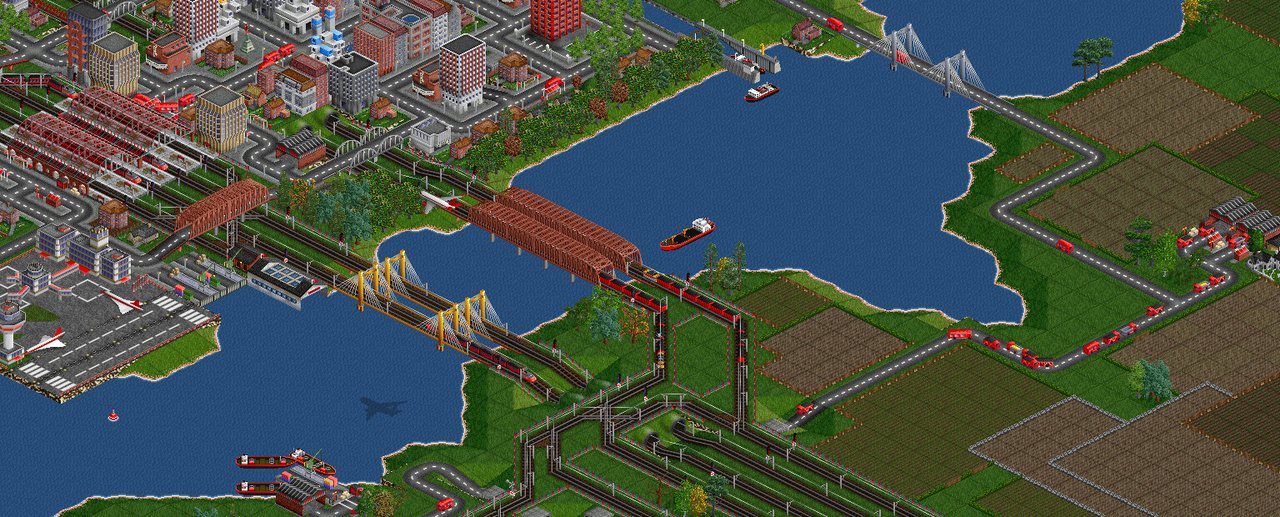
Transport Tycoon Deluxe was released in 1995, and people are still building railways in it, or more precisely in OpenTTD, the open-source project that grew out of it. Few strategy games have a community this long-lived, and the reason is the core loop: connect a coal mine to a power station, watch the first train pull out, then spend hours turning that single line into a continental network.
This guide explains what OpenTTD is and how its legal setup works, how the game pays you for cargo, how rail signals and stations work, and how road vehicles, ships and aircraft fit in. It ends with a look at modern relatives such as Transport Fever 2 and Railway Empire.
From Transport Tycoon to OpenTTD
Transport Tycoon was created by Chris Sawyer and published by MicroProse in 1994, followed by Transport Tycoon Deluxe in 1995. Players build road, rail, sea and air routes to carry passengers and cargo between towns and industries, competing with rival companies. Sawyer’s next big game, RollerCoaster Tycoon, reused much of its isometric presentation; our history of RollerCoaster Tycoon covers that story.
OpenTTD began when Ludvig Strigeus announced in 2003 that he would reverse engineer Transport Tycoon Deluxe and convert it to C. The first release, version 0.1, came out on 6 March 2004. Since then the project has grown into a full remake and expansion with a long list of improvements. As of October 2026, the stable release is the 15.x series, with version 16 in testing.
Is OpenTTD Legal and Free?
OpenTTD is free and open-source software licensed under the GNU GPL version 2. The project’s own code is open, and it supports alternative base graphics, sound and music sets. OpenGFX, a free and open-source base graphics set, is designed for players who do not have the original game’s files, and the default music set is the similarly free OpenMSX.
Distribution changed in 2026. Atari, which holds the rights to the original game, re-released Transport Tycoon Deluxe on Steam and GOG, and from 14 March 2026 OpenTTD is no longer offered as a standalone free game on those two stores; new players there get it bundled with the original. According to the OpenTTD team’s announcement, existing Steam owners keep the game and its updates, development remains independent and open-source, and downloads from the official OpenTTD website and other platforms are unchanged. In short: OpenTTD remains free to download from openttd.org.
How Cargo Payment Works
Understanding payment is the key to profit. According to the OpenTTD wiki, income for a delivery depends on four factors:
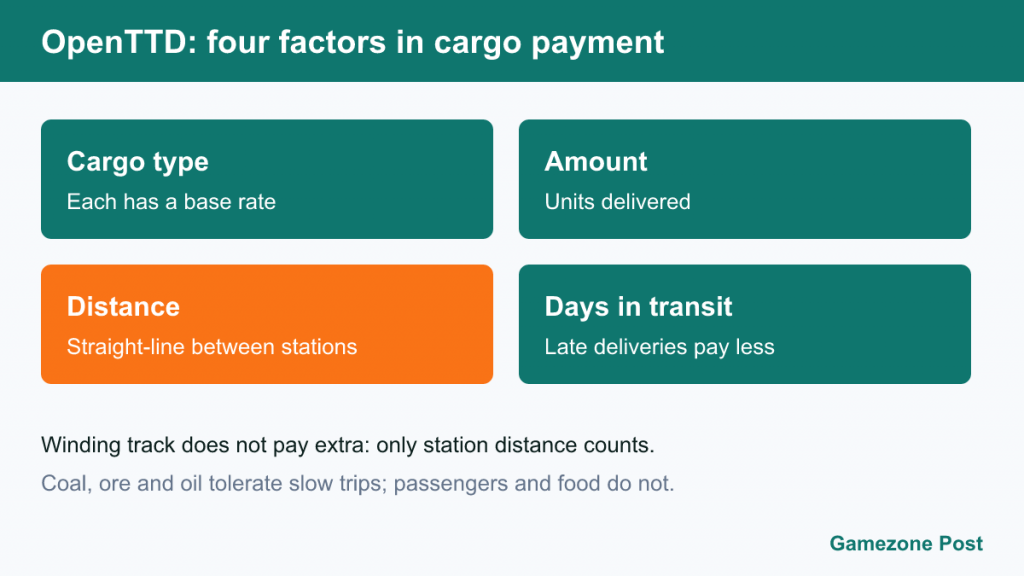
- Cargo type: each cargo has its own base payment rate. Valuables pay the most per unit, for example.
- Amount delivered.
- Distance: measured as the straight-line, grid-based (Manhattan) distance between the pickup and drop-off stations, not the length of track your vehicles travel.
- Days in transit: each cargo has thresholds for fast, medium and slow delivery. Late deliveries pay less.
What this means in practice
- Longer routes pay more per trip, up to a point. Very long routes eventually lose value as delivery time grows.
- Winding track does not pay extra. Because distance is measured between stations, a long detour only costs you time.
- Speed matters more on long routes. On short routes, a faster vehicle makes little difference to payment.
- Cargo time-sensitivity varies. Passengers, food and fruit lose value quickly, while bulk cargoes like coal, iron ore and oil tolerate slow delivery much better.
That last point explains a classic beginner strategy: long coal routes from mine to power station with sturdy, inexpensive trains can be very profitable, because coal does not lose much value on a slow trip.
Rail Basics: Lines, Signals and Junctions
Rail is the backbone of most OpenTTD networks. Trains carry large amounts of cargo efficiently, but they need careful design.
Signals
Signals divide track into blocks; only one train may be in a block at a time. OpenTTD offers two main families:
- Block signals: the traditional type. A train waits if the next block is occupied. Variants such as entry, exit and combo signals (often called pre-signals) help trains choose free platforms at stations.
- Path signals: a train reserves a path through a junction or station rather than a whole block, allowing several trains to pass through complex junctions at the same time. This increases throughput at railway junctions.
One-way versions of path signals are commonly used on main lines so trains cannot enter from the wrong direction.
Common rail designs
- Double-track main lines, one track per direction, with signals every few tiles to let many trains follow each other.
- Passing loops on single-track lines so trains can wait while oncoming traffic passes.
- Terminus stations with several platforms and path signals at the entrance so trains pick free platforms.
- Through stations for routes that continue onward, often more efficient than terminus designs on busy lines.
Common mistakes
- Deadlocks: two trains facing each other on a single track with no way past. Add passing loops or use one-way signals.
- Too few signals: long blocks mean trains wait unnecessarily.
- Steep slopes: heavy trains slow dramatically on hills; flatten routes or use more powerful engines.
- Overloading a single line: too many trains on one track cause queues; double the line or split traffic.
Stations, Catchment and Station Spread
Each station has a catchment area. Industries and buildings inside it can supply or accept cargo. Placing a station so its catchment covers a mine, or the dense center of a town, is essential.
OpenTTD allows multi-part stations: you can build separate station pieces (for example, a rail platform and a truck stop) and join them into one station, as long as they stay within a configurable maximum size known as station spread. This allows transfer hubs where trucks feed trains or trains feed ships.
Stations also have ratings for each cargo, which determine how much of an industry’s output or a town’s passengers actually reach your station. Frequent pickups, newer vehicles and fast service improve ratings.
Road Vehicles, Ships and Aircraft
Road vehicles
Buses and trucks are cheap and easy to start with, and they are ideal for short routes and for feeding cargo to rail stations. They carry less per vehicle, and large fleets can clog roads and town centers. Drive-through road stops help prevent jams.
Ships
Ships carry large loads slowly and need little infrastructure: docks and, where necessary, canals and locks. They are excellent for oil rigs and coastal industries, and their slow speed matters less for cargoes that tolerate long transit times.
Aircraft
Aircraft move passengers and mail quickly over long distances, which suits the payment model for time-sensitive cargo. Airports take up a lot of space, and larger aircraft require larger airports. A pair of big cities far apart is the classic profitable air route.
| Mode | Strengths | Weaknesses | Best use |
|---|---|---|---|
| Road | Cheap, flexible, quick to build | Small capacity, congestion | Short routes, feeders, early game |
| Rail | High capacity, efficient over distance | Expensive, needs signal planning | Bulk cargo, main passenger lines |
| Water | Large loads, minimal infrastructure | Slow, map-dependent | Oil rigs, coastal bulk cargo |
| Air | Fast over long distances | Large airports, limited cargo types | Passengers and mail between big cities |
A Profitable Start: Step by Step
- Survey the map. Look for a coal mine and a power station a moderate distance apart on flat ground.
- Build a simple line. A single track with stations at each end is enough for one or two trains.
- Buy a reliable engine and enough wagons to carry the mine’s output.
- Use full load at the pickup station so trains wait for cargo instead of running half-empty.
- Add buses between nearby towns for extra early income.
- Reinvest in a second line or more trains once your loan pressure eases.
- Upgrade to double track and path signals as traffic grows.
The same thinking about throughput and bottlenecks appears in factory games; see our explainer on factory and automation games for a related genre.
Multiplayer, AI and Mods
OpenTTD supports LAN and internet multiplayer with up to 15 companies, either cooperative or competitive. Players can share a company and build together, which is one of the game’s most popular modes. Since 2007 the game has supported custom AI opponents written by the community, and an integrated download system offers community-made content, including new vehicles, industries, scenarios and AIs.
Modern Relatives: Transport Fever 2 and Railway Empire
Transport Fever 2
Developed by Urban Games, Transport Fever 2 released on 11 December 2019 for Windows and Linux, with macOS and console versions later. It spans transport history from 1850 to the present, with nearly 200 vehicles including trains, buses, trams, trucks, aircraft and ferries, many based on real examples. It offers a campaign across three continents, a sandbox mode and mod tools. Players who love OpenTTD’s network building but want a modern 3D presentation often move here.
Railway Empire
Developed by Gaming Minds Studios and published by Kalypso Media, Railway Empire launched in January 2018. Set in the United States between 1830 and 1930, it focuses on rail alone, with a campaign largely following the construction of the first transcontinental railroad. You build lines, buy locomotives and serve cities and industries, which grow in response. A sequel, Railway Empire 2, followed in 2023. It is more structured and more focused than OpenTTD.
All of these belong to the broader family covered in our explainer on management and tycoon games.