RollerCoaster Tycoon: Chris Sawyer, Assembly Code and a Theme Park Classic
How Chris Sawyer built RollerCoaster Tycoon almost entirely in assembly language, what came after RCT2, and why OpenRCT2 keeps the classic alive.
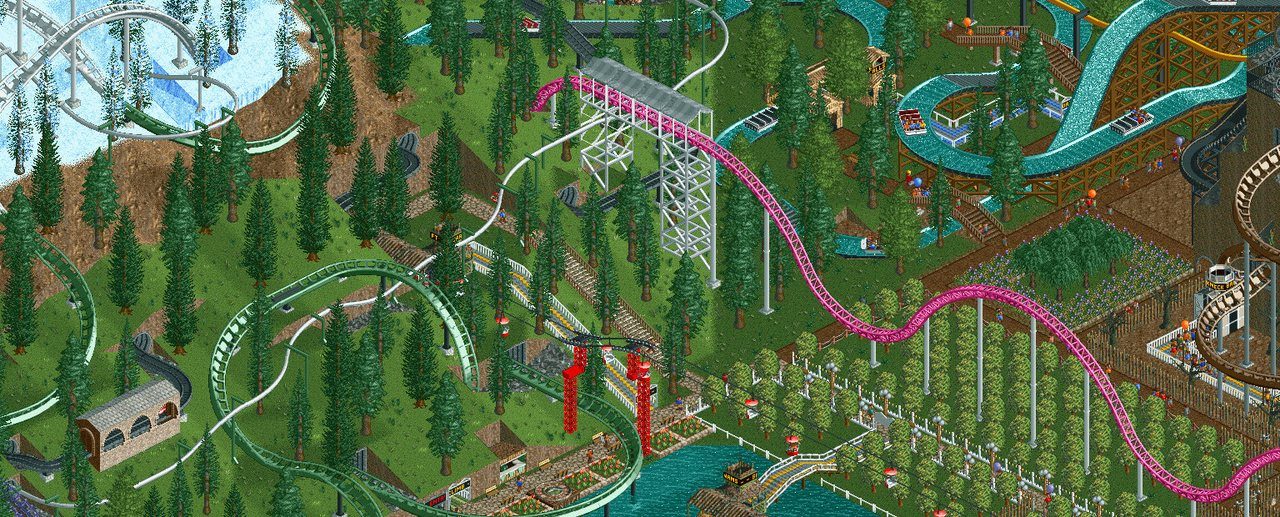
RollerCoaster Tycoon is one of those games people remember in surprising detail: the guest who wanted to leave because the park was too expensive, the queue line that snaked across half the map, the coaster that launched riders into a lake. Released in 1999, it became one of the defining management games of its era, and its sequel is still played today through an open-source project. Its development story is unusual too, because almost all of it was written by one programmer in assembly language.
This article covers where the game came from, how it was built, what each later entry changed and how the series’ influence lives on in modern park builders. For a broader look at the genre it belongs to, see our explainer on what makes a management or tycoon game.
Chris Sawyer Before RollerCoaster Tycoon
Chris Sawyer is a Scottish programmer who entered the games industry in 1983, writing games in Z80 machine code for home computers such as the Memotech MTX and later the Amstrad CPC. Between 1988 and 1993 he specialized in converting Amiga games to the PC, including titles such as Virus, Campaign, Birds of Prey, Dino Dini’s Goal and Frontier: Elite II. That conversion work demanded a deep, low-level understanding of PC hardware, which would matter later.
From 1993 he moved to original PC games. The first was Transport Tycoon, published by MicroProse in 1994, followed by a World Editor version and Transport Tycoon Deluxe in 1995. Transport Tycoon let players build road, rail, sea and air networks to carry passengers and cargo between towns and industries. It established much of the visual and interface language RollerCoaster Tycoon would later use: an isometric map, tile-based construction tools and a stream of small agents moving around the world.
From “White Knuckle” to RollerCoaster Tycoon
After Transport Tycoon, Sawyer turned to a different interest: roller coasters. His trips to theme parks, where he rode many coasters, shaped the idea of a game about building and running an amusement park. For most of development the project was called White Knuckle, and it was only later renamed to fit the “Tycoon” tradition his previous hit had established.
The game was developed over roughly two years in a small village near Dunblane, Scotland. Sawyer did the programming; Simon Foster created the graphics using 3D modeling and rendering tools before converting them to the game’s isometric sprites, and Allister Brimble composed the music. Real figures from the roller coaster and theme park industry contributed advice. Sawyer had family and friends playtest the game first, then worked with the publisher on more extensive testing.
Written in Assembly: Why It Mattered
The detail that made RollerCoaster Tycoon famous among programmers is its code. Sawyer wrote about 99% of the game in x86 assembly language using the Microsoft Macro Assembler, with the remaining 1% in C. By the late 1990s, most PC games were written primarily in higher-level languages such as C or C++, with assembly reserved for small performance-critical routines.
Writing nearly a whole game this way is slow and demanding, but it gave very fine control over performance. That control showed in the simulation. RollerCoaster Tycoon tracks large numbers of individual guests at once, each with their own money, hunger, thirst, nausea, energy and opinions, all moving through a park on hardware that would be considered extremely modest today. The game ran smoothly on ordinary home PCs of 1999 while simulating crowds of a size that felt remarkable for the time.
It is worth keeping the achievement in perspective. Assembly was not magic; Sawyer had spent years writing low-level code and had already shipped Transport Tycoon in a similar style. The result was a game whose technical efficiency directly enabled its design: more guests, more rides and a busier park than players expected.
How the Original Game Played
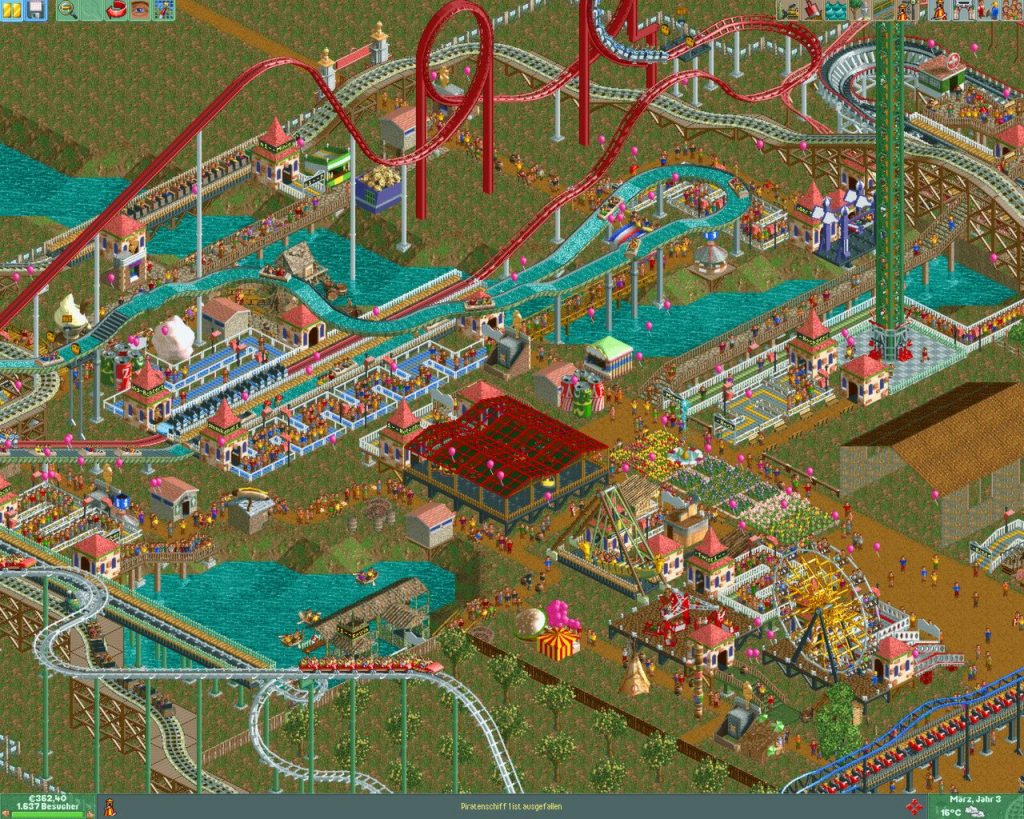
RollerCoaster Tycoon was released for Windows in March 1999, published by Hasbro Interactive under the MicroProse brand. Players took on scenarios, each with a starting park (sometimes empty, sometimes struggling) and a goal such as reaching a number of guests or a park rating by a deadline. Its core systems included:
- Ride building: pre-designed rides or custom coasters built piece by piece, with lifts, drops, loops and turns.
- Ride ratings: each ride was tested and given excitement, intensity and nausea ratings, which determined which guests wanted to ride it and how much they were willing to pay.
- Guests with thoughts: you could click any guest and read their thoughts, from “I’m hungry” to complaints about prices or the state of the paths.
- Staff: handymen to sweep paths and empty bins, mechanics to inspect and repair rides, security guards to deter vandals and entertainers to keep waiting crowds happy.
- Park management: stalls, toilets, path layout, scenery, research and marketing campaigns.
Much of the humor came from the simulation itself: guests vomiting after intense rides, crowds getting lost in sprawling paths, and coasters that crashed when players ignored the warnings. Two expansions followed, Added Attractions (released as Corkscrew Follies in North America) in 1999 and Loopy Landscapes in 2000, and later Gold and Deluxe editions bundled them together. An Xbox port, handled by Frontier Developments and published by Infogrames, arrived in 2003.
Sawyer reportedly earned around $30 million in royalties from the original game, an indication of how large a hit it became.
RollerCoaster Tycoon 2 (2002)
RollerCoaster Tycoon 2 was released in October 2002 by Infogrames and again developed by Sawyer. Rather than reinventing the formula, it refined it: more ride types and themed scenery, a scenario editor that let players build and share their own challenges, and a dedicated designer for building coasters outside of a park. Its expansions, Wacky Worlds and Time Twister (both 2003), were made by Frontier rather than Sawyer.
RCT2 is the version most often cited as the peak of the series, largely because of its flexibility and because it is the foundation of OpenRCT2 (covered below). After RCT2, Sawyer returned to transport with Chris Sawyer’s Locomotion (Atari, October 2004), described on his own site as the long-awaited sequel to Transport Tycoon.
The Series After Sawyer
RollerCoaster Tycoon 3 (2004)
RollerCoaster Tycoon 3 was developed by Frontier Developments and published by Atari in November 2004, with Sawyer acting only as a consultant. It moved the series to full 3D, letting players ride their coasters in first person and build fireworks displays synchronized to music. Its expansions, Soaked! and Wild!, added water parks and animal exhibits. Frontier later released a remastered Complete Edition.
Mobile ports, spin-offs and RollerCoaster Tycoon World
The years after RCT3 were uneven:
| Title | Year | Notes |
|---|---|---|
| RollerCoaster Tycoon 3D | 2012 | Nintendo 3DS version by n-Space with reduced features |
| RollerCoaster Tycoon 4 Mobile | 2014 | Freemium mobile game, heavily criticized |
| RollerCoaster Tycoon 3: Mobile Edition | 2015 | Faithful iOS port by Frontier |
| RollerCoaster Tycoon World | 2016 | PC game by Nvizzio Creations; largely negative reviews |
| RollerCoaster Tycoon Classic | 2016–2017 | Combined port of RCT and RCT2 for mobile, then Windows and macOS |
| RollerCoaster Tycoon Adventures | 2018 | Nintendo Switch, later PC and other consoles |
RollerCoaster Tycoon World is the most instructive case. Released on 16 November 2016, it introduced spline-based track building and an Architect mode, and was the first entry to use Steam Workshop, but it received largely negative reviews. The very next day, Frontier released Planet Coaster.
OpenRCT2: Keeping the Classic Alive
OpenRCT2 is an open-source re-implementation of RollerCoaster Tycoon 2, begun in 2014. Rather than distributing the original game, it reimplements the engine in modern code and requires the original RCT2 data files, which you still need to own. If you also own the first game and its expansions, OpenRCT2 can load those scenarios too. The project is licensed under the GPL (version 3 or later).
What makes it more than a compatibility fix is what it adds on top:
- Native versions for Windows, macOS and Linux.
- Cooperative multiplayer, where several players build the same park.
- Higher object and entity limits than the original.
- Improved interface, guest and staff AI, and editing tools.
- Features brought back from the first game, such as the mountain tool, launched coasters and the “have fun” objective.
For many players, OpenRCT2 is now the preferred way to play RCT2 on modern hardware, and its active community has given a 2002 game an unusually long life.
The Legacy: Planet Coaster and Modern Park Builders
Frontier’s history with the series is the clearest line from RollerCoaster Tycoon to today. The studio handled the Xbox port of the first game, the RCT2 expansions and RollerCoaster Tycoon 3, then built Planet Coaster (released 17 November 2016), widely described as a spiritual successor to RCT3. Planet Coaster’s emphasis on detailed scenery, guest feedback and custom coasters follows directly from what RollerCoaster Tycoon established.
Beyond theme parks, the game’s influence shows up in any management title that combines construction with crowds of individually simulated visitors. A few design lessons carried over especially well:
- Make the simulation readable. Guest thoughts turned abstract statistics into plain-language feedback.
- Let the player express themselves. Custom coasters gave every park a personal signature.
- Keep goals clear but flexible. Scenario objectives gave structure without dictating how to reach them.
- Let systems create comedy. Many of the game’s best moments were unscripted results of the simulation.
The same ideas appear in city builders too; our history of SimCity and the birth of the city builder shows how Maxis approached similar problems a decade earlier.
Common Questions
Was RollerCoaster Tycoon really written entirely in assembly?
Almost. About 99% of the code was x86 assembly, with around 1% in C.
Which version should I play today?
If you want the original experience, RollerCoaster Tycoon 2 through OpenRCT2 is the most popular choice on PC, since it adds modern conveniences while keeping the game intact. RollerCoaster Tycoon Classic is an official option that combines both early games. If you prefer 3D, RCT3’s Complete Edition or Planet Coaster are the natural picks.
Did Chris Sawyer work on RollerCoaster Tycoon 3?
Only as a consultant. Frontier Developments developed it.