SimCity and the Birth of the City Builder
How Will Wright's SimCity created the city builder, what each entry from 1989 to 2013 added, and how Cities: Skylines stepped into the gap it left.
Almost every city builder you can play today, from sprawling modern metropolis simulators to medieval village planners, owes something to a game that publishers initially did not want. SimCity had no enemies to defeat, no score to chase and no way to win. You simply built a city and watched it live. That idea turned out to be one of the most influential in the history of PC gaming.
This history follows the series from Will Wright’s first experiments to the troubled 2013 reboot, looks at the mechanics each entry introduced, and explains how Cities: Skylines took over the genre SimCity created. If you are new to city builders, our guide to city builder basics: zoning, services and budget explains the core systems referenced throughout.
Will Wright, a level editor and a reluctant industry
SimCity began with Will Wright and a helicopter game. While working on Raid on Bungeling Bay, Wright built a level editor to design the game’s maps, and that tool sparked the idea of a game about building places rather than destroying them. He started work on what would become SimCity in 1985, drawing on urban planning ideas and on System Dynamics, an approach to modeling complex systems such as cities as networks of interacting feedback loops.

Finding a publisher was hard. Broderbund initially declined, and other major publishers passed too: a game with no win condition did not look commercial. Wright’s solution was to co-found Maxis with Jeff Braun in 1987 and publish it themselves. Broderbund later agreed to handle distribution.
SimCity (1989): the toy that became a genre
SimCity shipped in February 1989 for the Amiga and Macintosh, with IBM PC and Commodore 64 versions later that year. Sales started slowly, then picked up as positive press coverage spread. It won Computer Gaming World‘s Game of the Year award for 1989 and went on to appear on a long list of platforms.
The core mechanics established a vocabulary city builders still use:
- Zoning. Instead of placing every building, you designate land as residential, commercial or industrial, and the simulated residents, called Sims, decide what to build there.
- Infrastructure. Roads, rail and power lines connect zones; without electricity, zones do not develop.
- Services and city conditions. Traffic, crime, pollution and land value all influence whether neighborhoods grow or decline.
- Taxes and budget. Tax rates fund services, but set them too high and growth stalls.
- Disasters. Floods, fires, earthquakes, tornadoes and even a monster attack could strike.
- Scenarios. At Broderbund’s suggestion, time-limited scenarios gave players concrete goals, some based on real cities.
Above all, it was open-ended. There was no win or loss condition; the goal was whatever kind of city the player wanted to build.
The Super NES version
Nintendo approached Maxis about a console port and ended up developing and publishing it itself. The Super NES version, released in Japan in April 1991, added seasonal graphics, reward buildings and an advisor character called Dr. Wright, plus distinctly Nintendo touches such as a Bowser attack disaster and a Mario statue reward. It sold about 1.98 million copies worldwide.
SimCity 2000 (1993): depth below and above ground
SimCity 2000 arrived on Macintosh in December 1993 and MS-DOS in February 1994. It replaced the flat top-down view with a near-isometric perspective and added a long list of systems:
- Terrain elevation, so hills and valleys affected layout.
- An underground layer for water pipes, subways and road tunnels.
- New facilities including schools, hospitals, libraries, museums, prisons and marinas.
- Nine power plant types, most of which aged and needed replacing.
- Separate tax rates for residential, commercial and industrial zones, plus city ordinances.
- Newspapers that delivered city feedback, and a query tool showing details such as land value.
- Arcologies, huge self-contained megastructures. Launching them triggered an “exodus” event, the closest thing the game had to a victory.
It became one of the best-selling computer games of the 1990s, with total sales reported at around 4.2 million copies. A Network Edition in 1996 let up to four players build and share resources, either cooperatively or competitively.
SimCity 3000 (1999): the EA era begins
Electronic Arts acquired Maxis in 1997, with the deal closing on 28 July. SimCity 3000 was already in development as a fully 3D game, a version that was proving troubled. After the acquisition, the 3D approach was scrapped, and producer Lucy Bradshaw led a rebuild based on the isometric, sprite-based approach of SimCity 2000.
Released on 1 February 1999 in North America, SimCity 3000 focused on making the city feel like a place with neighbors and consequences:
- Waste management: garbage piled up as cities grew and had to be dealt with.
- Neighbor deals for buying and selling water, power and garbage disposal with adjacent cities.
- Business deals, such as accepting a prison in exchange for income, at the cost of land value.
- Farms and agricultural zones, a third zoning density and aging utilities.
- Named advisors, citizen petitioners, a scrolling news ticker and real-world landmarks.
It shipped one million copies in its first six months, and Maxis reported sales of 5 million by 2007. SimCity 3000 Unlimited followed in 2000 with additional building sets, scenarios and disasters.
SimCity 4 (2003): regions and the long tail of modding
SimCity 4 launched on 14 January 2003 and remains the most elaborate of the classic, pre-reboot entries. Its biggest change was the region: instead of one isolated map, you built several cities in neighboring segments that could trade water, electricity and garbage disposal.
Play was split into modes. God mode let you shape terrain and trigger disasters before founding a city; mayor mode was for building, with terraforming limited and expensive. A MySim mode let players move individual Sims into the city, and buildings were classified by wealth levels, so neighborhoods could rise or fall depending on conditions. The Rush Hour expansion (22 September 2003) added avenues, elevated rail and traffic-route tracing, an early sign of how central transport would become to the genre.
SimCity 4’s longevity owes a lot to its community. The Building Architect Tool, released in 2004, let players create custom buildings, and the modding scene has remained active for more than two decades.
Spin-offs and SimCity Societies
For several years after SimCity 4, the series branched out. SimCity Societies (November 2007) was developed by Tilted Mill Entertainment rather than Maxis. It removed zoning, pipes and power grids in favor of individually placed buildings and six “societal values”: productivity, prosperity, creativity, spirituality, authority and knowledge. Leaning into one value changed how the city looked and which buildings unlocked. Critics praised its accessibility but found it too simple, and reviews were mixed.
Handheld and console spin-offs followed, including SimCity DS (2007), a modified SimCity 3000 using the touch screen, and SimCity Creator (2008), which let Wii players draw roads and rail with the Wii Remote.
SimCity (2013): ambition and a troubled launch
The first major new SimCity in about a decade, developed by Maxis Emeryville, launched on 5 March 2013 in North America. It was built on the GlassBox engine, which simulated individual agents, such as citizens and units of resources, instead of calculating abstract statistics. Traffic jams emerged from many agents traveling to and from work.
Its other ideas included road types that determined building density, utilities carried along roads, city specializations such as tourism or education, and shared regions where players could trade resources and cooperate on Great Works.
The launch, however, became notorious. The game required a constant internet connection, even for single-player play. Server outages, connection failures and lost progress followed, and some reviewers delayed their verdicts. EA added servers and offered early buyers a free game. Criticism of the small city size limits followed, and in October 2013 Maxis said larger cities had been abandoned because of performance problems. An offline mode was added more than a year after launch. The game received a Metacritic score of 64, and the Cities of Tomorrow expansion arrived in November 2013.
Maxis Emeryville closed in 2015, and the reboot’s reception is widely seen as a factor. Since then, the series’ main new release has been the mobile game SimCity BuildIt (2014).
How Cities: Skylines filled the gap
Finnish studio Colossal Order was known for the Cities in Motion transport games, and it pitched a full city builder to publisher Paradox Interactive. Paradox was hesitant to compete with SimCity, but the 2013 game’s problems changed the calculation and the project was greenlit.
Cities: Skylines launched on 10 March 2015 and offered what many SimCity players had wanted: large maps, offline play, detailed traffic and public transport systems that drew on Colossal Order’s background, and deep Steam Workshop modding support. More than 20,000 Workshop assets appeared within a month of release. As of June 2022 it had sold over 12 million copies, making it Paradox’s best-selling title. Cities: Skylines II followed on 24 October 2023 to mixed reviews. Our Cities: Skylines traffic guide shows how far the road simulation has come since 1989.
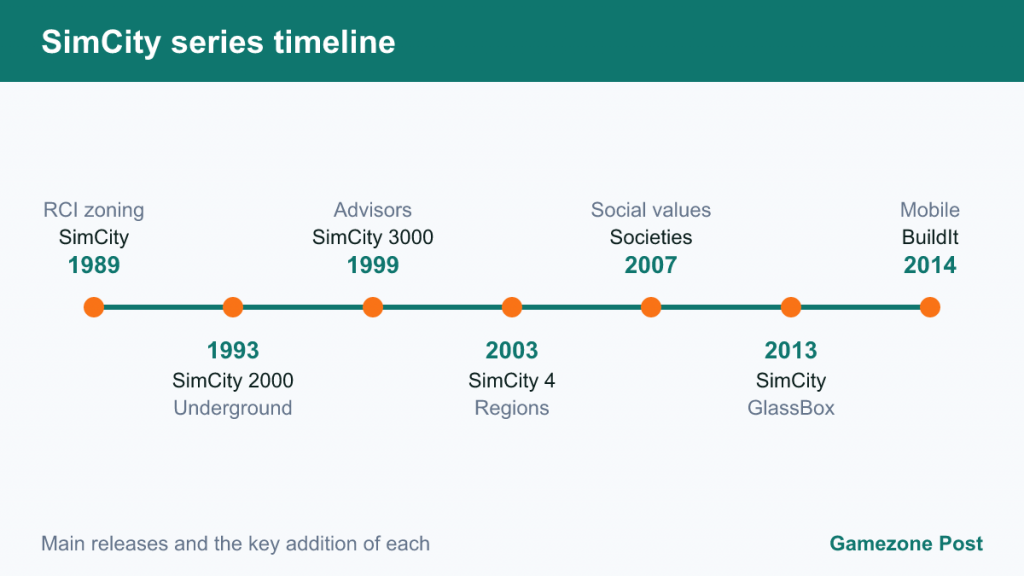
Series timeline
| Year | Game | Key addition |
|---|---|---|
| 1989 | SimCity | RCI zoning, open-ended city simulation |
| 1993 | SimCity 2000 | Isometric view, terrain, underground layer, ordinances |
| 1999 | SimCity 3000 | Garbage, neighbor and business deals, advisors |
| 2003 | SimCity 4 | Regions, god and mayor modes, wealth levels |
| 2007 | SimCity Societies | Societal values instead of zoning |
| 2013 | SimCity | GlassBox agent simulation, online regions |
| 2014 | SimCity BuildIt | Mobile spin-off |
The legacy of SimCity
SimCity’s influence reaches far beyond its own series. Maxis followed it with a family of “Sim” games, and Wright’s design approach eventually led to The Sims (February 2000), which grew into one of Maxis’ core franchises. In January 2008 the original SimCity’s source code was released as free software under the GPL to support the One Laptop Per Child project, renamed Micropolis because EA kept the trademark.
The deeper legacy is the genre itself. Zoning, utilities, budgets, land value, traffic and the feedback between them are now the shared language of city builders. Whether you play Cities: Skylines or a niche indie planner, you are working within a framework that a level editor for a helicopter game inspired almost four decades ago.