A Short History of Real-Time Strategy: From Dune II to Today
How real-time strategy grew from Herzog Zwei and Dune II through Warcraft, Command & Conquer, StarCraft and Age of Empires to remasters and new releases.
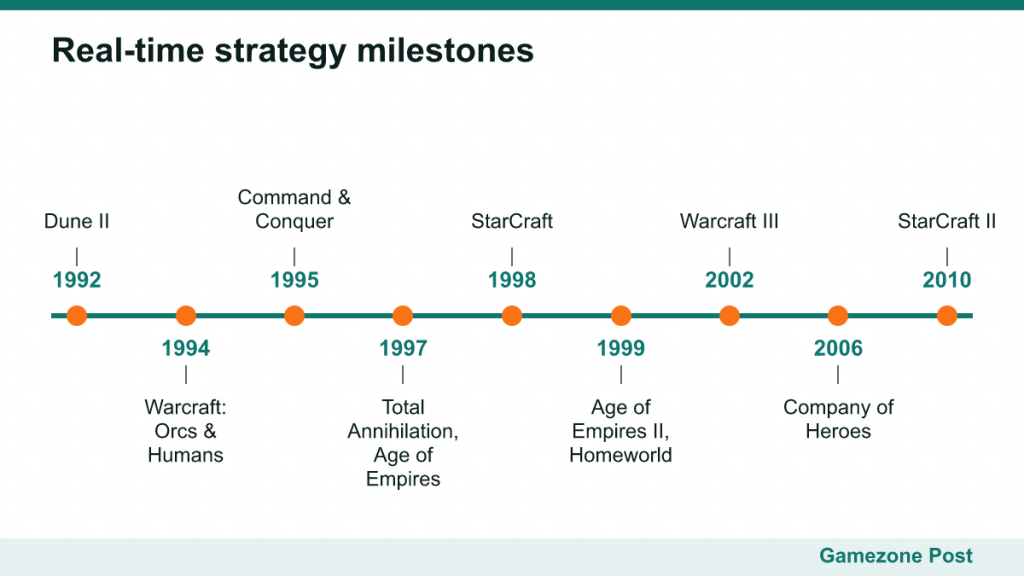
For roughly a decade, real-time strategy was the beating heart of PC gaming. Players argued over whether Command & Conquer or Warcraft was better, LAN parties ran on StarCraft and Age of Empires, and every year brought another ambitious RTS. Then the genre’s mainstream presence faded, even as its ideas spread into other kinds of games. This article traces that arc, from early experiments through the golden age and the 3D era to today’s remasters and new releases.
Before the Name: Early Experiments
Games where players acted simultaneously rather than in turns existed well before “real-time strategy” was a label. Wikipedia’s history of the genre points to Utopia (1982) among early roots, but the most cited precursor is Herzog Zwei, developed by Technosoft and published by Sega for the Mega Drive/Genesis. It launched in Japan in December 1989 and in North America in 1990.
Herzog Zwei had the player pilot a flying, transforming mech that bought ground units, airlifted them into battle and gave them orders, with neutral outposts serving as production sites. IGN has called it arguably the first RTS game. Its influence is well documented: Westwood’s developers cited it as an inspiration for Dune II, and a member of the team recalled that they played it for hours.
Dune II and the Birth of the Formula (1992)
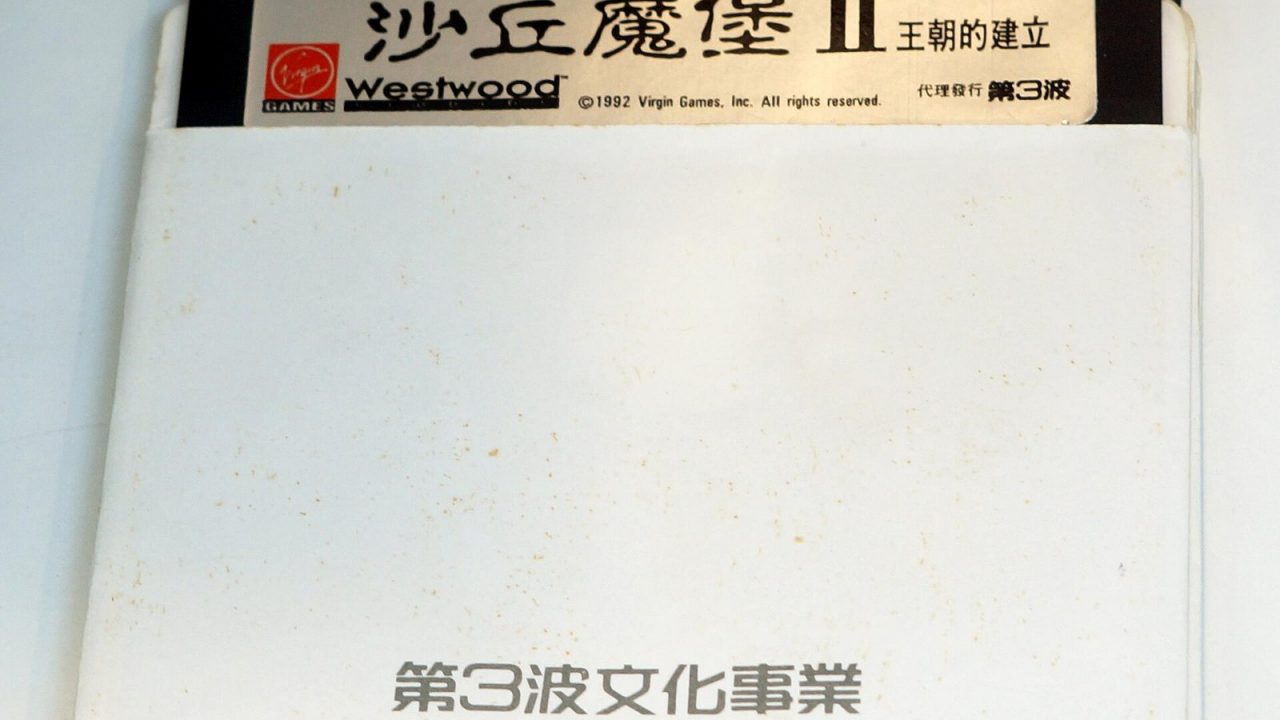
Dune II, developed by Westwood Studios and published by Virgin Games in 1992, is widely described as the archetypal real-time strategy game. Players chose one of three Houses (Atreides, Harkonnen or Ordos) and fought for the desert planet Arrakis by harvesting spice, refining it into credits and building an army.
Dune II brought together the elements that defined the genre for years:
- Mouse-based control of units and buildings.
- Resource gathering with harvester units.
- Base building, with structures unlocking further structures.
- A tech tree leading to advanced units and faction superweapons.
- Fog of war hiding the map until explored.
The term “real-time strategy” itself is credited to Westwood’s Brett Sperry, who used it to market Dune II. The core skills those systems demand, from economic management to unit control, are explained in our guide to RTS fundamentals.
The Rivalry Years: Warcraft and Command & Conquer (1994–1996)
Blizzard Entertainment’s Warcraft: Orcs & Humans (1994) took Dune II’s template into a fantasy setting and emphasized multiplayer. A year later, Westwood answered with Command & Conquer (1995), a modern-warfare RTS with full-motion video cutscenes and a memorable soundtrack. Blizzard’s Warcraft II followed in late 1995.
Campaigns mattered as much as mechanics in this period. Command & Conquer framed its missions with live-action briefings, while Warcraft built a fantasy world whose story would continue across sequels for decades. Story-driven campaigns gave solo players a reason to buy RTS games even if they never played online.
These games turned RTS into a mainstream PC genre. They refined interface conventions such as selecting groups of units with a drag box, introduced memorable factions and showed that multiplayer could be the long-term heart of a strategy game. The friendly rivalry between Westwood and Blizzard pushed both studios to improve quickly.
The Golden Age (1997–1999)
The late 1990s were crowded with landmark releases.
Total Annihilation (1997)
Cavedog’s Total Annihilation was among the first RTS games with 3D units and terrain. It also featured a streaming economy where resources flowed continuously rather than arriving in harvested chunks, and it supported huge armies.
Age of Empires (1997)
Ensemble Studios’ Age of Empires brought history to the genre. Instead of science fiction or fantasy, players guided ancient civilizations through ages of development. Its sequel, Age of Empires II: The Age of Kings (1999), became one of the most enduring RTS games ever made.
StarCraft (1998)
Blizzard’s StarCraft released in March 1998, followed by the Brood War expansion in December. Its three distinct races, Terran, Protoss and Zerg, are widely credited with revolutionizing the genre, showing that factions could be completely different yet balanced. StarCraft became enormously popular in South Korea, which accounted for about half of its four million sales by mid-2001, and its competitive scene helped popularize the idea of measuring player speed in actions per minute.
StarCraft also showed how much online play could matter. Its multiplayer ran through Blizzard’s Battle.net service with up to eight players per game, and Blizzard reported that Battle.net grew by 800 percent after the game’s release. For many players, the RTS of this era was as much a social experience as a single-player one: campaigns told the story, but online ladders and LAN games kept people playing for years.
Homeworld (1999)
Relic Entertainment’s Homeworld was one of the first fully 3D RTS games, letting fleets maneuver in all three dimensions in space. It proved the genre could move beyond the flat battlefield.
The 3D Era and New Ideas (2000s)
In the 2000s, RTS games moved to full 3D engines and experimented with heroes, smaller armies and new resource models.
Warcraft III (2002)
Built on a full 3D engine, Warcraft III put hero units with levels and abilities at the center of play. Its World Editor gave players powerful tools for custom maps, and those custom maps would later give rise to whole new genres.
Company of Heroes (2006)
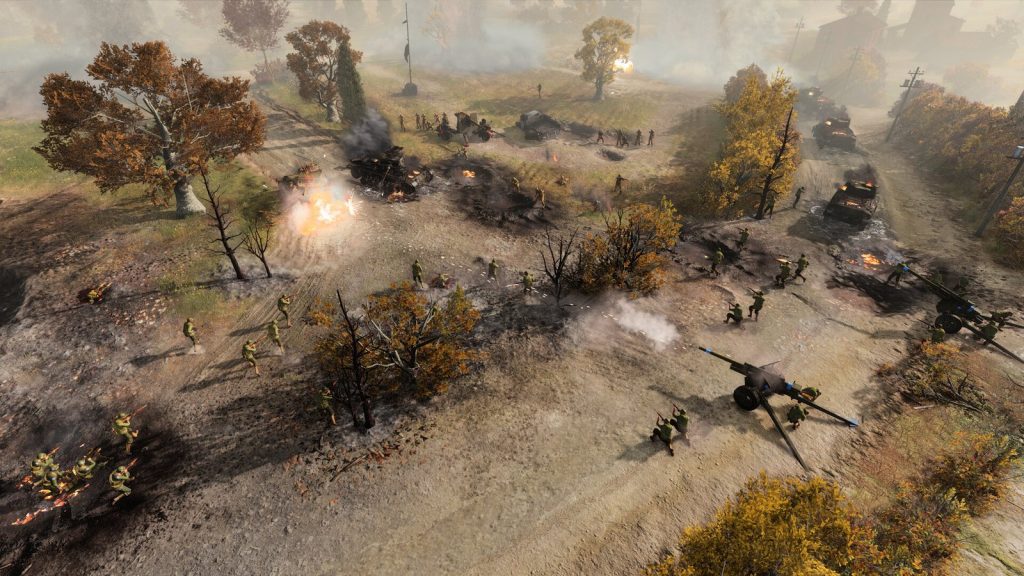
Relic’s Company of Heroes replaced traditional resource gathering with a control-point system. Players earned resources by capturing and holding territory, which pushed constant fighting across the map. Its squads, cover and destructible environments made the battlefield itself a key part of strategy.
Other notable releases
The decade also brought sequels and spin-offs for the major series, including Age of Mythology and Age of Empires III from Ensemble, and further Command & Conquer games. Real-time tactics games and hybrids like Total War grew alongside traditional RTS, as covered in our overview of strategy subgenres.
StarCraft II (2010)
StarCraft II: Wings of Liberty launched on July 27, 2010, more than a decade after the original. It became the standard-bearer of competitive RTS in the 2010s. In November 2017, Wings of Liberty became free to play, including its campaign and multiplayer.
Why the Genre Faded From the Mainstream
RTS never disappeared, but by the 2010s it was no longer one of the biggest genres on PC. There is no single agreed explanation, but several factors are commonly discussed:
- Demanding skills. Classic RTS asks players to manage an economy and an army simultaneously under time pressure. That high skill floor made competitive play intimidating for newcomers.
- Consoles. As Wikipedia notes, RTS games never gained the popularity on consoles that they had on PC. As the industry focused increasingly on consoles, the genre had less room to grow.
- The rise of MOBAs. Multiplayer online battle arena games originated as a subgenre of real-time strategy, born from Warcraft III custom maps. They dropped base building and army control in favor of a single hero, and drew in much of the audience that might once have played RTS.
- Expensive production. Large-scale RTS games with campaigns, multiplayer balance and many unit types are costly to make.
Ideas That Lived On
Even when RTS releases slowed, its design ideas spread widely:
- MOBAs took hero units and lane-based battles from Warcraft III custom maps.
- Tower defense grew into a genre of its own, with roots in RTS custom maps.
- Real-time tactics kept the battlefield focus without base building.
- Mobile strategy games adapted base building and army management for touchscreens, as in Clash of Clans (2012).
- Interface conventions such as drag-selection, control groups, minimaps and fog of war became standard across strategy and management games.
The Modern Revival
From the late 2010s onward, the classics returned in force. StarCraft: Remastered arrived in 2017. Age of Empires II: Definitive Edition, developed by Forgotten Empires with Tantalus Media and Wicked Witch Software, released on November 14, 2019, and has received a steady stream of new civilizations and expansions since, extending into 2026. Westwood’s classics returned in the Command & Conquer Remastered Collection in 2020.
New entries arrived too. Age of Empires IV, developed by Relic Entertainment with World’s Edge and published by Xbox Game Studios, launched on Windows on October 28, 2021, came to Xbox consoles in August 2023 and reached PlayStation 5 in November 2025, with expansions continuing through 2026. Company of Heroes 3 launched in February 2023. Alongside these, a wave of indie RTS games appeared on Steam from the early-to-mid 2010s, and titles focused on a traditional RTS experience, such as Steel Division 2 and Last Train Home, kept the format alive.
What Made the Genre Matter
Real-time strategy’s legacy reaches far beyond its own titles. Dune II gave games a shared language of harvesting, building and fighting. Warcraft and Command & Conquer made that language popular. StarCraft showed how deep asymmetric design could go, Age of Empires proved history could be thrilling in real time, and Warcraft III’s editor seeded entire genres, and Company of Heroes proved that even the resource model, the most basic part of the formula, could be reinvented.
If you want to experience that history first-hand, the remastered and definitive editions are the easiest way in. They keep the original designs while adding modern resolutions, online matchmaking and quality-of-life features, so the games that defined the 1990s remain playable on current hardware. Today, with remasters, new sequels and indie experiments sharing the same shelves, the genre is no longer the dominant force it once was, but it remains one of the most influential ideas in strategy gaming.