The History of Paradox Grand Strategy: From Europa Universalis to Today
From a French board game and a Swedish toy company to EU V: how Paradox built grand strategy, its engines and its expansion-and-patch model.
“Paradox game” has become shorthand for a whole style of strategy: a real-time map of the world you can pause, centuries of history, dozens of interlocking systems and a long tail of expansions. Today the studio’s catalog spans medieval dynasties, early modern empires, the Victorian economy, the Second World War and space. It began with a Swedish board game company and a French board game about European history.
This is the story of how Paradox’s grand strategy line developed, from the first Europa Universalis in 2000 through the Clausewitz engine era, the Jomini toolset and Europa Universalis V. It also explains the expansion-and-patch model that defines how these games are made and sold.
Board game roots
Paradox’s origins lie in Target Games, a Swedish board game and role-playing game company. Its video game division was the seed of what became Paradox. By 1999 Target Games had gone bankrupt, and the division continued as Paradox Entertainment.
The first grand strategy game came from a board game, too. Europa Universalis was a 1993 French board game designed by Philippe Thibaut, a sprawling simulation of European history. Paradox adapted it into a computer game, with Johan Andersson credited as a designer and programmer. Andersson would remain one of the central figures in Paradox’s strategy games for decades.
The first generation: the Europa engine (2000–2005)
Europa Universalis was released in Germany in October 2000 and in Sweden in December 2000, followed by North America and the UK in early 2001. It took the board game’s structure, nations on a map of provinces, diplomacy, war and colonization, and made it continuous. Instead of discrete turns, time flowed day by day and could be paused at any moment. That pausable real-time model became the foundation of the genre.
The same codebase, later called the Europa engine, powered a quick run of games:
| Game | Year | Focus |
|---|---|---|
| Europa Universalis | 2000 | Early modern nations |
| Europa Universalis II | 2001 | Expanded timeline and nations |
| Hearts of Iron | 2002 | The Second World War |
| Victoria: An Empire Under the Sun | 2003 | The 19th century, population and economy |
| Crusader Kings | 2004 | Medieval dynasties and characters |
| Hearts of Iron II | 2005 | The Second World War, refined |
In just five years, Paradox had founded the four series that still define it: Europa Universalis, Hearts of Iron, Victoria and Crusader Kings. Each took the same core idea, a pausable map of the world, and pointed it at a different subject.
Becoming Paradox Interactive
Around 2003, Fredrik Wester and then-CEO Theodore Bergquist bought out the video game business, including Paradox Development Studio and its handful of developers. Paradox Interactive was formed as an independent company in 2004. Paradox also became a publisher of other studios’ games, a decision that later brought hits like Colossal Order’s Cities: Skylines (2015).
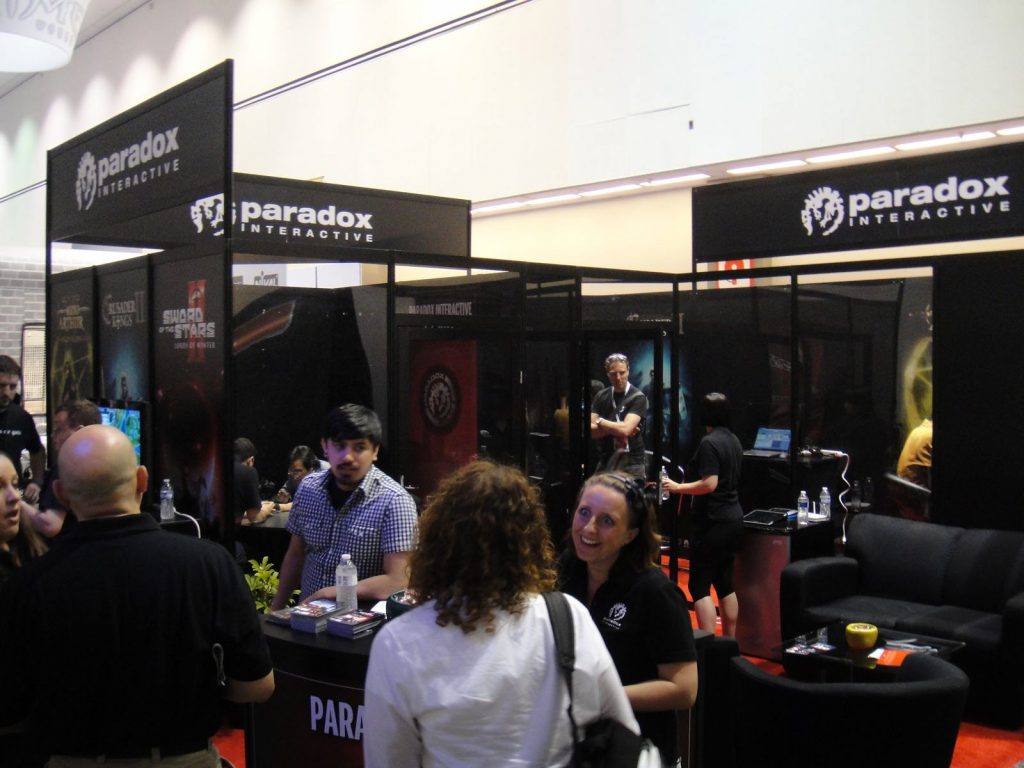
The company’s growth came with an early move into digital distribution. In 2006 it launched a digital store, later renamed GamersGate and spun off in 2008, at a time when niche strategy games struggled for shelf space in retail stores.
The Clausewitz era (2007–2016)
The Europa engine had been extended by copying and adapting code from game to game. For the next generation, Paradox built a new engine, Clausewitz, named after the Prussian military theorist. It debuted with Europa Universalis III in 2007 and gave the studio a shared, modern foundation for its next decade of games.
Clausewitz powered the second and third generations of every major series:
- Europa Universalis III (2007)
- Europa Universalis: Rome (2008)
- Hearts of Iron III (2009)
- Victoria II (2010)
- Sengoku (2011), set in feudal Japan
- Crusader Kings II (2012)
- March of the Eagles (2013), set in the Napoleonic Wars
- Europa Universalis IV (2013)
- Stellaris (2016)
- Hearts of Iron IV (2016)
Crusader Kings II and the turning point
Crusader Kings II, released on 14 February 2012, was a turning point. Its focus on characters and stories reached players who had never touched a grand strategy game, and its long run of expansions, 15 from Sword of Islam in 2012 to Holy Fury in 2018, showed how a game could keep growing for years. In October 2019 its base game became free to play, with expansions still sold separately. Paradox’s own history credits CK2 as one of the first titles developed with more focus on development timelines and testing.
Europa Universalis IV and long-term support
Europa Universalis IV, released in August 2013, became the definitive example of Paradox’s long-tail model. Its 1444 start and monarch point system shaped a decade of play, and by May 2024 it had accumulated 22 DLC, including 16 expansions. For how it compares with its successor, see our article on EU IV vs EU V.
Stellaris and Hearts of Iron IV
In 2016 Paradox released two major games. Stellaris took the grand strategy formula into space and blended it with 4X structure, showing that the studio’s approach could work outside history. Hearts of Iron IV refined the Second World War series with national focus trees and battle plans.
The Jomini toolset and the newest generation (2019–2025)
The latest generation of Paradox grand strategy uses Clausewitz together with Jomini, a 64-bit toolset layered on top of the engine and named, like Clausewitz, after a military theorist. Jomini made it easier to share technology between projects. Its games:
- Imperator: Rome (2019): the first Jomini title, set in the classical world.
- Crusader Kings III (2020): the character-driven series’ most accessible entry. Our Crusader Kings III beginner’s guide explains its core systems.
- Victoria 3 (2022): a deep simulation of pops, goods and markets in the industrial age.
- Europa Universalis V (2025): released on 4 November 2025.
Europa Universalis V was developed by Paradox Tinto, a studio opened in Spain in 2020 and led by Johan Andersson, the same designer credited on the first Europa Universalis. It starts in 1337, simulates population in detail and introduces systems like control and proximity. In a sense, the series came full circle: the person who programmed the original adaptation of a board game led its fifth-generation successor 25 years later.
How the four core series evolved
Following each series across generations shows how Paradox’s design priorities shifted.
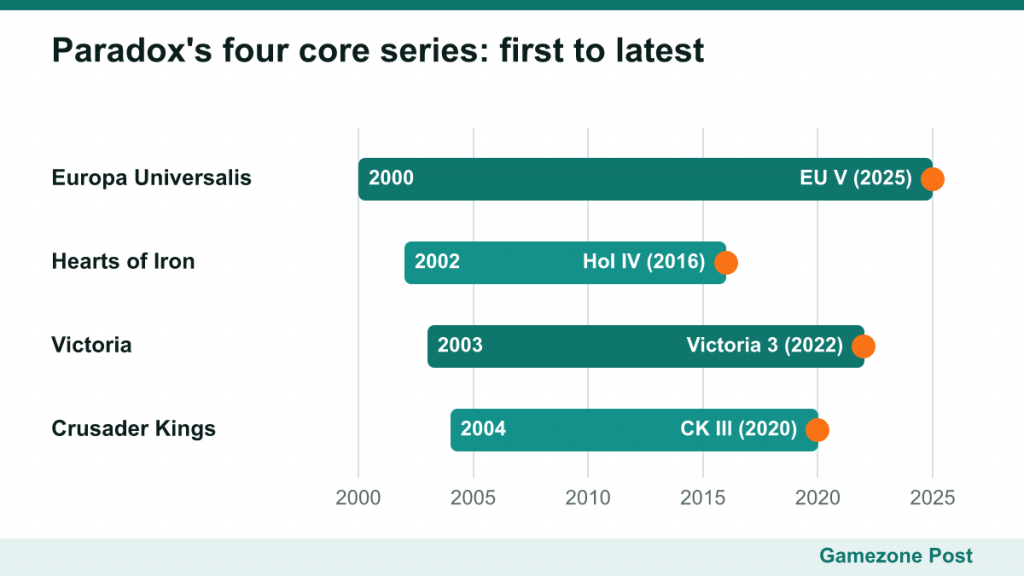
- Europa Universalis went from a direct adaptation of a board game (2000) through the 3rd and 4th generations’ focus on national ideas, trade and monarch power, to EU V’s simulation of population, markets and control. The series moved from abstract numbers toward modeling what those numbers represent.
- Hearts of Iron started as a Second World War map game in 2002 and grew into the production-and-logistics sandbox of Hearts of Iron IV, where focus trees, division design and battle plans are layered on an industrial economy.
- Victoria was always the economy series. The 2003 original and Victoria II (2010) modeled population groups, and Victoria 3 (2022) built an entire market simulation around them.
- Crusader Kings went from a niche medieval title in 2004 to the studio’s breakout series. CK2 made characters the heart of the game, and CK3 added systems such as stress and lifestyle perk trees that tie a ruler’s personality even more closely to the player’s choices.
The common thread is a move from abstraction toward simulation, helped by more powerful engines and by years of player feedback through expansions.
Beyond the core studio
As Paradox Interactive grew, it opened and acquired other studios, though not all of them work on grand strategy. According to Wikipedia, it acquired the French studio AGEod in 2009, opened Paradox Arctic in Umeå in 2014 and Paradox Thalassic in Malmö in 2017, acquired Triumph Studios in 2017 and Harebrained Schemes in 2018, and opened Paradox Tectonic in California in 2019 and Paradox Tinto in Spain in 2020. Paradox went public on Nasdaq First North in May 2016.
Smaller grand strategy experiments also came out of the main studio: Sengoku explored feudal Japan, and March of the Eagles focused on the Napoleonic Wars. Neither became a long-running series, but both tested ideas in narrower settings.
The expansion-and-patch model
Paradox games are known for how they’re supported after launch. The model has three parts:
- A base game that’s complete and playable on its own.
- Paid expansions of various sizes, from major mechanics expansions to smaller region or flavor packs, cosmetic packs and music.
- Free patches released alongside each expansion, often reworking core systems for every player, not just buyers.
The result is that a Paradox game at year five can be very different from the same game at launch. Supporters argue this lets small, focused teams keep improving games for a decade. Critics point to the large number of DLC and the difficulty newcomers have figuring out which expansions matter. Both views are fair, and the model has stayed central to how Paradox works.
Modding
Paradox titles are heavily moddable, because so much of their content is defined in editable script files. Total conversion mods that recreate entirely different settings are common, and community modding has long been part of each game’s lifespan.
What defines a Paradox grand strategy game
- Pausable real time, inherited from the very first Europa Universalis.
- A map-based world with provinces or locations, often the whole globe.
- Sandbox goals rather than a fixed victory condition.
- Interlocking systems: economy, diplomacy, war, religion, internal politics.
- Emergent history, where alternate histories arise from player and AI decisions.
- Long-term support through expansions and patches.
If you want to start playing rather than reading, our guide to which Paradox grand strategy game to start with suggests a learning path through the current lineup.