Crusader Kings III Beginner’s Guide: Dynasty, Traits and Succession
Learn to play a character, not a country, in Crusader Kings III: traits, stress, lifestyles, councils, claims and how succession keeps your realm whole.
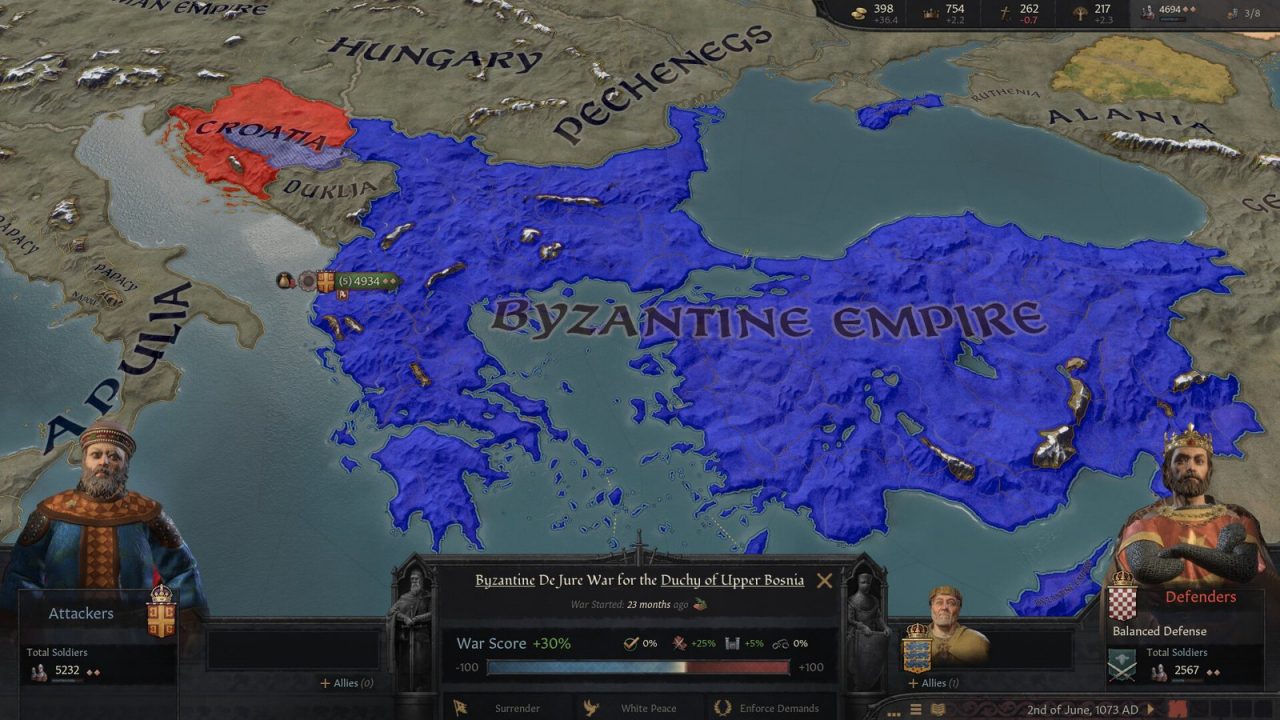
Most strategy games put you in charge of a nation. Crusader Kings III puts you in charge of a person. You play a medieval ruler with a personality, a family and a lifespan, and when that ruler dies you continue as their heir. The map is your stage, but the dynasty is the real protagonist. That one design choice is why CK3 feels so different from other grand strategy games, and why new players often struggle until it clicks.
This guide covers the systems you need to understand in your first campaigns: traits and stress, lifestyles, vassals and the council, claims and wars, and above all succession. It finishes with good starting rulers and the mistakes almost everyone makes early on. If you’re still deciding which Paradox game to try first, our guide to choosing a Paradox grand strategy game compares CK3 with the studio’s other titles.
The basics: what CK3 is
Crusader Kings III was developed and published by Paradox Interactive. It was released for Windows, macOS and Linux on 1 September 2020, and on PlayStation 5 and Xbox Series X/S on 29 March 2022 in most regions. The base game offers three start dates: 867, 1066 and 1178. You can pick any landed character, from a humble count to an emperor, and play across several centuries of medieval history.
There’s no fixed victory condition. You set your own goals: forming a kingdom, converting a region to your faith, building the most prestigious dynasty in Europe, or simply keeping one family on a throne for 400 years. The game only ends early if your dynasty runs out of landed members, which is the true “game over.”
Playing a character: traits, skills and stress
Skills
Every character has six skills: Diplomacy, Martial, Stewardship, Intrigue, Learning and Prowess, the last being personal fighting ability. Skills affect almost everything. Diplomacy shapes how others see you, Stewardship drives income and how many holdings you can manage, Martial improves your armies, Intrigue powers schemes and protects you from plots, and Learning helps with faith and technology.
Traits
Characters have several kinds of traits:
- Personality traits such as Brave, Craven, Just, Arbitrary, Compassionate or Ambitious. These define how a character wants to behave.
- Education traits, earned in childhood and tied to one skill, with higher levels giving bigger bonuses.
- Congenital traits like Genius or Beautiful that can be inherited, which is why marriage choices matter across generations.
- Lifestyle, health and other traits gained during play.
Stress
Personality traits tie into one of CK3’s signature systems: stress. When you make a choice that goes against your character’s personality, such as a Compassionate ruler executing a prisoner or a Just ruler imprisoning someone without reason, they gain stress. Losing loved ones, being imprisoned or tortured also adds stress.
According to the official wiki, stress runs from 0 to 400 and is grouped into levels at 100, 200 and 300. Crossing a level triggers a mental break. You can shed stress by picking up a coping mechanism trait such as drinking or reclusiveness, or by accepting more stress. Coping traits make it easier to lose stress later, but they can also carry other drawbacks. At the highest level, breaks can lead to severe outcomes up to and including death or abdication. In practice, stress means you can’t always take the “optimal” choice. A ruler’s personality is a real constraint, and roleplaying them well is usually the smoother path.
Lifestyles and focus
Each character can pursue one of six lifestyles, and each lifestyle has three perk trees. The five skill-linked lifestyles (Diplomacy, Martial, Stewardship, Intrigue and Learning) give perks that strengthen their associated skill and unlock new options. Over years of play your ruler earns lifestyle experience and gradually unlocks perks, and completing a tree grants a trait.
For beginners, Stewardship is a common safe pick. It strengthens your economy and increases the number of holdings you can personally manage. Martial helps if you plan to fight early, and Diplomacy helps if you rely on alliances and vassal goodwill. Your lifestyle doesn’t have to match your education, so choose the one your realm needs.
Your realm: domain, vassals and the council
Domain and domain limit
Your domain is the set of holdings you hold personally. The domain limit caps how many of them you can efficiently run. If you exceed it, the extra holdings stop providing taxes and levies after a year. The limit rises with title rank, good education and certain perks and innovations. The lesson is simple: when you conquer land you can’t hold directly, grant it to a vassal.
Vassals
Vassals are the counts and dukes beneath you. They pay you taxes and provide levies, but each has an opinion of you. Unhappy, powerful vassals join factions that may demand independence, a different ruler or a change of law, and they can rebel if refused. Keeping your most powerful vassals content, through titles, council seats, gifts or marriage ties, matters as much as fighting external enemies.
The official wiki also points out that vassals pay more when you’re their rightful liege, meaning their land sits inside your de jure kingdom or empire. Expanding within your own de jure territory first tends to be more profitable than sprawling across borders.
The council
Five councilors help you run the realm, each tied to a skill:
| Position | Skill | Typical tasks |
|---|---|---|
| Chancellor | Diplomacy | Domestic and foreign affairs, integrating titles |
| Steward | Stewardship | Collecting taxes, increasing development |
| Marshal | Martial | Organizing the army, increasing control |
| Spymaster | Intrigue | Disrupting or supporting schemes, finding secrets |
| Court Chaplain | Learning | Religious relations, fabricating claims, converting counties |
Councilors need high skill in their area, but a council seat is also a political tool. Appointing a powerful vassal makes them happier, even if someone else would be slightly more skilled. Your spouse can also serve as a confidant, adding a share of their skills to yours.
Claims, casus belli and war
You can’t simply attack a neighbor. Wars need a casus belli, a justification. The most common sources are:
- Claims: a legal right to a title, gained through inheritance, marriage, events or by having your Court Chaplain fabricate a claim on a county.
- De jure claims: rulers can push for land that legally belongs to a duchy or kingdom they hold.
- Religious and cultural wars: holy wars, and conquest wars available to certain cultures and faiths.
Armies are made of levies raised from your holdings, professional men-at-arms regiments you recruit and maintain, and knights, the strongest-prowess characters at your court. Commanders matter: a skilled Martial commander with good traits can win battles against larger armies. Before declaring war, check your target’s allies and liege; attacking someone with a powerful protector is the fastest way to lose.
Succession: the system that breaks realms
Succession is the part of CK3 that surprises new players most. When your ruler dies, their titles pass according to the realm’s succession law, and in many early-medieval realms that means partition.
How partition works
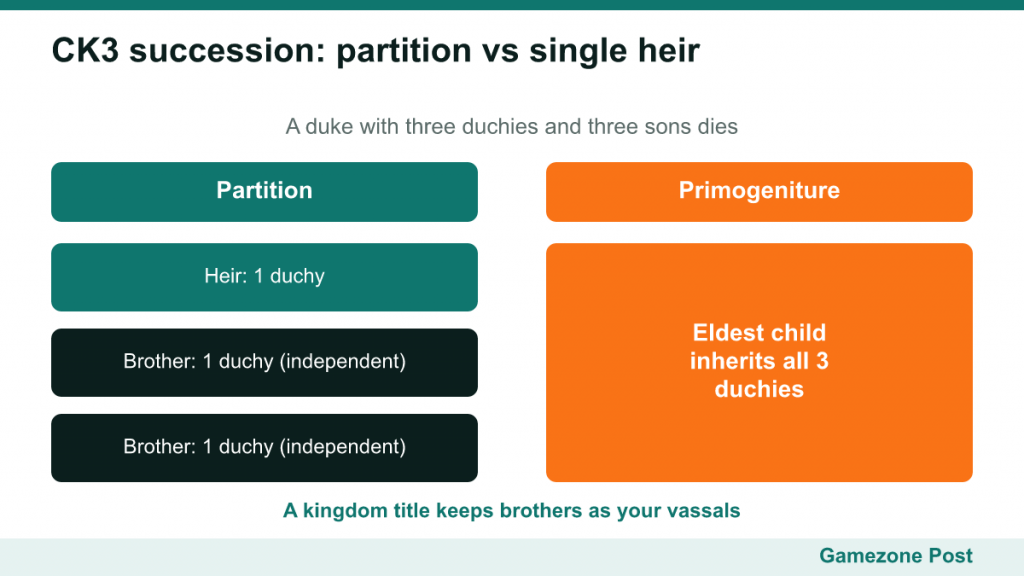
Under partition, titles are divided among all eligible children. The eldest child, your “primary heir” and the character you’ll play next, receives the primary title and capital. The other titles are distributed so that siblings get a share. A duke with three duchies and three sons can easily die and leave his heir with only one duchy, while his brothers become independent rivals.
The official wiki describes variants:
- Partition: the standard division of titles among children.
- Confederate partition: even more fragmenting, and can create new titles on succession.
- High partition: the primary heir takes half the titles at each step before the rest are divided.
- Single-heir laws such as primogeniture, where the eldest child inherits everything, and ultimogeniture, where the youngest does.
- House seniority, where the eldest member of the house inherits, available to certain cultures.
Some titles can also use elective title laws, where electors choose the next holder. Gender laws, such as male preference or equal, decide who’s eligible.
How to keep a realm together
- Create higher titles. Partition spreads titles among heirs, but a higher-tier title like a kingdom goes to the primary heir along with its de jure capital area. Holding a kingdom keeps your brothers’ duchies as your vassals rather than independent rivals.
- Have fewer heirs. Fewer children means fewer shares. Some players disinherit younger children, but that can cause stress for some personalities and costs prestige and goodwill.
- Get heirs into other positions. Younger sons who marry matrilineally into another dynasty, or join a holy order, don’t claim a share of your titles.
- Work toward better succession laws. Single-heir laws such as primogeniture need cultural innovations and crown authority, which take time in an early start.
- Prepare for the transition. Make sure your primary heir is the child you actually want to play, ideally with a strong education and good traits.
Accepting a little fragmentation and then reconquering it with your next ruler is a normal part of the game, not a failure.
Good starting rulers
The official CK3 wiki recommends three beginner characters from the 1066 start:
- Petty King Murchad of Munster (Ireland): the tutorial character. He’s on an island, mostly left alone, and has clear local rivals to absorb. He’s ideal for learning claims, war and forming a kingdom.
- Duke Vratislav of Bohemia: a vassal of the Holy Roman Empire, which protects him from invasion. He can work toward crowning himself King of Bohemia, and his start teaches vassal politics.
- Duke Robert of Apulia: an ambitious Norman with room to expand in southern Italy, though his land’s de jure ties to the Byzantine Empire can cause friction later.
Starting as a count or petty king teaches the systems at a manageable scale. Huge empires such as the Byzantines or the Holy Roman Emperor have many more vassals and much more internal politics to juggle.
Common early mistakes
- Ignoring succession until the ruler dies. Check your heir and the succession preview regularly.
- Exceeding the domain limit. Conquered counties you can’t manage should go to vassals.
- Waiting too long to marry. Good spouses are taken quickly, and marriages bring alliances and sometimes claims.
- Fighting against your traits. Constantly acting out of character piles up stress and triggers mental breaks.
- Angering powerful vassals. A strong faction can take your crown faster than any foreign army.
- Declaring war without checking allies. A small target with a big ally can wreck your levies.
- Treating your dynasty as disposable. If no landed member of your dynasty remains, your game ends, so marry off relatives and keep a few branches landed.
How CK3 fits the bigger picture
CK3 is the most character-driven of the Paradox grand strategy games. The map matters, but the stories come from people: rivalries, scandals, unlikely heirs and disastrous marriages. If you enjoy that and later want to manage nations, economies or wars at a larger scale, the other titles in the family offer that. Our explainer on how the strategy subgenres differ shows where grand strategy sits alongside RTS and 4X.