Europa Universalis IV vs Europa Universalis V: What Changed
What Europa Universalis is about, and how EU V (2025) differs from EU IV (2013) in start date, population, economy, research, control and platforms.

For over a decade, Europa Universalis IV was the reference point for nation-building grand strategy. It launched in 2013 and received years of expansions and patches. In November 2025, Paradox released its successor, Europa Universalis V, and players now face a real choice. EU V isn’t just EU IV with better graphics. It changes the start date, the economic model and the way your country is simulated from the ground up.
This article explains what Europa Universalis is about, then compares the two games system by system and suggests who should play which. If you’re new to Paradox games altogether, start with our guide to choosing your first Paradox grand strategy game.
What Europa Universalis is about
Europa Universalis is a grand strategy series about running a state over centuries of early modern history. You pick a country, from a great power like France or the Ottomans to a tiny duchy or a non-European state, and guide it through war, diplomacy, trade, religion and internal politics. The clock runs in pausable real time, and the map is the whole world.
There’s no fixed win condition. Players set their own goals: forming a historical nation, building a colonial empire, dominating trade or simply surviving as a minor power. Compared with Crusader Kings, which is about a dynasty of characters, Europa Universalis is about the state as an institution, its economy, armies and diplomatic position. For a broader comparison of strategy subgenres, see our explainer on RTS vs 4X vs grand strategy.
The two games at a glance
| Europa Universalis IV | Europa Universalis V | |
|---|---|---|
| Developer | Paradox Development Studio | Paradox Tinto |
| Release | August 2013 | 4 November 2025 |
| Time span | 1444 to 1821 | 1337 to 1837 |
| Platforms | Windows, macOS, Linux | Windows |
| Engine | Clausewitz | Clausewitz (per Wikipedia) |
| Technology | Bought with monarch points | Advances researched with research points |
| Population | Abstracted as province development | Simulated population groups (pops) |
| Trade | Trade nodes and merchants | Markets with dozens of goods |
Start date and timeline
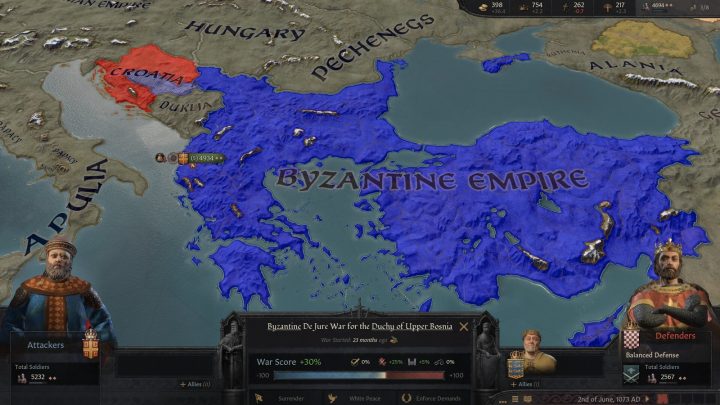
EU IV’s standard start is 11 November 1444, shortly before the fall of Constantinople, and the game ends in 1821. You can choose later start dates too.
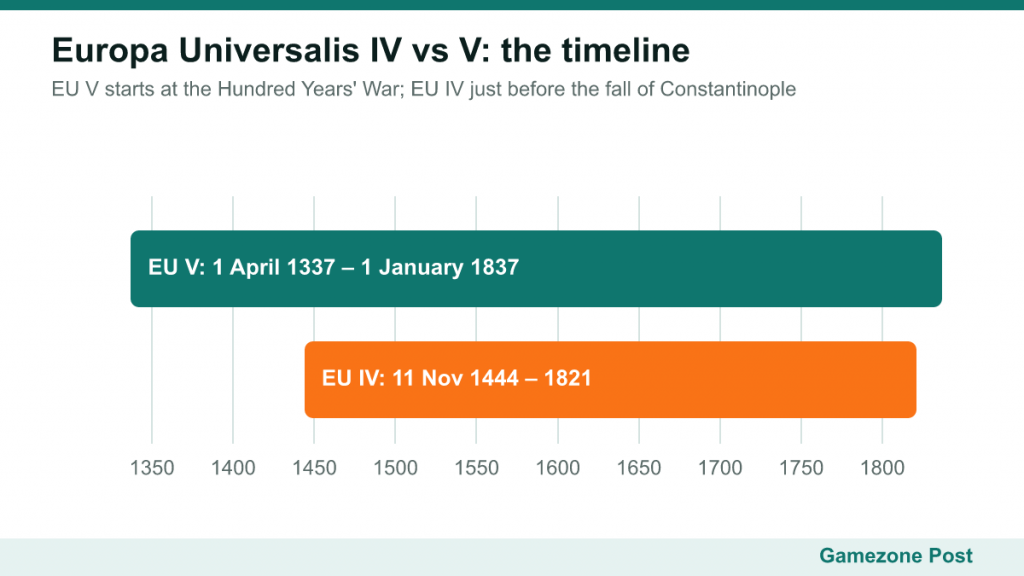
EU V starts much earlier, on 1 April 1337, at the beginning of the Hundred Years’ War, and runs to 1 January 1837, giving almost five centuries of history. The earlier start means you play through the late medieval period, with the Black Death era and a very different political map, before the age of exploration begins. EU V organizes its technology into ages: Traditions, Renaissance, Discovery, Reformation, Absolutism and Revolutions.
Population and the economy
This is the biggest change between the two games.
EU IV: development
In EU IV, each province has a development value made up of administrative, diplomatic and military parts. Development abstracts population and wealth into a few numbers. You can raise it by spending monarch points. Taxes, manpower and production come from development, buildings and the trade goods a province produces.
EU V: pops
EU V simulates population directly. According to Wikipedia and the game’s Steam page, populations are shown on the map in detail and divided by social class, culture and religion, with migration and economic productivity modeled. A province can be split between religions or cultures in ways EU IV couldn’t show. The population produces and consumes goods, which feeds an economic simulation much closer to Victoria than to older EU games.
Trade
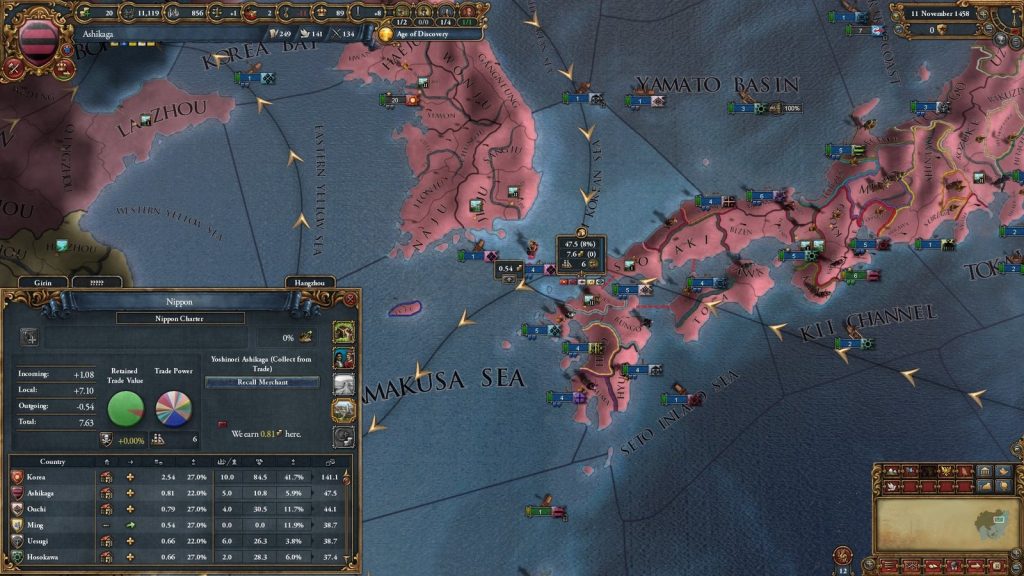
EU IV’s trade system is built around trade nodes. Trade value flows downstream through a network of nodes, and you place merchants to collect or steer it. EU V replaces this with markets and dozens of goods and crops, which Paradox describes as the most detailed trade system yet in the series. Production, demand and the reach of your market now matter more than where your merchants stand.
Monarch points vs new systems
In EU IV, monarch power comes in three types: administrative, diplomatic and military. Your ruler and advisors generate these points, and you spend them on technology, ideas, development, stability, cores and much more. It’s elegant but abstract, and much of the game becomes managing three currencies.
EU V moves away from this model. Technology comes from advances, which you research one at a time using research points, with each age offering its own set. Instead of pouring one currency into everything, you work with interconnected systems: population, estates, markets, laws and government reforms.
Control, estates and government
Control and proximity
EU V introduces control, a measure of how much your central government can draw on a location’s resources. Higher control means more taxes, levies and manpower. Control is capped mainly by proximity, a measure of travel cost from your capital. Roads, rivers and governors improve proximity, while mountains, forests and jungles hurt it. The practical effect is that a sprawling, poorly connected empire is weaker than its map size suggests, which is a far more physical version of the “overextension” ideas in EU IV.
Estates
Both games have estates, groups such as the nobility, clergy and burghers that hold power in your country. In EU IV, estates were added with the Cossacks expansion and later integrated into the base game. They grant bonuses in exchange for privileges and can become threats if they grow too influential. In EU V, estates are central to the society simulation. The Steam page describes them jockeying for power as you balance privileges to keep the population under control.
Government and laws
EU V adds laws, government reforms and societal values, such as choosing whether to centralize power at court or share it with nobles. EU IV has its own government reforms and national ideas, but EU V puts more weight on how your society is structured rather than on picking idea groups.
War and the map
Both games feature land and naval warfare, sieges, alliances and peace deals. EU V’s Steam page describes warfare that evolves from levies and mercenaries to standing armies and fortresses, reflecting its earlier start. Because the map tracks population and terrain in more detail, logistics and geography play a larger role.
Diplomacy in both games uses alliances, royal marriages and claims. EU V also adds international organizations, such as structured groupings of states, as a named system.
Automation and accessibility
One notable feature of EU V is how much can be automated. Wikipedia notes that most gameplay can be handed to the AI, so you can focus on the parts you enjoy, such as trade or the military, while the AI handles the rest. That’s helpful because EU V is a more complex game. Rock Paper Shotgun’s review praised its depth but called the complexity “overwhelming” and less accessible than other Paradox titles. IGN praised its depth and its population and terrain systems while noting launch balance issues.
EU IV is also complex, but it’s had over a decade of community guides, wikis and tutorials. It has accumulated a large expansion catalog: Wikipedia counted 22 DLC as of May 2024, comprising 16 expansions and 6 immersion packs. Newcomers often find the sheer amount of DLC-dependent content confusing.
Reception in brief
EU V launched to a “generally favorable” reception, with a Metacritic score of 85/100. It was nominated for the Steam Awards’ “Most Innovative Gameplay” and for a D.I.C.E. Strategy/Simulation Game of the Year award.
Which should you play?
Choose Europa Universalis IV if:
- You play on macOS or Linux, since EU V is Windows-only at launch.
- You want a game with a mature, stable design and a huge library of guides and mods.
- You prefer the faster, more abstract “map painting” feel of monarch points and development.
- You like the 1444 start and the classic Age of Exploration focus.
Choose Europa Universalis V if:
- You want a deeper simulation of population, goods and markets.
- You’re interested in the late medieval period and the Hundred Years’ War era.
- You enjoy how geography and logistics shape power through control and proximity.
- You like the idea of automating parts of the game you find tedious.
- You’ve enjoyed Victoria 3’s economy and want that depth in an earlier era.
For complete newcomers
Neither game is a gentle introduction to grand strategy. If you’ve never played a Paradox title, Crusader Kings III is generally the friendlier starting point. If you specifically want Europa Universalis, EU V’s automation lets you learn one system at a time, while EU IV benefits from more learning resources.
Common questions
Does my EU IV experience help in EU V?
Yes, for the fundamentals: reading the map, managing alliances, timing wars and balancing estates. Expect to relearn the economy, though, because pops, goods and markets replace development and trade nodes.
Will EU IV still be playable?
Yes. Owning EU V doesn’t affect your EU IV library, and both games can be installed side by side.
How should I approach my first EU V campaign?
Pick a mid-sized, relatively secure country, automate the systems you don’t understand yet, and take them back one at a time. Watch control in your outer provinces, since poorly connected territory yields far less than its size suggests. Speed up the clock only once your economy is stable.
Is EU V a direct continuation of EU IV’s mechanics?
Only partly. Estates, diplomacy and the general idea of guiding a state remain, but population, trade, research and control work very differently.