Which Paradox Grand Strategy Game Should You Start With?
Crusader Kings III, Europa Universalis IV and V, Hearts of Iron IV, Victoria 3 or Stellaris? Compare era, focus and learning curve to pick your first.

Paradox Interactive’s grand strategy games have a reputation that is both attractive and intimidating. Players tell stories of Byzantine succession plots, colonial empires built from a single province and alternate-history world wars, and then add that the first ten hours were confusing. Both parts are true. These are deep games, and the one you start with shapes whether the learning curve feels exciting or exhausting.
This guide compares the six main Paradox grand strategy titles you are likely to consider today: Crusader Kings III, Europa Universalis IV, Europa Universalis V, Hearts of Iron IV, Victoria 3 and Stellaris. For each, you will find the era it covers, what you actually spend your time doing, how steep it is for a newcomer and who it suits best. If you are new to the wider genre, our overview of how strategy subgenres differ is a useful primer.
What All Paradox Grand Strategy Games Have in Common
Before comparing them, it helps to know the shared foundations, because skills learned in one carry over to the others.
- Real time with pause. Days tick by continuously, but you can pause at any moment and adjust the game speed. Pausing constantly while you learn is normal.
- A historical or simulated world map. You pick a country, dynasty or species and play within a detailed map full of AI-controlled rivals.
- No single win condition. Most Paradox games run between start and end dates and let you set your own goals. You “win” by achieving what you set out to do.
- Systems over scripts. Events add flavor, but most stories come from interacting systems: economy, diplomacy, characters and war.
- Long support. Paradox typically supports each game for years with free patches and paid expansions, so a game’s feature set grows over time.
Crusader Kings III: Characters First
Released: September 1, 2020. Era: The Middle Ages, with start dates in 867, 1066 and 1178.
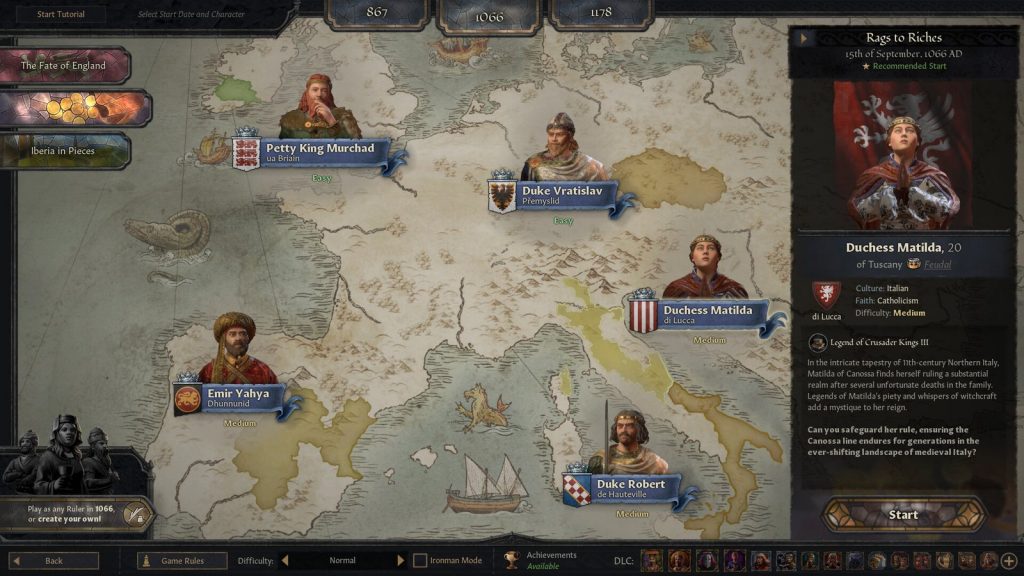
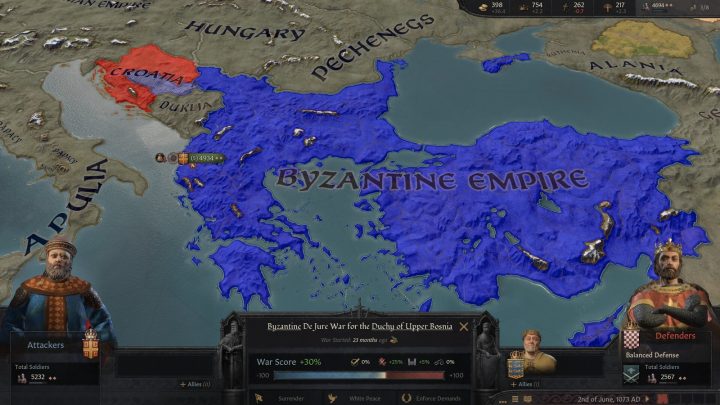
Crusader Kings III is the most character-driven Paradox game. You do not play a country; you play a ruler and, after their death, their heir. Your goal is to keep your dynasty powerful across generations. Traits, lifestyles and inherited genetics shape each ruler and their children, and you can arrange marriages, educate heirs, grant titles, plot against rivals and even design your own faith. The map stretches from Northern Europe and the British Isles to the Horn of Africa and as far east as Burma.
Why it is a strong first pick: The personal stakes make it easy to care about what happens. Even when you do not understand every number, you understand that your brother wants your throne or that your heir has a terrible temperament. The game’s interface explains a lot through tooltips, and it ships with a tutorial that walks you through a starting ruler.
Watch out for: Succession rules. Dividing your lands among children can break up your realm, and learning how inheritance works is the main early hurdle.
Europa Universalis IV and Europa Universalis V: Nations and Empires
Europa Universalis IV
Released: August 13, 2013. Era: Roughly four centuries, from the late Middle Ages to the Napoleonic era.
EU IV puts you in charge of any of hundreds of nations and asks you to guide it through the early modern period: exploration, colonization, the Reformation and the rise of absolutist states. Its core systems include trade nodes that funnel wealth across the map, diplomacy with alliances and royal marriages, national ideas and traditions, and monarch mechanics where your ruler’s skills affect how quickly your nation develops. After more than a decade of updates, it is enormous in scope.
Europa Universalis V
Released: November 4, 2025. Era: From April 1, 1337 to the start of 1837, almost five centuries.
Developed by Paradox Tinto, EU V is the newest grand strategy release in this list. It keeps the series’ focus on running a nation through the late medieval and early modern world, but rebuilds the foundations. Population is modeled in detail on the map, so provinces can be split by culture or religion. Estates compete for power, a market-based trade system covers dozens of goods, and the military develops from levies and mercenaries toward standing armies. It is currently a Windows release.
Which EU for a beginner? EU V has the advantage of being new and designed with modern interface conventions, while EU IV has a vast amount of community guides and a decade of polish. Both are complex. If you prefer understanding economic cause and effect, EU V’s population and market systems may click; if you want the most documented experience, EU IV is still a solid choice.
Hearts of Iron IV: War and Industry
Released: June 6, 2016. Era: The years around the Second World War.
Hearts of Iron IV is the most military-focused Paradox game. You lead a nation into, through or around World War II, and your main tools are industry, production and armies. You design division templates, assign factories to production lines, research weapons and plan offensives using front lines and battle plans. National focus trees give each major country a branching set of political and military goals, which is how the game produces alternate histories.
Why it can work as a first game: The goal is obvious: prepare for war and win it. If you are a history or military enthusiast, the setting provides a lot of motivation.
Watch out for: Logistics and division design. Supply, terrain and template choices are where many new players struggle, and battles can go badly without a clear reason unless you learn to read the tooltips.
Victoria 3: Economy and Society
Released: October 25, 2022. Era: 1836 to 1936.
Victoria 3 is the economic and political simulation of the family. Your country’s population is divided into groups with their own needs and political wishes. You build industry, trade for raw materials, find markets for finished goods and reform laws and the constitution while interest groups push for and against change. War exists, but much of the game is about growing a modern economy and keeping society stable as it transforms.
Who it suits: Players who like spreadsheets in the best sense, enjoy watching numbers grow and are curious about the 19th century’s industrial and political upheavals.
Watch out for: It is less about painting the map than other entries, which surprises some players. Learning how supply, demand and construction interact takes time.
Stellaris: Grand Strategy in Space
Released: May 9, 2016. Era: A fictional far future.
Stellaris is the odd one out: it takes place in a procedurally generated galaxy and borrows heavily from 4X games. You design your own species and government, explore star systems, meet alien civilizations and decide whether to cooperate or conquer. Because every galaxy is different and you design your own starting empire, it feels closer to a space 4X than to a history simulator. If 4X games are already familiar, see our explainer on what a 4X game is for the overlap.
Why it is a popular entry point: There is no history to learn and no fixed geopolitical situation. The early game is about exploration, which naturally introduces systems one by one.
Comparison at a Glance
| Game | Released | Era | Main focus | Beginner difficulty |
|---|---|---|---|---|
| Crusader Kings III | 2020 | Middle Ages (867–) | Characters and dynasty | Moderate; very readable |
| Europa Universalis IV | 2013 | Late medieval to Napoleonic | Nation, trade, diplomacy | High |
| Europa Universalis V | 2025 | 1337–1837 | Nation, population, markets | High |
| Hearts of Iron IV | 2016 | World War II | War and industry | Moderate to high |
| Victoria 3 | 2022 | 1836–1936 | Economy and politics | High |
| Stellaris | 2016 | Fictional future | Space empire, exploration | Moderate |
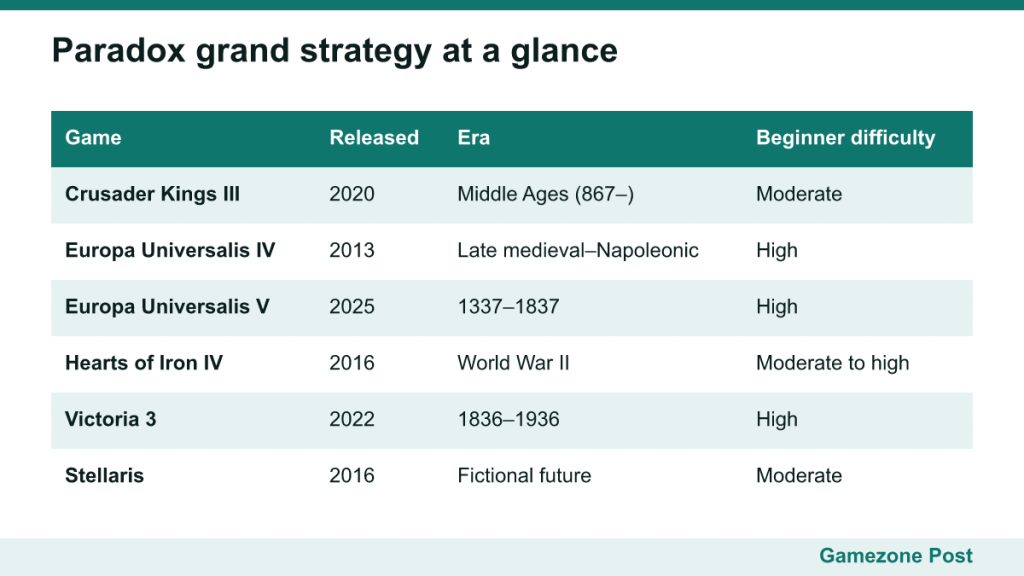
Difficulty ratings here are general guidance about how many systems you have to juggle early on, not official classifications.
Tutorials, Expansions and How to Approach the DLC
All of these games include some form of tutorial, and every one of them also explains mechanics through layered tooltips: hover over a number and the game shows what makes it up. Learning to read tooltips is the single most useful skill across the Paradox catalog.
Paradox games are known for their large number of expansions. The model generally works like this: major features are often added through paid expansions, while a free patch released alongside them updates the base game for everyone. Smaller content packs add flavor, art, music or region-specific events. For a beginner, the base game is a complete experience. It makes sense to play first, learn what you enjoy and only then look at which expansions expand those parts of the game. Community wikis and patch notes describe what each expansion contains.
A Suggested Learning Path
There is no wrong order, but many players find a smooth route like this:
- Start with Crusader Kings III or Stellaris. Both introduce real-time-with-pause play, diplomacy and war in a way that is easy to follow, either through characters or exploration.
- Move to Hearts of Iron IV or Europa Universalis if you want deeper warfare or nation management. The interface habits you built transfer directly.
- Try Victoria 3 once you are comfortable with tooltips and long-term planning, because its economy rewards patience and understanding.
Good habits for any first campaign
- Pick a mid-sized, stable starting nation or ruler rather than a tiny one surrounded by enemies.
- Play on slow speed and pause often.
- Set one modest goal, such as unifying a region or surviving a specific war.
- Expect to restart once. Your second campaign will make far more sense than your first.
The Short Answer
If you want the friendliest entry, start with Crusader Kings III for medieval drama or Stellaris for science fiction. If World War II is your passion, Hearts of Iron IV will keep you motivated through the learning curve. If you want to run a nation across centuries, choose between the long-polished Europa Universalis IV and the newer Europa Universalis V. And if economies and societies fascinate you, Victoria 3 is the one to grow into. Whichever you choose, the skills you learn will make every other Paradox game easier to pick up.