Age of Empires: The History of the Series From 1997 to Today
From Ensemble Studios' 1997 original to Age of Kings, Mythology, AoE III, the studio's closure, the Definitive Editions, Age of Empires IV and Retold.

Few strategy series have lasted as long, or been loved as consistently, as Age of Empires. Its formula of villagers gathering food, wood, gold and stone, advancing through ages and raising historical armies was set in 1997 and is still recognizable in every entry released since. Along the way, the series survived the closure of the studio that created it and found new life through remasters and new developers.
This history covers each major game, the people and studios behind them, and the design ideas each entry contributed to real-time strategy. For the wider context of the genre, see our short history of real-time strategy.
Ensemble Studios and the original (1997)
Ensemble Studios was founded by Tony Goodman in 1994 and incorporated in 1996, with Rick Goodman and John Boog-Scott as co-founders. Designer Bruce Shelley was among its key early figures.
Age of Empires, published by Microsoft, was released on 15 October 1997. It took the real-time strategy formula popularized by Warcraft II and Command & Conquer and gave it a historical, civilization-building twist. Players led ancient civilizations from the Stone Age to the Iron Age, gathering resources with villagers, researching technologies and advancing through ages that unlocked new buildings and units. It added a sense of historical progress that made it feel closer to Civilization than to its fantasy and sci-fi rivals.
The game was a major success. Its expansion, The Rise of Rome, followed on 31 October 1998, and by 2000 the base game had sold more than three million copies.
Age of Empires II: The Age of Kings (1999)
The sequel, released on 30 September 1999, moved the setting to the Middle Ages and became the series’ defining entry. It featured 13 civilizations, each with unique units, and four ages: Dark, Feudal, Castle and Imperial. Its five historical campaigns, including a tutorial campaign about William Wallace and campaigns for Joan of Arc, Saladin, Genghis Khan and Barbarossa, combined history lessons with strategy.
Age of Kings also introduced quality-of-life features that later RTS games adopted widely:
- An idle villager button to find workers with nothing to do.
- A town bell to send villagers into buildings for defense.
- Formations for moving armies in organized groups.
- An AI designed to play without cheating.
- A scenario editor with a trigger system for custom campaigns.
It shipped two million copies within three months. The Conquerors expansion followed on 24 August 2000, adding new civilizations, including the Aztecs and Mayans. Our Age of Empires II: Definitive Edition beginner’s guide explains how the game plays today.
Age of Mythology (2002)
Ensemble’s next game, Age of Mythology (30 October 2002), swapped history for myth. It was the studio’s first game on its fully 3D BANG! engine. Players chose between the Greeks, Egyptians and Norse, picking one of three major gods before the match and a minor god at each age advance.
Its new ideas included:
- God powers: one-time special abilities, such as calling down lightning or summoning help.
- Myth units: monsters and mythological creatures fighting alongside human armies.
- Heroes, especially effective against myth units.
- Favor, a new resource earned in a different way by each culture. Stone, a classic Age resource, was dropped.
The Titans expansion followed in October 2003. In September 2024 the game returned as Age of Mythology: Retold, effectively its definitive edition.
Age of Empires III (2005)
Age of Empires III (18 October 2005) moved the series to the European colonization of the Americas, covering roughly 1492 to the 1870s. It was the boldest change in the series’ formula:
- The Home City, a persistent second city in Europe that couldn’t be attacked, with upgrades that carried over between matches.
- Shipment cards: earning experience during a match let you send units, upgrades or resources from your Home City. Players built decks of cards suited to booming, rushing or turtling.
- Five ages: Discovery, Colonial, Fortress, Industrial and Imperial, with a politician chosen at each advance, similar to Age of Mythology’s minor gods.
- Physics-based destruction powered by Havok, so buildings collapsed and trees fell dynamically.
It launched with eight European civilizations. The WarChiefs (2006) added Native American civilizations, and The Asian Dynasties (2007), co-developed with Big Huge Games, added Asian ones.
Halo Wars and the end of Ensemble
Microsoft had acquired Ensemble in 2001. The studio’s final game was Halo Wars (2009), a console real-time strategy game set in the Halo universe. In September 2008, Microsoft announced internally that Ensemble would close once Halo Wars was finished, and the studio shut down in January 2009.
Its staff scattered into new studios. Robot Entertainment, founded by Tony Goodman and other Ensemble veterans in 2009, developed the free-to-play Age of Empires Online, released in 2011. Another group formed Bonfire Studios, later acquired by Zynga.
The HD editions and community revival
The series could have faded at that point. Instead, it was revived by its community. In April 2013 Microsoft released Age of Empires II HD Edition on Steam. Later that year, The Forgotten expansion, developed by Forgotten Empires (whose roots were in a fan-made expansion) with SkyBox Labs, added new content to a game that was then 14 years old. The African Kingdoms (2015) and Rise of the Rajas (2016) followed.
The success of AoE II’s second life convinced Microsoft to invest in the franchise again, eventually through a dedicated division, World’s Edge.
The Definitive Editions
- Age of Empires: Definitive Edition (20 February 2018): a full remaster of the original.
- Age of Empires II: Definitive Edition (14 November 2019): developed by Forgotten Empires, Tantalus Media and Wicked Witch Software, with 4K graphics and all previous content. It has continued to receive expansions, including Return of Rome and the Chronicles series covering classical Greece and Persia.
- Age of Empires III: Definitive Edition (15 October 2020).
- Age of Mythology: Retold (4 September 2024).
AoE II: Definitive Edition in particular kept receiving new expansions more than two decades after the original release, something few strategy games of its era can claim.
Age of Empires IV (2021)
The first new numbered entry in 16 years, Age of Empires IV, was developed by Relic Entertainment, known for Company of Heroes, with World’s Edge, and released on 28 October 2021. It returned to the medieval period with four ages named like AoE II’s, but changed how you advance: instead of researching at the Town Center, most civilizations build one of two landmarks, each granting different bonuses.
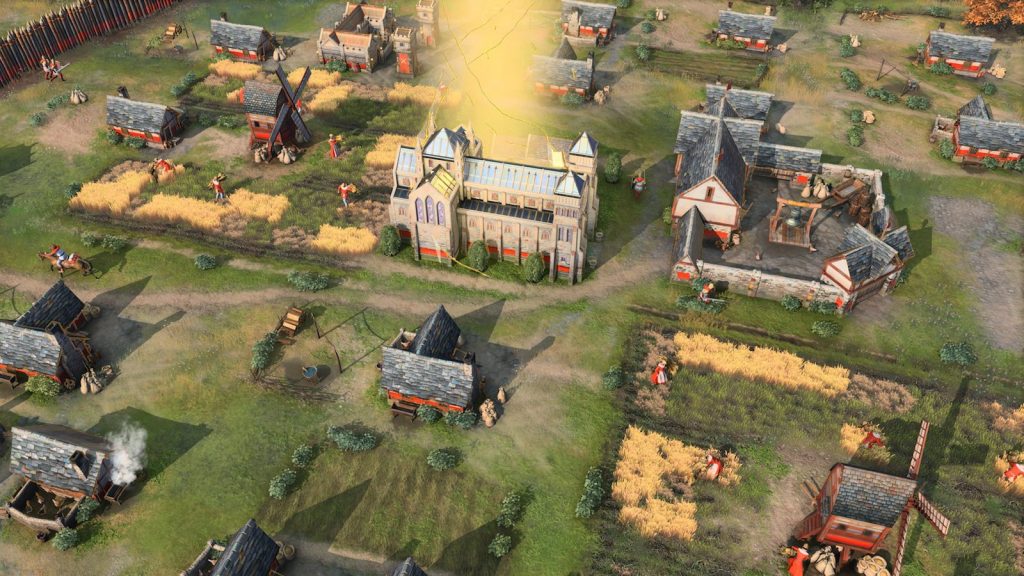
It launched with eight civilizations, added the Ottomans and Malians in a free 2022 update, and later grew through expansions such as The Sultans Ascend (2023), which added the Byzantines and Japanese plus variant civilizations. Its campaigns, including The Normans, The Hundred Years War, The Rise of Moscow and The Mongol Empire, pair missions with documentary-style history videos. Console versions followed on Xbox in 2023 and PlayStation 5 in 2025.
Age of Empires Mobile
In October 2024, Age of Empires Mobile, developed by TiMi Studio Group, brought the brand to phones. It’s a different style of game from the PC entries, built around mobile strategy conventions rather than traditional RTS matches.
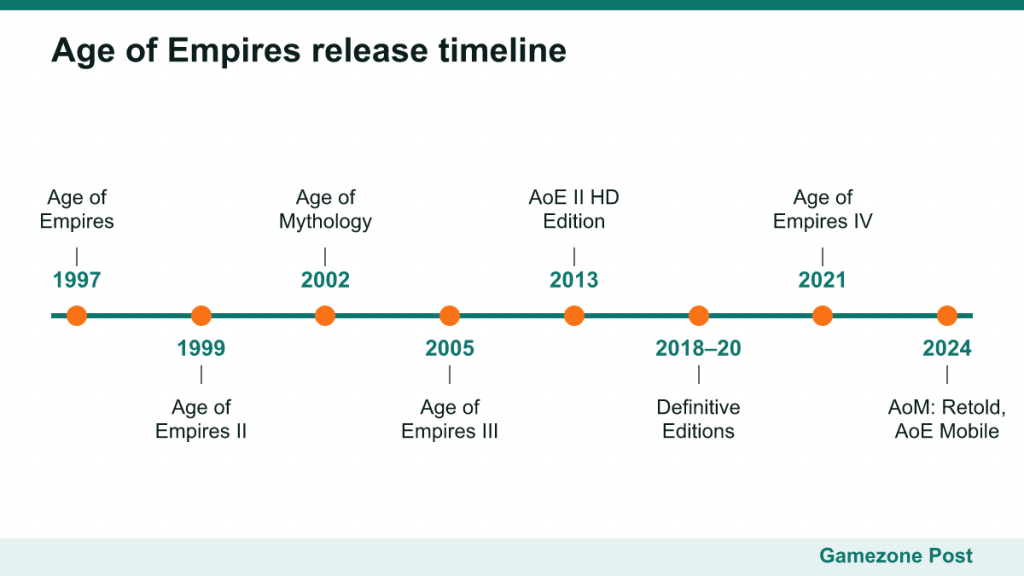
Timeline at a glance
| Year | Release | Developer |
|---|---|---|
| 1997 | Age of Empires | Ensemble Studios |
| 1998 | The Rise of Rome (expansion) | Ensemble Studios |
| 1999 | Age of Empires II: The Age of Kings | Ensemble Studios |
| 2000 | The Conquerors (expansion) | Ensemble Studios |
| 2002 | Age of Mythology | Ensemble Studios |
| 2005 | Age of Empires III | Ensemble Studios |
| 2007 | The Asian Dynasties (expansion) | Big Huge Games with Ensemble |
| 2011 | Age of Empires Online | Robot Entertainment |
| 2013 | Age of Empires II HD Edition | Remaster for Steam |
| 2018–2020 | Definitive Editions of AoE, AoE II and AoE III | Various partner studios |
| 2021 | Age of Empires IV | Relic Entertainment |
| 2024 | Age of Mythology: Retold; Age of Empires Mobile | Microsoft’s World’s Edge; TiMi Studio Group |
Where to start today
With so many versions available, newcomers often ask which one to play first. A rough guide:
- Age of Empires II: Definitive Edition is the classic. It has the largest catalog of civilizations and campaigns and the most learning material. If you want the “real” Age experience, start here.
- Age of Empires IV is the most modern and arguably the most welcoming to new players, with tutorial-style challenges and polished campaigns. Its civilizations are more asymmetric than AoE II’s.
- Age of Mythology: Retold suits players who want god powers, monsters and a more fantastical tone.
- Age of Empires III: Definitive Edition appeals to those who like the deck-building Home City system and a later historical era.
- Age of Empires: Definitive Edition is mostly for nostalgia or history fans; its mechanics are the simplest of the series.
All of the PC entries share the same core: villagers, resources, ages and historically themed armies. Skills learned in one carry over to the others, especially the economic habits covered in our guide to RTS fundamentals.
What Age of Empires gave the RTS genre
- History as a setting. It proved that real history could be as compelling as fantasy or science fiction in RTS.
- Ages as progression. Advancing through ages became a recognizable structure that other games borrowed.
- Usability features like the idle villager button and town bell.
- Asymmetric civilizations built on a shared core, which kept dozens of factions balanced and distinct.
- Longevity through community. Fan developers and remasters kept a 1999 game thriving for decades.
Through more than a quarter-century, the series has sold over 25 million copies, according to Wikipedia. Its biggest legacy is perhaps that AoE II still hosts active games today, played by people who weren’t born when it came out.