Age of Empires II: Definitive Edition Beginner’s Guide
Learn AoE II: DE from scratch: resources and villagers, the four ages, a simple Dark Age opening, scouting, unit counters, civilizations and game modes.
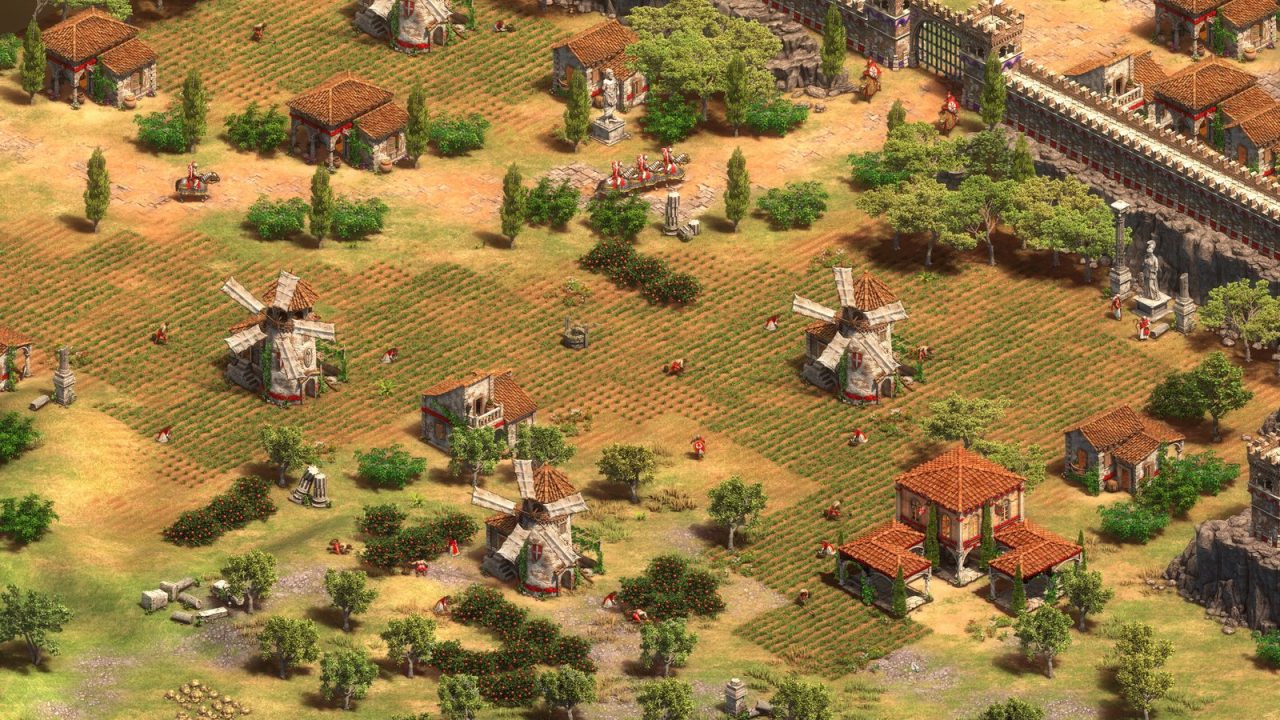
Age of Empires II first came out in 1999, and more than a quarter of a century later it is still one of the most played real-time strategy games around. The Definitive Edition, released on November 14, 2019, modernized the graphics and interface and has kept adding civilizations and campaigns ever since, with new expansions still arriving in 2026. For a newcomer, that long history is both good and bad news: there is plenty of help available, but also a lot of accumulated knowledge to catch up on.
This guide covers the essentials: resources and villagers, the four ages, a simple Dark Age opening explained step by step, scouting, the unit counter system, civilizations and the different ways to play. If the general vocabulary of RTS games is new to you, our explainer on macro, micro and build orders is a useful companion.
Resources and Villagers
Age of Empires II has four resources, all gathered by villagers:
| Resource | Sources | Drop-off | Main uses |
|---|---|---|---|
| Food | Sheep and other herdables, hunt, berries, fish, farms | Mill or Town Center | Villagers, many units, age advancement |
| Wood | Trees | Lumber Camp or Town Center | Buildings, archers, farms |
| Gold | Gold mines | Mining Camp or Town Center | Advanced units, technologies, later ages |
| Stone | Stone mines | Mining Camp or Town Center | Walls, towers, Castles, extra Town Centers |
Villagers are the backbone of your economy. They gather every resource, construct and repair buildings, and can garrison inside Town Centers and towers for protection. Each villager takes one population space.
Food sources in order
Food is the resource you need most in the early game, and it comes from different places over time:
- Herdables such as sheep can be captured by bringing a unit near them and are usually eaten under your Town Center first.
- Aggressive hunt like boar gives a lot of food but fights back, so villagers need to be careful when luring it.
- Berries are the safest food source but slower to gather; build a Mill next to them.
- Farms require a Mill and become your main food source later in the game.
Population
Houses, Town Centers and Castles provide population space, and each house adds 5. If you run out, units wait in the queue until space opens up, which is one of the most common ways beginners slow themselves down. A standard match allows up to 200 population.
The Four Ages
Every match moves through four ages. Advancing costs resources and requires two buildings from your current age.
| Advance to | Cost | Building requirement | What it unlocks (examples) |
|---|---|---|---|
| Feudal Age | 500 food | Two Dark Age buildings, for example a Lumber Camp and a Mill | Archery Range, Stable, Blacksmith, towers and stone walls |
| Castle Age | 800 food, 200 gold | Two Feudal Age buildings, for example a Blacksmith and a Stable | Knights, Castles, Siege Workshop |
| Imperial Age | 1000 food, 800 gold | Two Castle Age buildings (such as a Siege Workshop and University) or a Castle | Paladins, Trebuchets, gunpowder units, Wonders |
The Dark Age is about setting up your economy and scouting. The Feudal Age brings the first real military options. The Castle Age is when armies, unique units and expansions take off, and the Imperial Age unlocks the strongest units and upgrades.
A Simple Dark Age Opening, Step by Step
A build order is a planned opening that uses your resources efficiently. Exact numbers vary between players and civilizations, so treat the following as a common beginner-friendly template rather than a fixed rule. Most civilizations start with three villagers and a scout.
- Queue villagers immediately at the Town Center and keep queuing them for the whole Dark Age. Constant villager production is the single most important habit.
- Build two houses with your starting villagers, then send them to sheep under the Town Center.
- Send your scout out to find more sheep, berries, boar, wood, gold and stone, and bring sheep home.
- Put the first several new villagers on sheep. Food gathered right next to the Town Center is fast.
- Send the next group to wood and have one of them build a Lumber Camp at a forest line close to your Town Center.
- Lure a boar to your Town Center with a villager when sheep start running low, and gather it with several villagers.
- Build a Mill at the berries and put a few villagers there. The Mill also counts as one of your two Dark Age buildings.
- Keep adding houses as your population approaches the limit.
- Add more villagers to wood, then start building farms as your hunt and sheep run out.
- Research Loom for better villager health and armor before advancing, then click up to the Feudal Age once you have 500 food, keeping most villagers on food to get there faster.
Practice this against the AI until you can do it without thinking. Once it is automatic, you can start adapting it, for example by building a Barracks early for a military plan or sending villagers to gold earlier.
Scouting
You begin every random map game with a Scout Cavalry (some civilizations get an Eagle Scout instead). Its early job is economic: find sheep, boar, berries, wood lines, gold and stone. Its second job is military: find your opponent and see what they are doing. The official tutorial notes that the auto-scout button is convenient but less efficient than manual scouting.
Things to check when you scout an opponent:
- Have they built a Barracks, Archery Range or Stable? That hints at their plan.
- How many villagers are on each resource? Lots of wood suggests archers; lots of gold early can mean a fast advance.
- Are they walling? A walled opponent is planning a longer game.
The Unit Counter Triangle
Age of Empires II is built around counters. The core idea is a rock-paper-scissors relationship between the main unit types:
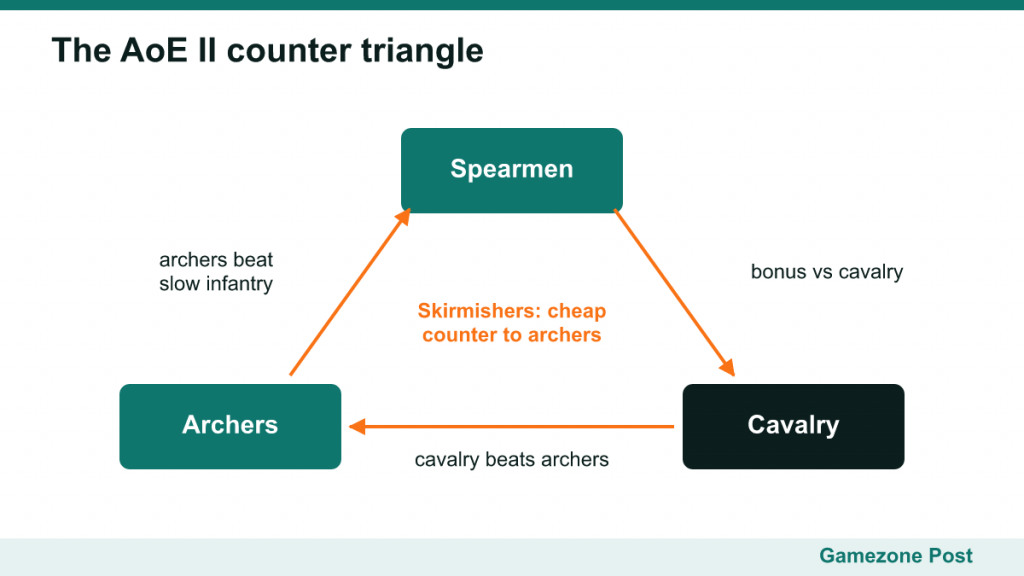
- Spearmen and pikemen have bonus damage against cavalry.
- Cavalry is fast and strong against archers and siege.
- Archers beat slow infantry from range.
- Skirmishers are a cheap counter to archers.
Counters are not absolute: numbers, upgrades and micro all matter. But building the right counter usually trades far more efficiently than building more of the same unit. This is why scouting matters so much. If you see your opponent making a Stable, spearmen are a good insurance policy; if you see archers, skirmishers or cavalry are natural answers.
Upgrades at the Blacksmith (attack and armor) and unit line upgrades at production buildings can swing fights as much as counters do, so do not neglect them as the game progresses.
Civilizations and Bonuses
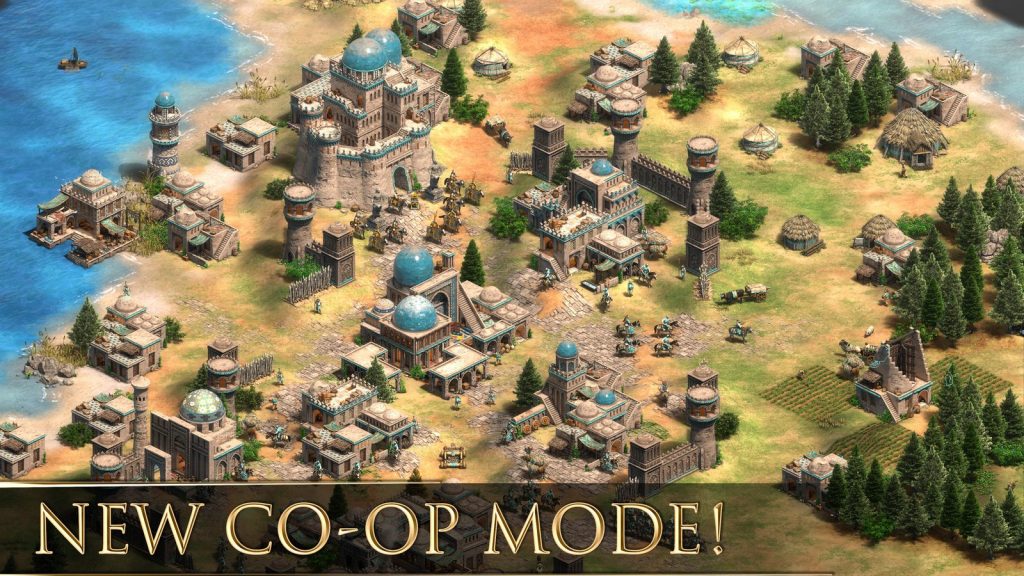
The Definitive Edition has well over 45 civilizations across the base game and its expansions, with more still being added, such as the Mapuche, Muisca and Tupi in The Last Chieftains expansion in February 2026. Each civilization has:
- Civilization bonuses, such as faster wood gathering or stronger cavalry.
- A team bonus that helps allies in team games.
- Unique units, such as the Teutonic Knight or the Mayan Plumed Archer.
- Unique technologies in the Castle and Imperial Ages.
- A tech tree that determines which generic units and upgrades are available.
For beginners, civilizations with straightforward bonuses are easiest. Franks, known for strong cavalry, and Britons, known for archers, are frequently recommended starting points because their strengths are easy to understand. Check the in-game tech tree and civilization overview before a match to see what your choice does well.
Campaigns, Skirmish and Ranked
There are several ways to play, and they teach different things.
Campaigns
The Definitive Edition contains a large number of historical campaigns, each rated for difficulty. The official site recommends the “Learn to Play with William Wallace” campaign as the place to start, since it teaches the basic skills step by step.
Skirmish against the AI
Single-player skirmishes let you play on random maps against AI opponents with difficulty from Easiest to Extreme. This is the best place to practice your build order and try different civilizations.
Multiplayer
Multiplayer includes ranked ladder matches, unranked Quick Play on competitive maps and settings, and custom games with friends. Many players spend time in Quick Play or custom games with friends before jumping into ranked.
Common Beginner Mistakes
- Idle Town Center. If it is not producing villagers in the early game, you are falling behind.
- Housed. Forgetting houses blocks production; build them before you hit the cap.
- Idle villagers. Use the idle villager button to find them quickly.
- Too much of one resource. If resources are piling up, spend them or move villagers.
- Ignoring upgrades. Economic upgrades at the Lumber Camp, Mill and Mining Camp are cheap and pay for themselves.
- Not scouting. Without information, you cannot build the right counters.
Where to Go From Here
Start with the tutorial campaign, then play skirmishes on a comfortable AI difficulty using the opening above. Once your Dark Age feels smooth, focus on reaching the Feudal Age efficiently and building a small army that counters what you scout. Age of Empires II is one of the cornerstones of the genre, and if you are curious how it fits into the bigger picture, our short history of real-time strategy traces its roots. Patience and repetition are the real secrets: every game makes the next one easier.