RTS vs 4X vs Grand Strategy: How the Strategy Subgenres Differ
A clear map of the strategy family: RTS, real-time and turn-based tactics, 4X, grand strategy and hybrids like Total War, compared side by side.
“Strategy game” covers an enormous range of experiences. One player’s idea of strategy is a tense twenty-minute match of StarCraft, where every second of hesitation costs units. Another’s is a weekend spent guiding a medieval dynasty through four hundred years of marriages and wars. Both are strategy games, yet they ask for completely different skills and moods.
This guide maps out the main branches of the strategy family: real-time strategy (RTS), real-time tactics (RTT), turn-based tactics (TBT), 4X, grand strategy and hybrids such as Total War. For each, you will find how time works, what scale you operate at, what a typical session feels like and which games represent it best. At the end there is a comparison table and a short guide to picking the subgenre that suits you.
Two Questions That Sort Every Strategy Game
Before looking at the labels, it helps to ask two simple questions about any strategy game.
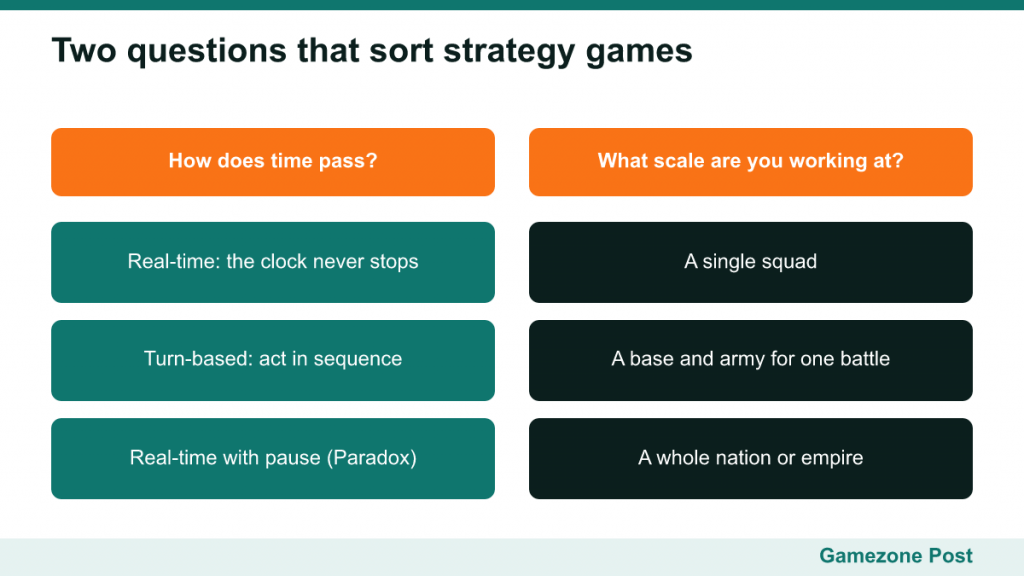
How does time pass? In a real-time game, the clock runs continuously and everyone acts at once. In a turn-based game, players act in sequence (or plan simultaneously and resolve together), and nothing happens while you think. A third model, real-time with pause, runs continuously but lets you stop the clock whenever you want to issue orders. It is the standard model in Paradox Interactive’s grand strategy games.
What scale are you working at? Some games put you in charge of a single squad, where each soldier’s position matters. Others have you running a base and an army for one battle. Still others hand you an entire nation or galactic empire for centuries. Scale determines what you manage: individual units, an economy, or a whole society with politics and diplomacy.
Most subgenres are simply a particular answer to those two questions.
Real-Time Strategy (RTS)
Real-time strategy is the genre most people picture when they hear “strategy game” from the 1990s and 2000s. The term itself was coined by Brett Sperry of Westwood Studios to market Dune II in the early 1990s, although earlier games such as Herzog Zwei (1989) already had many of its ingredients.
A classic RTS combines four activities that all happen at once:
- Resource gathering, usually with worker units harvesting materials from the map.
- Base building, placing structures that produce units and unlock technology.
- Unit production, limited by what you can afford and often by a population cap.
- Combat, commanding groups of units against an opponent doing the same thing.
Technology in an RTS is mostly tied to buildings: you construct one structure to unlock the next. Matches are short compared with other strategy genres, and success depends heavily on execution, meaning how quickly and accurately you can manage your economy and army at the same time. Landmark examples include Warcraft: Orcs & Humans (1994), Command & Conquer (1995), Age of Empires (1997), Total Annihilation (1997), StarCraft (1998) and Warcraft III (2002).
Not every RTS follows the classic formula. Company of Heroes (2006) replaced worker-based harvesting with capturable control points, which pushes players to fight over the map rather than defend a mining line.
Best for: players who enjoy fast decisions, multitasking and direct head-to-head competition.
Real-Time Tactics and Turn-Based Tactics
Tactics games zoom in. Instead of running an economy, you command a limited force, often a few squads or individual soldiers, and win through positioning, terrain and timing.
Real-Time Tactics (RTT)
Real-time tactics games usually drop resource gathering, base building and unit production. You work with the forces you are given and focus on formations, terrain and the strengths of each unit. Well-known examples include the Close Combat series (from 1995), Myth: The Fallen Lords (1997), the stealth-focused Commandos series (from 1998) and Men of War (2009). The real-time battles in Total War also work on RTT principles.
Turn-Based Tactics (TBT)
Turn-based tactics games keep the small scale but remove time pressure. Each unit moves and acts on your turn, and terrain features such as elevation, cover and line of sight carry real weight. Many TBT games keep your squad between missions so soldiers gain experience, which creates a strong attachment to individual units. The genre grew out of tabletop tactical and miniature wargaming. The X-COM series, Jagged Alliance 2, the Steel Panthers games and tactical role-playing games such as Final Fantasy Tactics all belong to this tradition, and some of them add a strategic layer that runs between battles.
Best for: players who like puzzles, careful planning and caring about individual units more than big armies.
4X
4X stands for explore, expand, exploit and exterminate. The term was coined by Alan Emrich in a 1993 preview of Master of Orion, and it describes empire-building games that start small on an unknown map and grow over a long session. We explain the genre in detail in What Is a 4X Game?, but the key traits are:
- A large technology tree, where research rather than buildings is the main gate to progress.
- Multiple victory conditions, such as conquest, science, culture or diplomacy.
- Usually symmetric starts: every faction begins as a small, roughly equal power, with distinct bonuses.
- Mostly turn-based play, although real-time 4X games exist.
Typical examples are the Civilization series, Master of Orion, Endless Space and Stellaris. Sessions are long, and a single game can stretch across many sittings.
Best for: players who enjoy steady growth, long-term planning and having several ways to win.
Grand Strategy
Grand strategy games operate at the level of whole states. You control a nation or empire and manage its economy, military, diplomacy and often its internal politics. Combat is usually abstracted rather than fought out unit by unit. Paradox Interactive is the best-known developer here, with Europa Universalis, Hearts of Iron, Crusader Kings, Victoria and Stellaris, and its games use real-time with pause.
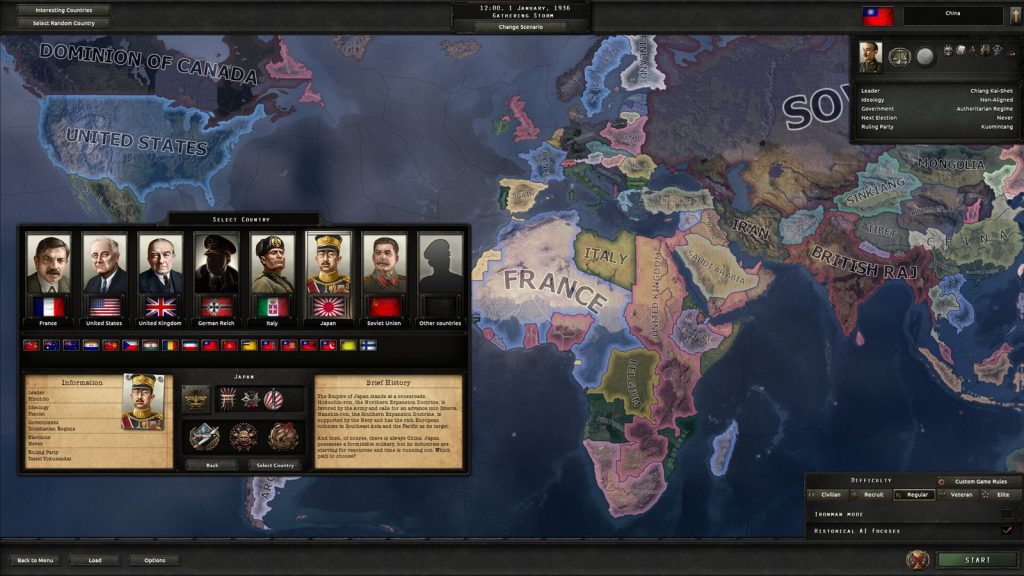
Grand strategy overlaps heavily with 4X, but two differences are usually highlighted:
- Asymmetry and history. You typically start as a real historical country with its actual borders, resources and neighbors. A small duchy and a great empire face very different games.
- Time limits instead of victory screens. Many grand strategy games run between fixed start and end dates without hard victory conditions. You set your own goals, whether that is uniting a region, surviving a war or building the richest economy.
The result is something closer to a historical sandbox than a race. Sessions can be very long, but saving and returning is part of the normal rhythm.
Best for: players who love history, emergent stories and complex systems, and who do not need the game to tell them when they have won.
Hybrids: Total War and Beyond
Some of the most popular strategy series refuse to sit in one category. The clearest example is Creative Assembly’s Total War series, which began with Shogun: Total War in 2000. Each game combines a turn-based campaign map, where you manage settlements, economy, diplomacy and armies, with real-time battles where formations, flanking and terrain decide the outcome. In other words, the campaign feels like a 4X or grand strategy game while the battles play like real-time tactics.
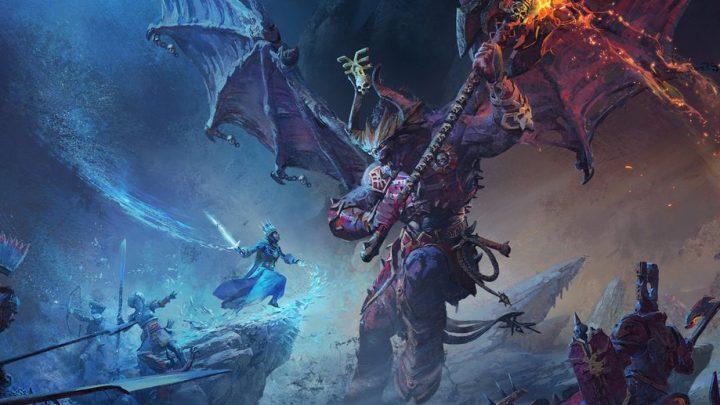
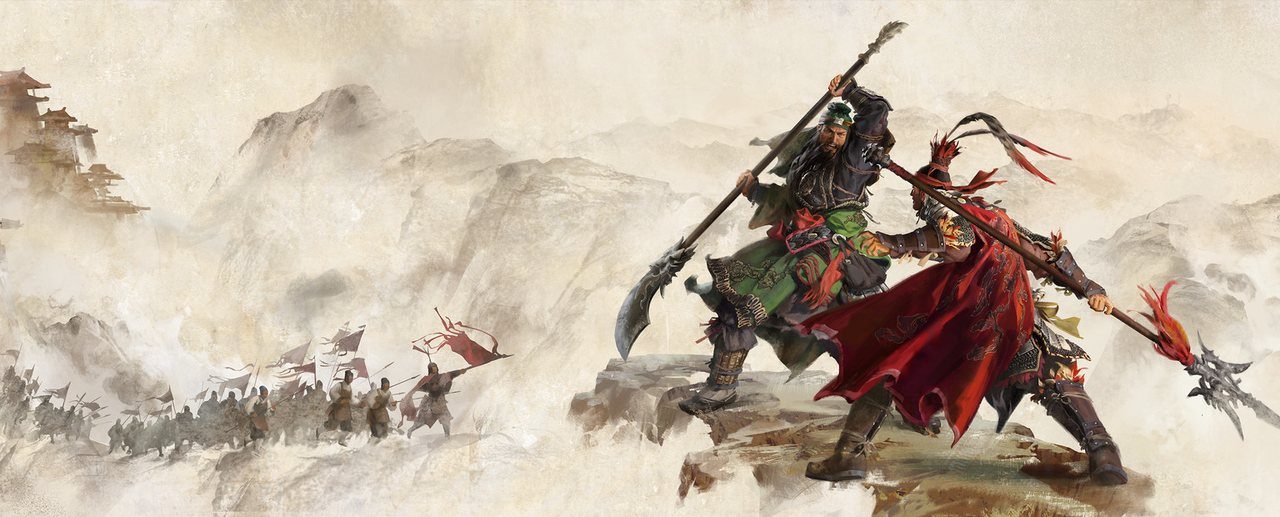
The series includes historical entries such as Rome: Total War (2004), Total War: Shogun 2 (2011) and Total War: Three Kingdoms (2019); the fantasy Total War: Warhammer trilogy (2016, 2017 and 2022); and narrower “Saga” spin-offs like Thrones of Britannia (2018) and Troy (2020).
Other hybrids mix genres in different ways. Stellaris blends 4X structure with Paradox’s grand strategy systems. Some tactics games, like the X-COM tradition, wrap their turn-based battles in a real-time strategic layer. When a game seems hard to classify, it is usually because it borrows its campaign from one subgenre and its battles from another.
Side-by-Side Comparison
| Subgenre | Time model | Scale | Typical session | Representative games |
|---|---|---|---|---|
| RTS | Real time | One battle: base, economy and army | Short single matches | StarCraft, Age of Empires, Command & Conquer, Company of Heroes |
| Real-time tactics | Real time | Fixed squads or regiments, no base | Short missions | Close Combat, Myth, Commandos, Men of War |
| Turn-based tactics | Turns | Small squads, individual soldiers | Missions within a longer campaign | X-COM series, Jagged Alliance 2, Steel Panthers |
| 4X | Mostly turns (some real time) | Empire growing from a single start | Long games over many sittings | Civilization, Master of Orion, Endless Space |
| Grand strategy | Real time with pause | Historical nations or dynasties | Very long campaigns between fixed dates | Europa Universalis, Crusader Kings, Hearts of Iron, Victoria |
| Hybrid (Total War) | Turn-based campaign, real-time battles | Empire plus battlefield command | Long campaigns with optional short battles | Total War series |
Which Subgenre Should You Try?
Rather than starting from game titles, start from how you like to play.
If you want quick, competitive sessions
Pick an RTS. Matches have clear beginnings and ends, and the skill ceiling is high. Most modern RTS games include campaigns and skirmishes against the AI, so you can learn without facing other people straight away.
If you like to think without a clock
Choose turn-based tactics or a turn-based 4X. You can take as long as you need on every move, which makes these genres ideal for players who enjoy planning more than reflexes.
If you love building something over time
Try a 4X game. Watching a single settlement grow into an empire is the genre’s core pleasure, and multiple victory types mean peaceful players are not forced into constant war.
If you love history and stories
Go for grand strategy. These games generate memorable narratives from their systems: unlikely alliances, succession crises, collapsing empires. They are also the most complex, so expect a learning curve and lean on tutorials.
If you want spectacle and planning together
Total War is the natural fit. You get the long-term planning of a campaign and the satisfaction of personally leading armies on the battlefield, and you can auto-resolve the fights you do not want to play.
Common Misconceptions
- “Real time means action game.” Not really. In real-time-with-pause grand strategy, the pace can be as relaxed as a turn-based game.
- “4X and grand strategy are the same thing.” They overlap, but symmetric starts and victory conditions push 4X toward a contest, while historical asymmetry and fixed dates push grand strategy toward a sandbox.
- “Tactics and strategy are interchangeable words.” In game terms, tactics refers to how you fight a single engagement; strategy covers economy, production and long-term goals. Many games include both layers.
Once you know which questions to ask, time model and scale, the strategy family becomes much easier to navigate. Most players end up enjoying more than one branch, often starting in one subgenre and discovering that its neighbor scratches a slightly different itch.