How Total War Works: Turn-Based Campaigns and Real-Time Battles
How Creative Assembly's Total War blends a turn-based campaign map with real-time battles: settlements, armies, generals, morale, terrain and auto-resolve.
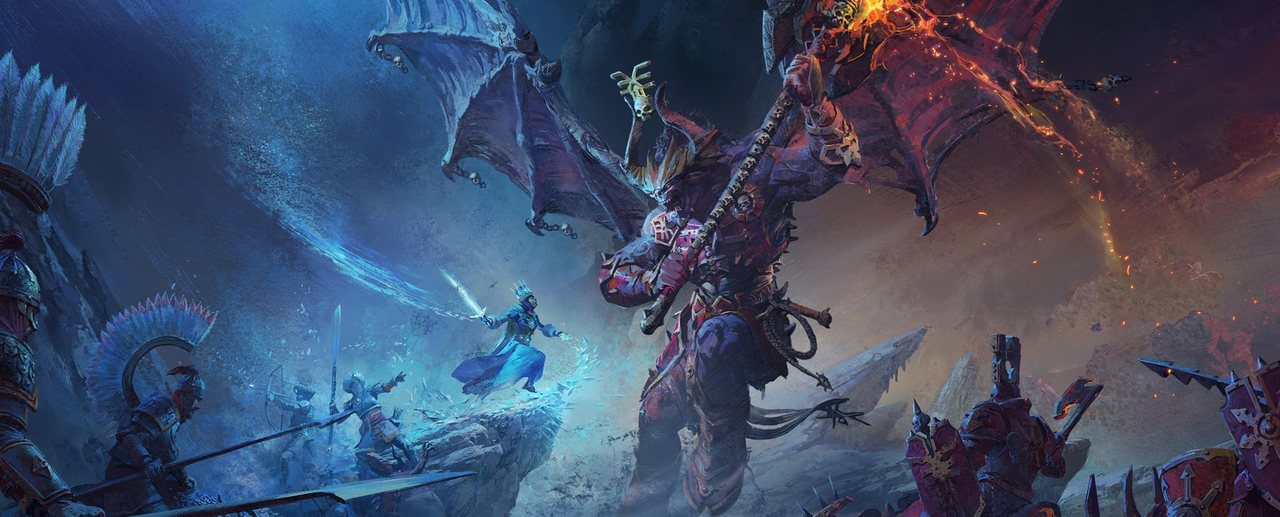
Total War is one of the few strategy series that refuses to choose between two kinds of game. On the campaign map, it plays like a turn-based empire builder: you manage settlements, raise taxes, recruit armies and negotiate with neighbors. When two armies meet, the game zooms down to the battlefield and becomes a real-time tactics game, with thousands of soldiers fighting under your command. Understanding how those two halves connect is the key to enjoying the series.
This explainer covers the campaign layer, the battle layer, how they feed each other, how auto-resolve fits in, and how the historical, Warhammer and Saga entries differ. For a wider look at where Total War sits among strategy subgenres, see our guide to RTS vs 4X vs grand strategy.
A Quick Overview of the Series
Total War is developed by British studio Creative Assembly and has been published by Sega since 2005. It began with Shogun: Total War in 2000. Main entries since then include:
- Historical: Medieval: Total War (2002), Rome: Total War (2004), Medieval II: Total War (2006), Empire: Total War (2009), Napoleon: Total War (2010), Total War: Shogun 2 (2011), Total War: Rome II (2013), Total War: Attila (2015), Total War: Three Kingdoms (2019) and Total War: Pharaoh (2023).
- Fantasy: the Total War: Warhammer trilogy (2016, 2017 and 2022).
- Saga: narrower spin-offs focused on a single region and moment, such as Thrones of Britannia (2018) and Troy (2020).
In December 2025, Creative Assembly announced two further projects in early development, Total War: Medieval III and Total War: Warhammer 40,000, with no release dates given at the time of writing.
The Campaign Map: Turn-Based Empire Building
The campaign is where you spend most of your planning time. Each turn, you move armies and characters across a large strategic map, manage your settlements, conduct diplomacy and end your turn so that AI factions can act.
Settlements and provinces
Your faction controls territory by holding settlements. In Rome: Total War, for example, you took settlements by besieging them or by bribing them to change sides. Settlements are grouped into regions or provinces, depending on the game, and each one can be developed with buildings.
Economy and public order
Buildings provide income, recruitment options, growth and other effects. Taxes bring in money, but heavy taxes and poor conditions make people unhappy. Rome: Total War, for instance, modeled squalor (reduced by aqueducts), and unhappy cities could revolt. Later games use different names and systems, but the principle remains: an empire needs a healthy economy and stable regions to support its armies.
Characters, generals and agents
Armies are led by characters. In Rome: Total War, adult male family members could govern settlements or lead armies, gained traits over time and eventually died of old age, battle, assassination or disease. Warhammer games use named lords and heroes with skill trees. Three Kingdoms introduced “guanxi,” a system of relationships between characters, each with personality traits and desires.
Many entries also feature agents, such as Rome’s spies, assassins and diplomats, who gather information, sabotage enemies and negotiate deals.
Diplomacy
Through diplomacy, you can form alliances, trade agreements and non-aggression pacts, demand tribute or declare war. A strong diplomatic position lets you focus your armies on one front at a time.
The Battlefield: Real-Time Tactics
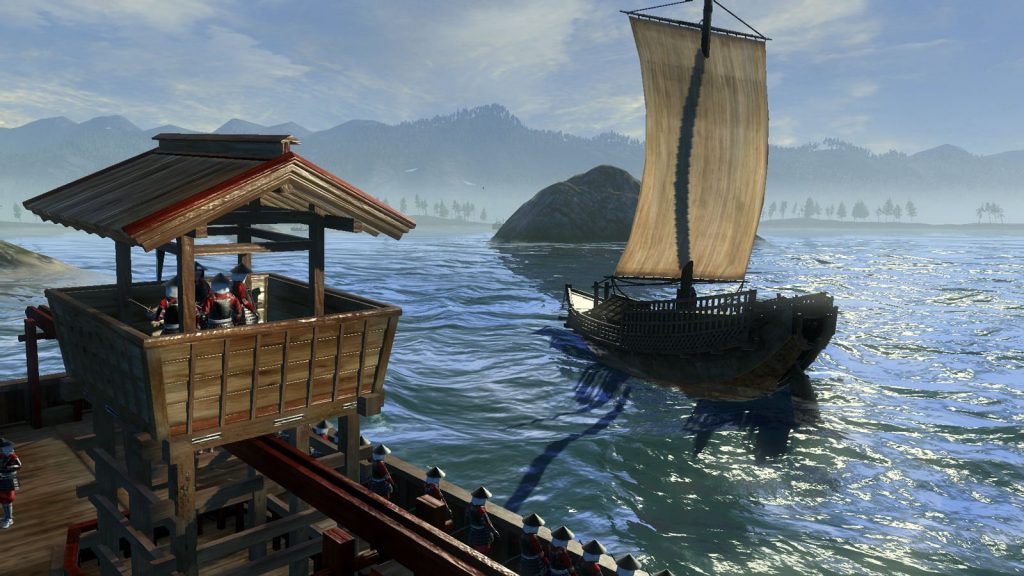
When armies meet, you can fight the battle yourself. The view moves to a 3D battlefield based on where the armies met on the campaign map, and you command each unit in real time.
Units and formations
Battles are fought with units, regiments of many soldiers that move and fight together. Infantry, missile troops, cavalry and artillery each have strengths and weaknesses. Formations matter: Rome’s phalanx and testudo traded mobility for defense, and line formations, flanks and reserves are the backbone of good play throughout the series.
Morale
Morale is arguably the most important stat in Total War. Each unit has morale, and when it drops too low, the unit flees. Morale falls from heavy casualties, being flanked or attacked from the rear, seeing allies rout or losing the general. In practice, most battles are won by breaking the enemy’s will rather than killing every soldier.
Flanking
Wikipedia’s overview of the series notes that flanking maneuvers and formations factor heavily into gameplay. Attacking a unit from the side or rear deals more damage and causes a sharp morale drop. The classic “hammer and anvil” uses infantry to pin the enemy line (the anvil) while cavalry swings around to strike its rear (the hammer).
Terrain
Terrain shapes every fight. High ground helps missile units and defenders, forests can hide troops for ambushes, and rivers and bridges create chokepoints. Choosing where to fight on the campaign map affects the battle you get.
Sieges
Attacking a walled settlement is a special kind of battle. You need siege equipment or a long blockade, and defenders gain a big advantage from walls and towers. In Three Kingdoms, for example, a siege is won when all hostile generals are killed or the city’s central point is captured.
How Total War battles differ from a classic RTS
Although battles happen in real time, they are not a classic real-time strategy match. There is no base to build and no workers to manage: you fight with the army you brought from the campaign map. That makes Total War battles closer to real-time tactics. The skills that matter are positioning, timing and reading morale rather than the economic multitasking described in our guide to RTS fundamentals. A typical battle has a recognizable rhythm: deployment, where you place units before the fight; an approach, where missile units trade fire; the main clash of infantry lines; and the decisive moment, when a flank collapses and routing spreads. Recognizing which phase you are in tells you where to direct your attention.
How the Two Halves Connect
The campaign and battles constantly feed each other:
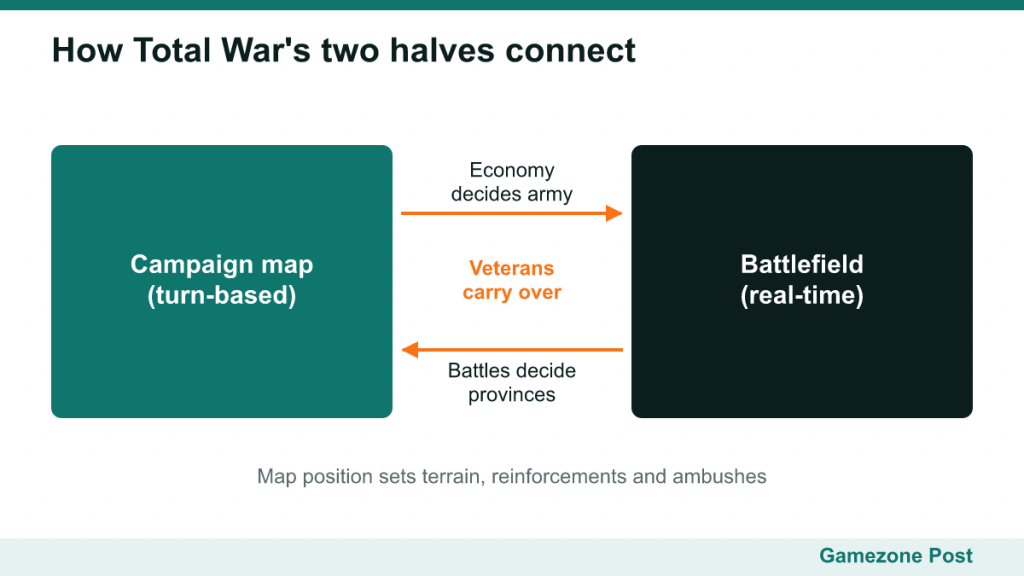
- Your economy decides your army. Better buildings unlock better units; more income lets you field more of them.
- Battles decide the campaign. A decisive victory can destroy an enemy army and open the way to their settlements, while a defeat can cost you a province.
- Experience carries over. Units and generals that survive battles gain experience, making veteran armies valuable.
- Positioning on the campaign map determines terrain, reinforcements and whether you are ambushed.
This is what makes Total War distinctive. A clever campaign can let you win battles before they start, and a brilliant battlefield commander can rescue a weak strategic position.
Auto-Resolve: When You Do Not Want to Fight
Not every battle needs to be played by hand. Total War lets you auto-resolve a battle, and the game calculates the outcome from the strength of the armies involved instead of simulating the fight on screen. The pre-battle screen gives an indication of how the sides compare.
Auto-resolve is ideal for one-sided fights, such as a full army against a small rebel force, and saves a lot of time over a long campaign. Players widely report that it works less well in closer battles, since a human commander can use terrain, flanking and focus fire in ways a calculation does not capture, and that it can value some unit types very differently from manual play. A common habit is to auto-resolve easy fights and play close or important battles yourself.
Historical vs Warhammer vs Saga
Historical entries
Historical Total War games focus on armies that resemble each other: infantry, cavalry and missile troops, with differences coming from culture, equipment and era. Empire and Napoleon added gunpowder line infantry and naval battles, while Three Kingdoms offered a choice between a Romance mode, where generals have near-superhuman strength, and a Records mode with a more historical approach.
Warhammer trilogy
Total War: Warhammer pairs real-time battles with turn-based sandbox campaigns set in Games Workshop’s fantasy world. Factions are dramatically asymmetric, with monsters, flying units, magic and powerful heroes. Warhammer III, released February 17, 2022, features factions such as Grand Cathay, Kislev and the forces of Chaos, and owners of all three games can play the combined Immortal Empires map.
Saga entries
“A Total War Saga” is a sub-brand for smaller, focused games. Thrones of Britannia is set in 878 AD during the Viking invasions of the British Isles, and Troy was the first Total War game set in the Bronze Age. The Fall of the Samurai expansion for Shogun 2 was retroactively given the Saga name.
Tips for New Players
- Start with the tutorial or prologue. Most recent entries teach both layers step by step.
- Keep your army balanced. A mix of infantry, missile units and cavalry or monsters handles most situations.
- Protect your general. Losing them hurts morale across the army.
- Use the pause. Single-player battles can be paused or slowed down to give orders.
- Watch your economy. Overspending on armies is a classic early mistake that leads to debt and unrest.
- Do not fight every battle manually. Save your attention for the ones that matter.
Total War rewards players who enjoy both thinking ahead and commanding in the moment. Learn how morale, flanking and terrain decide battles, and how economy and positioning set them up, and the series’ blend of empire building and battlefield spectacle quickly becomes hard to put down.