Factory and Automation Games Explained: Factorio, Satisfactory and the Logistics Loop
What makes a factory-builder tick: extraction, belts, ratios and bottlenecks, plus how Factorio, Satisfactory, Dyson Sphere Program and shapez differ.
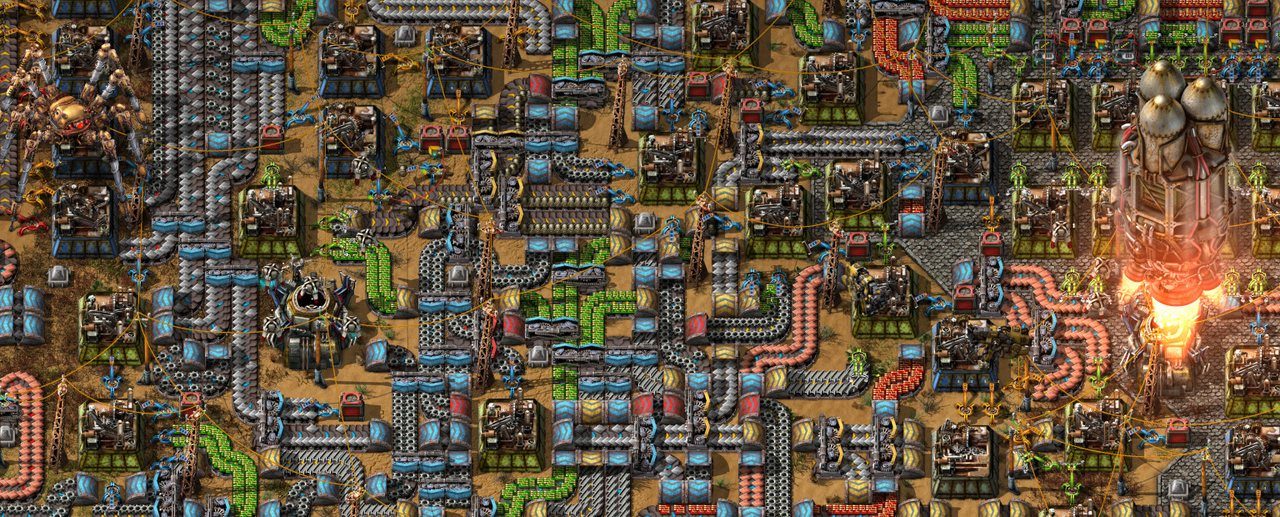
Factory and automation games start with something simple: you mine a few rocks by hand. A few hours later you’re staring at a sprawling machine of belts, pipes and assemblers that turns raw ore into rockets, and you’re already planning how to make it twice as big. The community catchphrase “the factory must grow” captures the appeal. These games are about building systems that run themselves, finding where they break, and fixing them.
This explainer covers what defines the genre, the core loop every factory game shares, and the concepts that trip up newcomers, especially ratios and bottlenecks. It then compares four of the best-known games: Factorio, Satisfactory, Dyson Sphere Program and shapez. If you’re coming from management sims, our explainer on what makes a management or tycoon game shows where factory builders sit in that wider family.
What defines a factory-builder
A factory game is a builder where the main thing you produce is a production system, not a city or a park. Most share these traits:
- Resource extraction: mining drills, pumps or extractors placed on finite or infinite nodes.
- Processing chains: raw materials are smelted, refined and combined into intermediate products, which feed into more complex ones.
- Logistics: belts, pipes, trains, drones or vehicles move items between machines.
- Automation: once built, the chain runs without your input. Your job shifts from crafting to designing.
- Progression by research or milestones: new machines and recipes unlock as you deliver goods, usually toward a long-term goal like launching a rocket.
- Power: machines need energy, so a power grid is its own production chain.
Unlike tycoon games, there’s usually no money, no customers and no market. The “economy” is purely physical: items, throughput and space.
The logistics loop
Almost every session follows the same rhythm:
- Identify a goal. You need a new product, often for research or a milestone.
- Trace the recipe. Work out which inputs it needs and where they come from.
- Build the chain. Place extractors, processing machines and the logistics between them.
- Watch it run. Find where items pile up or run short.
- Fix and scale. Remove the bottleneck, add capacity, then start again with a bigger goal.
The pleasure comes from steps four and five. A well-designed factory is satisfying to watch, and a broken one is a puzzle you created yourself.
Ratios, throughput and bottlenecks
These three ideas are the heart of the genre, and understanding them early saves hours of frustration.
Ratios
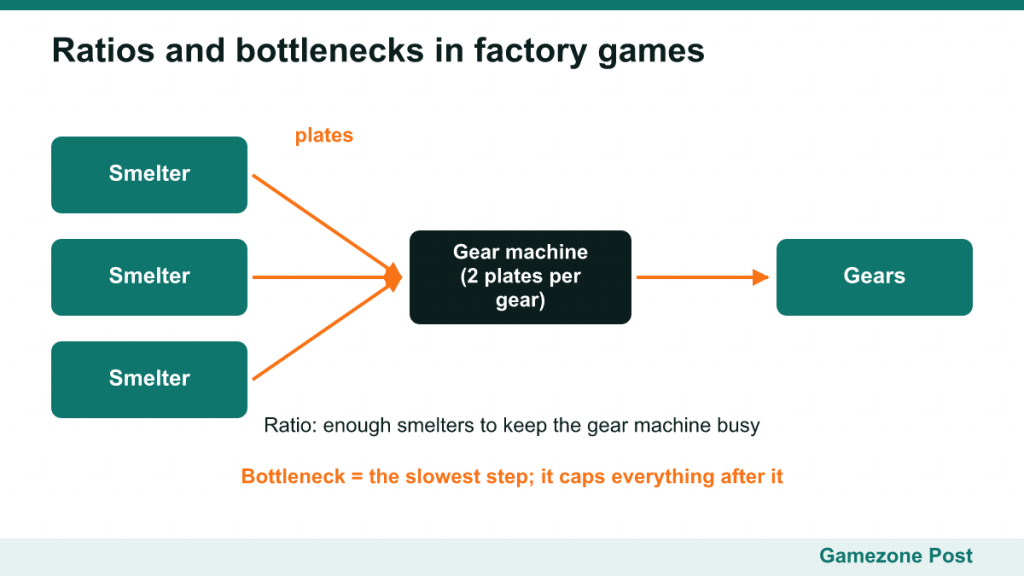
Machines take a fixed time to craft a recipe, and recipes need fixed amounts of input. If one machine makes a component faster than the next machine consumes it, items back up. If it’s slower, the next machine sits idle. A ratio is the number of each machine type needed so production and consumption match.
A simplified example: a gear machine needs two plates per gear, and a smelter produces plates at half the rate the gear machine wants them. In that case you need several smelters per gear machine to keep it fully busy. Real games involve many more steps, which is why players use in-game stats, calculators and community-made planners.
Throughput
Every logistics link has a capacity. A belt carries a limited number of items per second, a pipe a limited flow, and a train a limited cargo per trip. When you scale up, the transport method often becomes the limit before the machines do. That’s why factory games add faster belts, bigger pipes or trains as you progress.
Bottlenecks
A bottleneck is the single slowest step in a chain, and it caps the output of everything after it. Signs include:
- A belt that’s full and stationary before a machine (too much input, or the machine is too slow).
- A machine that’s idle with an empty input (starved upstream).
- Power flickering or machines working slowly (power shortage).
Fixing the bottleneck often reveals the next one. That’s normal; it’s the core loop working as intended.
Common design approaches
- Spaghetti: building wherever there’s room and connecting things as you go. Fast early, messy later, and a rite of passage.
- Main bus: running parallel lanes of key materials through the base so new production lines can branch off. Popular in Factorio.
- Modular blocks: self-contained production cells that take in raw inputs and output one product, often connected by trains or drones.
- Centralized vs distributed: some players bring all resources to a central factory, others build specialized outposts near resources and ship the products.
There’s no single correct design. A good rule is to leave space. Nearly every new player boxes in a production line and later has to tear it apart to expand.
Factorio: the genre-defining classic
Factorio is developed by Wube Software, a studio in Prague. It entered Steam early access on 25 February 2016 and reached version 1.0 on 14 August 2020. You crash-land on an alien planet and must automate mining, processing and assembly, researching from basic automation through oil refining and robotics to a rocket launch, which wins the base game.
Two things set Factorio apart. First, it’s top-down and 2D, so you can see and plan your factory at a glance. Second, it has enemies: native creatures attack, and their aggression rises with the pollution your factory produces. Defending outposts with turrets and walls adds pressure that pure building games lack (it can be reduced or turned off in settings).
The Space Age expansion, released on 21 October 2024 alongside a free 2.0 update for the base game, adds space platforms and four new planets: volcanic Vulcanus, lightning-swept Fulgora, the jungle world Gleba and frozen Aquilo. Each planet has its own resource logic. A Nintendo Switch version arrived in October 2022.
Best for: players who love optimization, deep logistics (including trains and logic circuits) and a challenge.
Satisfactory: building in first person
Satisfactory is developed by Coffee Stain Studios. It launched in early access on 19 March 2019 and reached its 1.0 release on 10 September 2024 on PC. You play a “Pioneer” sent by the FICSIT corporation to build factories on an alien planet. Progress runs through tiers and the Space Elevator, which takes shipments of parts to unlock further phases.
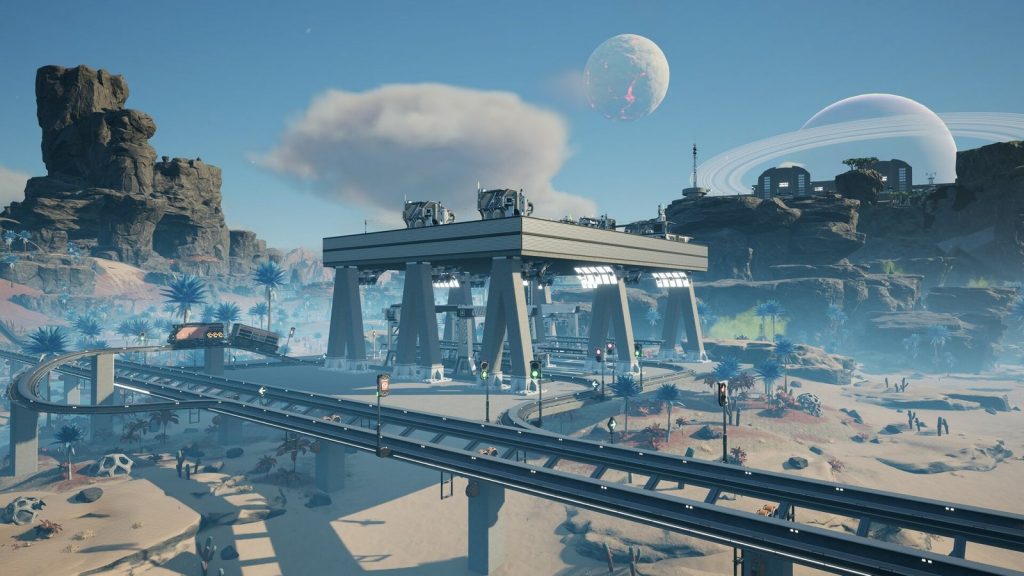
The big difference is perspective. Satisfactory is played in first person in a 3D world. Factories stack vertically and stretch across hand-crafted biomes, and building them feels closer to construction than planning. The world is also meant to be explored, with resources and collectibles spread across it. It supports cooperative multiplayer, and creatures are present but combat is a smaller part than in Factorio.
Best for: players who want scale, visual spectacle and a sense of place, and who enjoy building aesthetically as well as efficiently.
Dyson Sphere Program: interstellar logistics
Dyson Sphere Program is made by Youthcat Studio in Chongqing, China, and published by Gamera Games. It entered early access on 21 January 2021. You control a mech called Icarus, building factories on one planet, then expanding across a star cluster. Drones and logistics vessels move goods between planets and systems, and the long-term goal is to build a Dyson sphere around a star to harvest its energy.
Its signature is scale across planets. Where Factorio and Satisfactory concentrate on one world, DSP makes interplanetary and interstellar logistics central. A combat layer arrived in December 2023 with the “Rise of the Dark Fog” update.
Best for: players who want a space setting and enjoy the jump from planetary to interstellar logistics.
shapez and shapez 2: pure, relaxed automation
shapez, from German indie studio tobspr Games, strips the genre to its abstract core. There are no ores or enemies; you extract basic shapes and colors, then cut, rotate, stack and paint them to match ever more complex target shapes delivered to a central hub. Buildings are free, so the only limits are space and design.
The original 2D shapez was followed by shapez 2, which moved to 3D with multi-layer building. It entered early access on 15 August 2024 and reached its full release on 23 April 2026. Reviewers have praised its calm, zen-like atmosphere.
Best for: beginners, puzzle fans and anyone who wants the logic of automation without combat or resource pressure.
Comparison at a glance
| Game | View | Combat | Main twist | Difficulty curve |
|---|---|---|---|---|
| Factorio | 2D top-down | Yes (adjustable) | Pollution-driven enemies, trains, circuits | Steep, very deep |
| Satisfactory | 3D first-person | Light | Vertical building, exploration | Moderate |
| Dyson Sphere Program | 3D third-person | Dark Fog (added 2023) | Interplanetary logistics | Moderate to steep |
| shapez / shapez 2 | 2D / 3D top-down | None | Abstract shape processing | Gentle start |
Tips for your first factory
- Automate early. Hand-crafting is a trap. Automate basic intermediate products as soon as you can.
- Leave room. Space between production lines is cheap now and expensive later.
- Label and organize. Use signs, colors or consistent layouts so you remember what each line does.
- Read the stats. All four games show production and consumption rates. Use them instead of guessing.
- Don’t chase perfection. A messy factory that works teaches more than a perfect plan that never gets built. Rebuilding with what you’ve learned is part of the fun.
- Watch your power. Many “broken” factories are simply underpowered.
Why the genre is so absorbing
Factory games combine the satisfaction of a puzzle with the open-endedness of a sandbox. There’s always a next bottleneck, a bigger goal or a cleaner layout to try. They also teach a way of thinking: breaking big problems into chains, measuring flow and fixing the slowest link first. If you enjoy the planning side of city builders, the same systems thinking applies. Our primer on city builder basics shows how it carries over to managing a whole city.