What Is a 4X Game? Explore, Expand, Exploit and Exterminate Explained
What "4X" means, where the term came from, and how Civilization, Master of Orion, Stellaris and Endless Space turn four verbs into a genre.

Few genre labels are as compact, or as quietly confusing, as “4X.” Strategy players use it every day to describe games like Civilization or Stellaris, yet the name itself does not say “strategy,” “empire” or “turn-based.” It is shorthand for four verbs: explore, expand, exploit and exterminate. Those four words describe the arc of nearly every match in the genre, from a single settler on an unknown map to a sprawling empire racing an opponent for victory.
This explainer covers where the term came from, what each of the four Xs means in practice, the systems almost every 4X game shares, and how the genre differs from its close relatives such as real-time strategy and grand strategy.
Where the Term “4X” Came From
The label is usually credited to game writer Alan Emrich. In a September 1993 preview of Master of Orion for Computer Gaming World, he rated the game “XXXX,” a tongue-in-cheek nod to the adult-film rating, and explained that the four Xs stood for “EXplore, EXpand, EXploit and EXterminate.” The phrase stuck, and within a short time other writers and players applied it to similar games.
The games themselves are older than the name. Space strategy titles such as Reach for the Stars, Andromeda Conquest and Cosmic Balance II, all from 1983, are now considered early 4X games. Reach for the Stars is often singled out for linking economic growth, technology and conquest in a way later games built on. Sid Meier’s Civilization (1991) then popularized the level of depth that came to define the genre, and Master of Orion, designed by Steve Barcia at Simtex and published by MicroProse in 1993, became the classic that space 4X games are still compared to.
So “4X” is a description applied after the fact. It named a design pattern that already existed, and it has stayed useful because that pattern is so recognizable.
The Four Xs, One by One
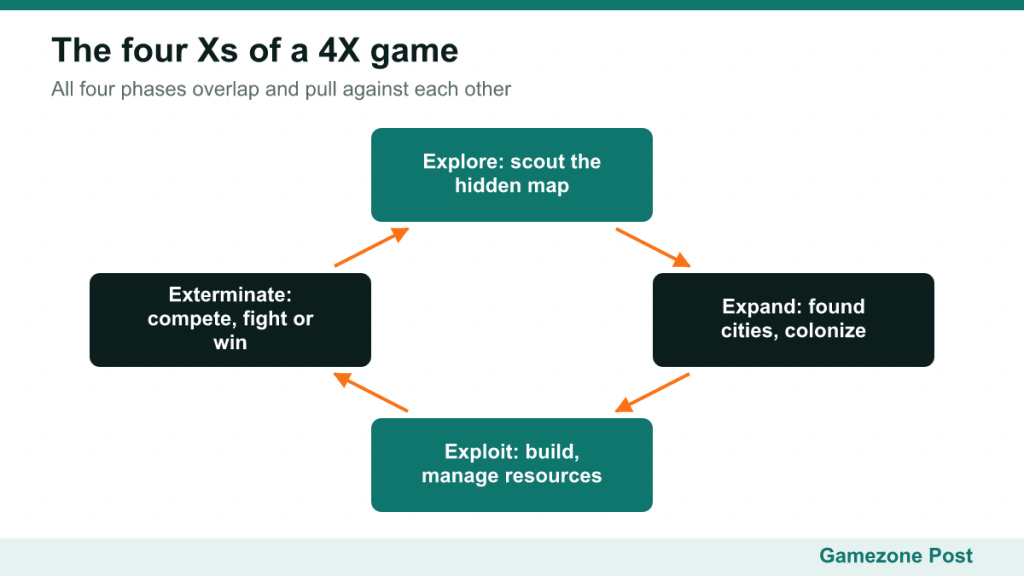
Each X maps roughly to a phase of play, although in a good 4X game all four overlap and pull against each other.
Explore
Almost every 4X match starts with an unknown map. In Civilization, the world is hidden under fog until your scouts or settlers reveal it. In Master of Orion and Stellaris, you send ships to survey star systems. Exploration is about information: where the good land or planets are, where rivals are located, and which natural chokepoints or resources matter. Early scouting decisions shape everything that follows, because you cannot plan expansion around territory you have never seen.
Expand
Once you know what is out there, you claim it. Expansion means founding new cities, colonizing planets or building outposts. It is the main way to grow your economy, because more territory means more resources, more production and more research. Most 4X games also put brakes on expansion so that “found as many cities as possible” is not automatically correct. Those brakes include growing costs for new settlements, happiness or stability penalties for large empires, and the simple risk of spreading your defenses thin.
Exploit
Exploitation is economic management. You develop the land and planets you hold: building improvements, assigning population to jobs, choosing what each city produces, and balancing several resources at once. In Endless Space, Amplitude Studios built the whole economy around four core resources known by the initials FIDS: Food, Industry, Dust and Science. Civilization uses food, production, gold, science, culture and faith (depending on the edition). This is the part of a 4X game where long-term planning pays off, and where much of a typical session’s time goes.
Exterminate
Finally, conflict. Sooner or later your borders touch someone else’s, and the game offers military tools to deal with it: unit production, fleets, ship design, sieges and invasions. “Exterminate” sounds absolute, but in most modern 4X games war is only one option. Diplomacy, trade, alliances and alternative victory conditions let you win without destroying anybody. The word is better read as “compete”: every 4X game ends with one side ahead of the others.
Systems Almost Every 4X Game Shares
Beyond the four verbs, the genre has a set of shared building blocks. Recognizing them makes it much easier to pick up a new 4X game, because the controls change but the underlying ideas rarely do.
Technology Trees
Research is central to the genre, and 4X tech trees tend to be larger than those in other strategy games. A tech tree is a web of discoveries where each one unlocks new buildings, units, abilities or further research. An important distinction from real-time strategy is how progress is gated. In a 4X game the main requirement for an advanced technology is usually earlier technology. In a typical RTS, progress comes from constructing buildings that unlock more advanced buildings and units.
Master of Orion split research into six separate fields, such as Computers, Construction and Weapons, and let you spread investment across them. Civilization uses a single connected tree (with a second tree for civics in the later games). Stellaris shows you a small random selection of available research options rather than the whole tree, which makes each playthrough’s progress a bit different.
Victory Conditions
Most 4X games offer several ways to win, typically including conquest, a technology or science victory, a cultural victory and a diplomatic victory. Master of Orion let you win by eliminating every rival or by winning a vote of the galactic council for peaceful unification. Endless Space lists economic, diplomatic, expansionary and supremacy victories, among others. Multiple victory types matter because they give peaceful and aggressive players different routes, and they force you to watch what your rivals are working toward, not just how big their armies are.
Turn Structure and Time
The first computer 4X games were turn-based, and that remains the most common model. In a turn-based 4X, each player issues orders for their cities and units and then ends the turn, after which the game resolves movement, production and combat. Some games use simultaneous turns in multiplayer to reduce waiting.
Real-time 4X games exist too. Sins of a Solar Empire (2008) was marketed as “RT4X,” and earlier examples include Imperium Galactica and Sword of the Stars. Paradox Interactive’s Stellaris (2016) runs in real time with pause: the clock moves continuously, but you can stop it at any moment to give orders. Paradox describes it as a grand strategy game, yet it carries so many 4X traits that players commonly count it in both camps.
Asymmetric Factions
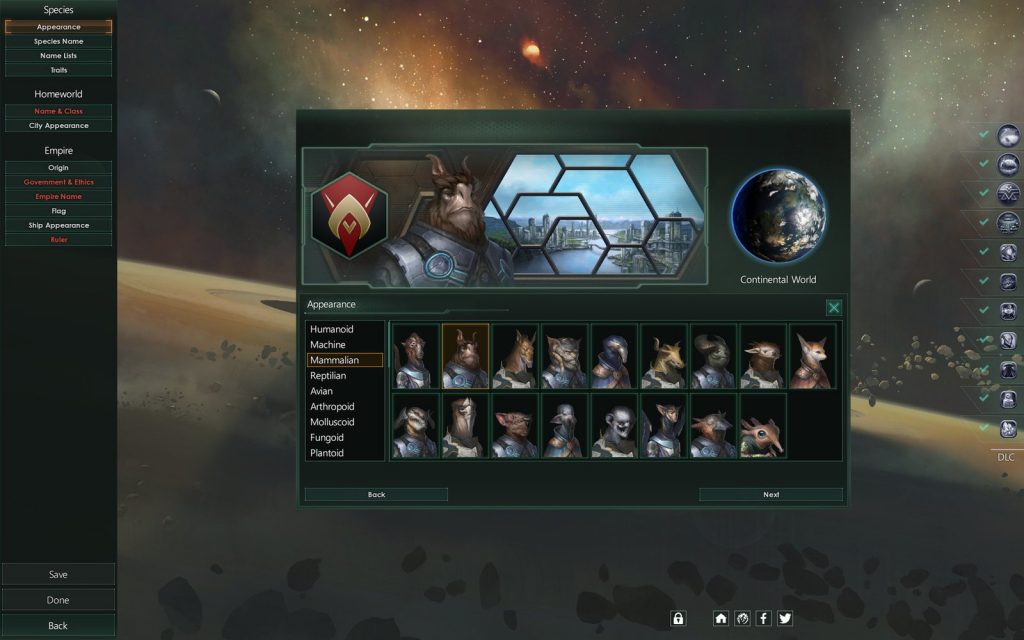
Players usually choose a civilization, race or faction, and each one comes with distinct bonuses. Master of Orion had ten playable races, with humans strong at trade and diplomacy and the Bulrathi excellent at ground combat. Civilization gives each civilization unique abilities, units or buildings. Stellaris goes further and lets you design a species and government from traits, ethics and civics. These differences encourage replaying the same map with a different plan.
Four Games That Show the Genre’s Range
Looking at a few well-known series shows how much variety fits under one label.
| Game | Setting | Time model | What stands out |
|---|---|---|---|
| Civilization series (1991 onward) | Human history on a hidden world map | Turn-based | Multiple victory types, tile-based cities and a broad historical sweep |
| Master of Orion (1993) | Galaxy of star systems | Turn-based | Ten races, ship design, six research fields, galactic council vote |
| Endless Space (2012) and Endless Space 2 (2017) | Science-fiction galaxy | Turn-based campaign with semi-automated battles | FIDS resource economy, heroes, strongly asymmetric factions |
| Stellaris (2016) | Procedurally generated galaxy | Real-time with pause | Custom species and governments, events, mid- and late-game crises |
Civilization is the most approachable entry point for many players because its historical setting is familiar. Space 4X games like Master of Orion and Endless Space add ship design and interstellar logistics. Stellaris blends 4X with narrative events and grand strategy-style real-time play. All four still revolve around the same arc: scout, settle, build up and outcompete.
The Genre’s Common Problems
4X games are famous for long sessions. Turn-based games often run for hundreds of turns, and a single match can take many hours. That length brings well-known design challenges that are worth knowing about before you start.
- Late-game micromanagement. As an empire grows, managing dozens of cities or planets can make a single turn take several minutes. Many games add automation, governors or sector systems to cut the clicking, with mixed success.
- Snowballing. Because growth compounds, a player who gets ahead early often stays ahead. The middle and late game can feel like a formality once the outcome is clear.
- Victory commitment. Designers often make late-game victory projects expensive enough that you must commit to one route, which can turn the endgame into a race rather than a contest of choices.
- AI limitations. Computer opponents in complex 4X games are hard to make strong, so higher difficulty levels commonly rely on resource bonuses for the AI rather than smarter play.
These quirks explain why many 4X players restart after the first hundred turns, and why expansions so often target the late game.
How 4X Differs From Neighboring Genres
4X sits in a crowded family of strategy games, and the borders are blurry. A few comparisons help.
4X vs Real-Time Strategy
Real-time strategy games such as StarCraft or Age of Empires also involve exploring a map, gathering resources and fighting. The difference is mostly scale and pacing. An RTS match is short, usually measured in minutes, and focuses on combat and execution speed. A 4X game is long, measured in hours, and puts more weight on research, economics and diplomacy. Technology also works differently, as noted above: research-driven in 4X, building-driven in most RTS games.
4X vs Grand Strategy
Grand strategy games, such as Europa Universalis or Hearts of Iron, overlap heavily with 4X. Two differences are commonly cited. First, grand strategy games typically lack hard victory conditions and instead run between set start and end dates. Second, they are usually asymmetric and historical: you begin as a specific country with its real starting borders, rather than as one of several equal factions on a blank map. Stellaris shows how blurry the line can be, combining a 4X-style random galaxy with Paradox’s grand strategy framework.
4X vs Wargames and Tactics Games
Wargames and tactics games usually focus on military operations alone, often with a fixed set of forces. A 4X game includes combat but surrounds it with economy, research and diplomacy, and it lets you decide how much of your empire’s effort war deserves at all.
Tips for Your First 4X Game
- Start on an easy difficulty. 4X games show you many systems at once, and lower difficulties give you room to learn.
- Pick one victory type to aim for. It gives early decisions a direction; you can switch later.
- Expand early, but watch the brakes. Claim good land quickly while keeping an eye on happiness, stability or rising settlement costs.
Why the 4X Label Still Matters
Three decades after Alan Emrich’s pun, “4X” remains one of the most useful labels in strategy gaming. It promises a long session, a growing empire, a large research tree and a contest that can be won through war, science, culture or diplomacy. Whichever series you start with, the four Xs describe every turn: learn the map, claim it, develop it and outlast everyone else on it.