Victoria 3 Economy Explained: Pops, Goods and Construction
How Victoria 3's market simulation works: pops and needs, goods prices, production methods, construction, investment, interest groups and why GDP stalls.
Victoria 3 is a grand strategy game where the economy isn’t a background system. It is the game. Instead of clicking a button to gain money, you build an industrial society: factories employ people, those people earn wages and buy goods, prices move with supply and demand, and your choices ripple through the whole market. When it works, you watch an agrarian country become an industrial power over a century. When it doesn’t, factories close, prices spike and your GDP refuses to grow.
This guide explains how the simulation fits together: pops and their needs, goods and prices, buildings and production methods, construction and investment, and the politics that shape it all. It ends with the most common reasons a Victoria 3 economy stalls, and how to fix them. Mechanic names follow the official Victoria 3 wiki. Paradox has updated the game many times, so exact numbers may change, but the logic holds.
Victoria 3 in brief
Victoria 3 was developed by Paradox Development Studio and released on 25 October 2022 for Windows, macOS and Linux. It covers 1836 to 1936, and you can play over 100 countries. The main goal for most nations is modernization through industrialization, while balancing interest groups, passing laws and taking part in diplomacy and wars. If you’re still choosing a Paradox title, our guide to which Paradox game to start with compares Victoria 3 with the rest.
Pops: the people behind the numbers
The basic unit of Victoria 3’s society is the pop, a group of people sharing the same culture, religion, state of residence, profession and workplace. A state might contain pops of farmers, laborers, machinists, clerks, shopkeepers, aristocrats and capitalists, each with its own wealth and political leanings.
Work, wages and dependents
Each pop has a workforce and dependents. The workforce is employed by buildings and earns wages or dividends; dependents consume but don’t work. Pops gain qualifications for other professions over time, based on factors like literacy and wealth. That’s why a country with low literacy struggles to staff advanced factories that need educated workers.
Needs and standard of living
Pops spend their income on needs such as food, clothing, heating, furniture and services. Richer pops want more and better goods. A pop’s standard of living (SoL) mainly reflects its wealth. Rising SoL makes pops more loyal. Falling SoL, or SoL below what a pop expects, makes them more radical, which leads to turmoil and political trouble.
The key insight is that pops are both your workers and your customers. When wages rise, pops buy more goods, which raises demand, which makes more factories profitable. When wages collapse, demand collapses with them.
Goods, markets and prices
Every good has a base price, the price when buy orders and sell orders are equal. Grain, clothes, iron, steel and automobiles all have their own base values. The actual market price rises when demand exceeds supply and falls when supply exceeds demand. According to the wiki, a good can be up to 75% more or less expensive than its base price.
- Market goods are traded within your national market and can be traded with other markets.
- Local goods, such as electricity, services and transportation, are produced and consumed within each state and can’t be traded.
Prices are your best economic signal. A good selling far above its base price is a sign of unmet demand and a profitable opportunity to build. A good far below base means overproduction, and the factories making it are probably struggling. Watching the market screen tells you what to build next.
Here’s how the loop plays out in practice. Say clothes are selling well above their base price because your growing urban population wants them. You build textile mills, clothes output rises and the price drifts back toward base. The mills now buy more fabric, so fabric prices climb, which makes cotton plantations or sheep ranches more profitable. One decision has rippled through three industries. Learning to anticipate that ripple, and to build the supply side before the demand side, is the core skill of the game.
Trade
You can import goods you can’t produce enough of and export your surpluses. The way trade works was reworked by the Charters of Commerce mechanics pack (June 2025), which revised the trade, company and treaty systems, so check a recent guide if you’re returning after a break. Trade is useful for covering shortages, but most nations still need a strong domestic industrial base.
Buildings and production methods
Buildings, such as farms, mines, textile mills, tooling workshops and steel mills, employ pops and turn input goods into output goods. Each building has one or more groups of production methods, and each group always has one active method. Production methods decide:
- Which goods the building consumes and produces, and how much.
- How many workers, and which professions, it employs.
- Side effects, such as extra outputs or pollution.
Production method groups include:
- Base methods: the main recipe. Advanced versions need technology and better-educated workers but increase output.
- Secondary methods: add a secondary output at some cost.
- Automation methods: reduce unskilled workers but consume extra goods, such as tools or engines.
- Ownership or organization methods: shape who owns or staffs certain buildings.
Switching to a better method usually means buying more inputs, so it’s only profitable if those inputs are affordable. Upgrading production methods before you can supply the inputs, such as switching to steel-based methods without steel production, can drive input prices up and turn a profitable building into a loss-maker.
Construction: how your economy grows
New buildings cost construction points. Every country has a small base amount, but most construction comes from the construction sector, a building that employs pops and produces construction capacity. It consumes goods: basic methods use wood and fabric, while advanced methods use iron, steel, glass and explosives.
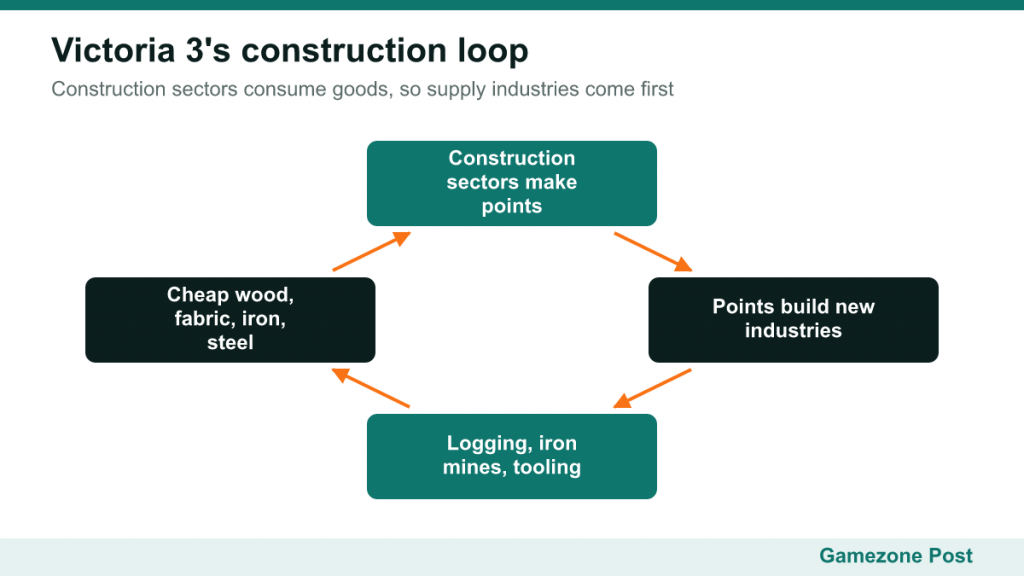
That creates a fundamental loop: to build faster you need more construction sectors, and to run them you need cheap construction goods, which means building the industries that supply them. Early in the game, many players focus on:
- Logging camps and other sources of wood.
- Iron mines and, later, steel mills.
- Tooling workshops to produce tools for mines and other industries.
- More construction sector levels as goods become available.
Government vs private construction
There are two construction queues:
- Government construction, paid from your treasury, which you control directly.
- Private construction, paid from the investment pool, which fills with dividends from owners such as wealthy pops. Private investors choose what to build based on profitability.
Your economic system law decides how construction points are split between the two. Under more laissez-faire systems, the private sector does more of the building. The investment pool only pays for goods, while construction sector employees are paid from the national budget.
Interest groups and laws
Economics and politics are inseparable in Victoria 3. Pops support interest groups, such as Industrialists, Landowners, the Devout, Rural Folk, the Armed Forces, the Intelligentsia, the Petty Bourgeoisie and Trade Unions, based largely on their profession and wealth. Each group has preferences for certain laws.
Laws shape the economy directly. Your economic system, trade policy (protectionism or free trade), tax system, labor laws and land reform all affect who earns money, how much the state collects and how fast you can industrialize. Passing laws means building support among interest groups, which often requires boosting the groups that favor your plans, such as industrialists for a more market-friendly economy.
Why GDP stalls (and how to fix it)
GDP measures the total value of what your country produces. When it stops growing, the cause is almost always one of these:
1. Not enough construction
If your construction capacity is small, your economy can’t grow fast. Fix: add construction sector levels and keep the queue full.
2. Expensive inputs
If wood, iron, tools or coal are expensive, every factory that uses them earns less. Fix: build the industries that supply them before expanding the industries that consume them.
3. No demand
Overbuilding one industry floods the market, crashes the price and makes factories unprofitable. Fix: check prices before building. Build what’s selling above base price.
4. Not enough workers
Factories can’t run without qualified pops. Low literacy or few people outside subsistence farming limit how much industry can be staffed. Fix: invest in education, encourage migration and use automation methods to reduce labor needs where appropriate.
5. Missing infrastructure
Without enough infrastructure, a state’s goods can’t reach the wider market efficiently. Fix: build railways and ports in your key industrial states.
6. Political blockage
Laws that keep labor tied to the land or restrict investment slow everything down. Fix: work toward reforms by supporting the interest groups that back them.
A sensible early-game approach
- Expand construction early and keep it running all the time.
- Build input industries (wood, iron, tools, coal) before finished goods.
- Follow prices: build what the market is short of.
- Keep pops’ standard of living rising to reduce radicalism and grow demand.
- Research technologies that unlock better production methods, but only switch when you can supply the inputs.
- Don’t neglect your budget. Deficits drain your gold reserves and can lead to default.
Victoria 3 compared with other Paradox economies
Most Paradox games abstract the economy. Victoria 3 simulates it directly, with individual goods, markets and pops. Europa Universalis V also uses pops, goods and markets, applied to an earlier historical era. Our comparison of Europa Universalis IV and V explains how those ideas carried over.