Hearts of Iron IV Beginner’s Guide: Divisions, Production and Fronts
Learn the core loop of Hearts of Iron IV: focus trees, factories, production lines, division templates, combat width basics, battle plans and supply.
Hearts of Iron IV is the Paradox grand strategy game about the Second World War, and it has a reputation as the most military-focused of the studio’s titles. That’s true, but the war is mostly decided before the shooting starts. A HOI4 campaign is won by building the right economy, producing the right equipment and designing sensible divisions in the years before war. Your armies on the map are the result of all that preparation.
This guide walks through the core loop of HOI4 in the order you’ll meet it: national focuses, industry, production, division templates, combat basics, battle plans and supply, with air and naval warfare in outline. It also suggests good nations for a first campaign. If you haven’t picked a Paradox title yet, our guide on which Paradox game to start with compares HOI4 with the others.
The basics
Hearts of Iron IV was developed by Paradox Development Studio and released on 6 June 2016 for Windows, macOS and Linux. It offers two start dates: 1 January 1936, which gives you years of peacetime to build up, and 14 August 1939, just before war breaks out in Europe. You can play any country in the world. Like other Paradox games, time runs in pausable real time, and you can speed it up or slow it down.
The official wiki recommends the 1936 start for learning, because it lets you understand the economy before the pressure of war arrives.
National focus trees and political power
Every nation has a national focus tree, a branching set of goals that grant bonuses, trigger events or unlock options. Major nations have detailed, historically inspired trees, often with alternate-history branches. You can work on only one focus at a time, so the order you choose matters. Early focuses often add factories, research slots or political options.
Political power is a separate currency used to appoint ministers and advisors, change laws such as conscription and economic mobilization, and adjust trade policy. Spending it early on useful advisors and economic laws is usually a good investment.
Industry: civilian factories, military factories and dockyards
Your economy rests on three types of factory:
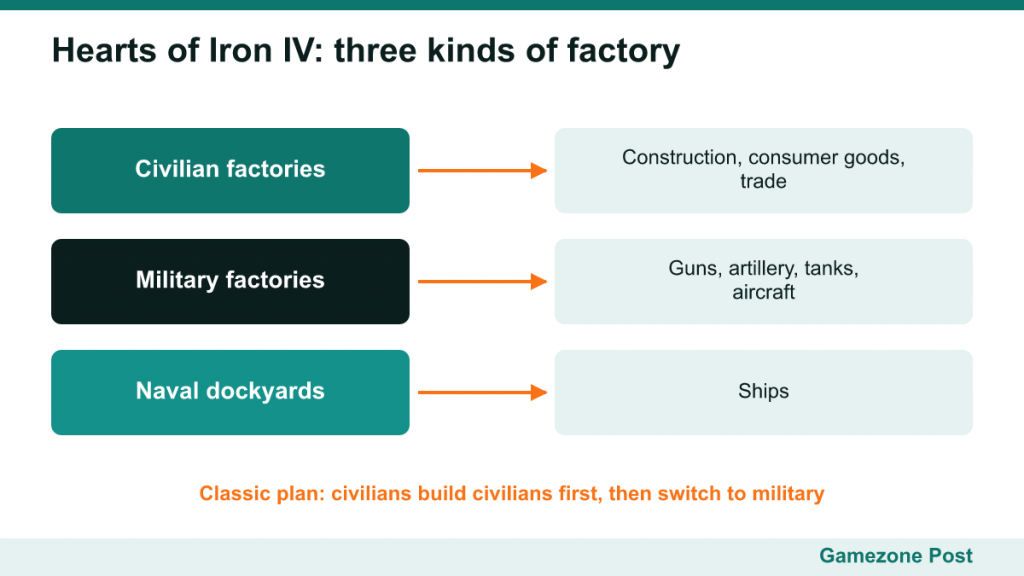
- Civilian factories build everything in the Construction menu, including new factories, infrastructure and defenses. They also produce consumer goods for your population and pay for resource trade.
- Military factories produce equipment: guns, artillery, vehicles, tanks and aircraft.
- Naval dockyards build ships.
The classic early-game plan is to use civilian factories to build more civilian factories first, compounding your construction capacity, and then switch to military factories as war approaches. How long to keep building civilians depends on your nation and how soon it expects to fight.
Resources and trade
Equipment needs strategic resources: oil, aluminium, rubber, tungsten, steel and chromium. If you don’t produce enough, you can trade for them, at the cost of giving trading partners some of your civilian factories. Research that boosts extraction can reduce how much you need to import. The wiki also notes that stability affects factory output, so very low stability hurts your whole economy.
Production lines and efficiency
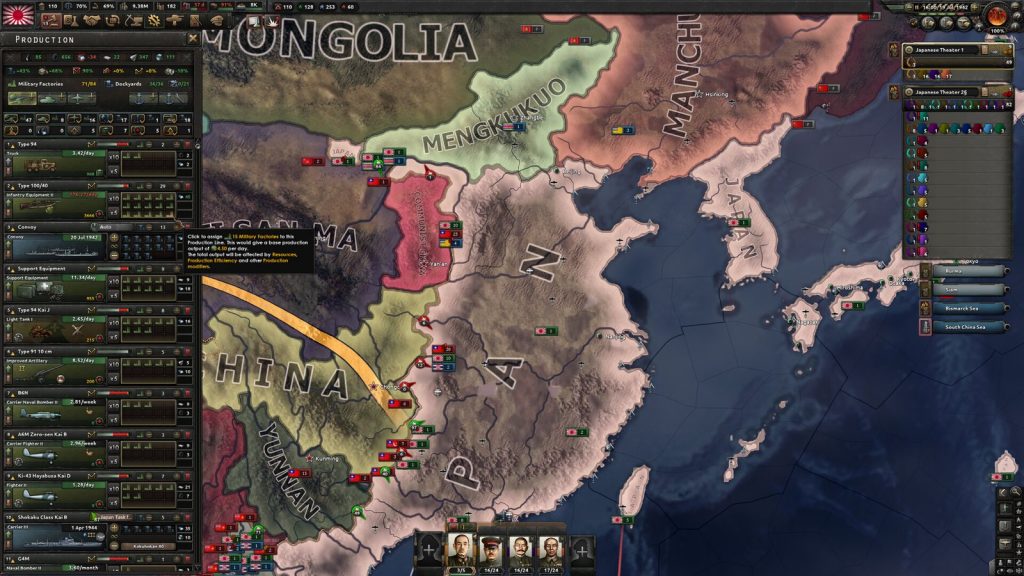
Military factories are assigned to production lines, each making one type of equipment. More factories on a line mean more output.
- New lines start at low production efficiency and improve over time. Switching a line to a different product resets some of that progress, so frequent switching is costly.
- Infantry equipment is the foundation. The wiki recommends running several lines of it early so your army doesn’t fall behind.
- Add lines for support equipment, artillery and, later, anti-tank, anti-air, aircraft and tanks as your plans need them.
Use the Logistics screen to see surpluses and shortages for each equipment type. A division template is worthless if you can’t equip it.
Division templates
Divisions are built from templates you design in the division designer. A template combines combat battalions, such as infantry, artillery, tanks or motorized infantry, with support companies like engineers, recon, artillery or logistics. Editing templates costs army experience.
Combat width basics
Battles have a combat width, the amount of front line that fits into one fight. Each battalion takes up some width, and a division’s width is the total of its battalions; support companies take none. Battle width depends on terrain and increases when you attack from multiple directions. If the divisions you commit exceed the available width, they take a penalty, so templates whose widths fit neatly into common battle widths perform better.
Exact values have changed several times through patches and expansions, so check the current wiki or community guides for today’s recommended template widths rather than copying an old guide. For a first game, a basic infantry template with some artillery and a few support companies is perfectly serviceable.
Stats that matter
- Organization: a division’s ability to keep fighting. When it reaches zero, the division retreats, even if it still has men.
- Strength (HP): how much damage it can take before it’s destroyed.
- Soft and hard attack: damage against unarmored and armored targets. Each target’s hardness sets the mix.
- Defense and breakthrough: how well a division absorbs attacks when defending or attacking.
- Armor and piercing: armored units that the enemy can’t pierce take reduced damage and deal extra.
Fronts and battle plans
HOI4 lets you command divisions individually, but most players use battle plans for large operations.
- Create an army and assign divisions and a general.
- Draw a front line along the border with the enemy. Divisions spread out to defend it.
- Draw an offensive line showing where you want the army to advance.
- Wait for units to get into position and build up planning bonuses, then execute the plan.
Battle plans save enormous micromanagement, but they’re blunt. Concentrated attacks with your best divisions, using shorter offensive lines on weak points, usually work better than a single long offensive across the whole front. Many players combine plans with manual control of tank and motorized divisions for encirclements.
Naval invasions also use battle plans. You pick a port and a target province, gather naval intelligence and, where enemies are active, secure naval superiority before launching.
Supply
Armies need supply. Divisions out of supply lose effectiveness and, as the wiki notes, cannot attack or even move. Supply flows from your capital through hubs and railways, and infrastructure limits how much reaches each area. Overseas supply relies on ports and convoys, so protecting your shipping matters for any campaign across water.
Check the supply map mode before planning big offensives. A brilliant attack into an area with poor infrastructure stalls when supply runs out.
Air and naval warfare in outline
Air
New aircraft go into a reserve pool. You form air wings at air bases and assign them to a region with a mission, such as air superiority, close air support or strategic bombing. Different aircraft have very different ranges. Winning air superiority over a battle area gives your ground forces significant advantages.
Navy
Ships are grouped into fleets at ports and given missions like patrol, strike force or convoy escort. Submarines are best used to raid enemy convoys. For most land powers, a modest navy is enough. Island nations and major naval powers need much more.
Research
Research slots let you study several technologies at once across categories including infantry, support, armor, artillery, naval, air, engineering and industry. Researching ahead of the historical date carries a time penalty. Early priorities usually include industry, infantry weapons and land doctrines.
Good starter nations
- Minor nations away from the main fronts, such as Australia or Mexico, which the wiki highlights as relatively insulated places to learn the systems at your own pace.
- Major powers like the United States, United Kingdom or France have more to manage but also more resources and factories, and they let you see the full scope of the game.
The wiki also suggests starting with a nation you know well or find fun, and advises against ultra-small nations like Bhutan for a first game.
A simple plan for a 1936 start
Every nation is different, but this outline works for most first campaigns:
- First weeks: pick a focus that boosts industry or research, hire an economic advisor with political power, and queue civilian factories in states with free building slots and good infrastructure.
- First year: keep most construction on civilian factories. Fill research slots with industry, construction and basic infantry equipment. Set up a few infantry equipment lines with your starting military factories.
- Middle years: start shifting construction toward military factories. Design a solid infantry template and check that your equipment output can support the divisions you plan.
- As war approaches: raise economic and conscription laws as your nation’s politics allow, build forts on key borders if you expect to defend, and assign armies to front lines.
- When war starts: defend first, gather intelligence on enemy weak points, then launch concentrated offensives with planning bonuses.
Expect your first war to go badly in places. HOI4 teaches mostly through lost battles that reveal a production gap, a supply problem or an overstretched front.
Common beginner mistakes
- Too many military factories too early. Building civilians first gives you a larger economy later.
- Constant production switching. It wrecks efficiency.
- Divisions without equipment. Check the Logistics screen before adding more divisions.
- Ignoring supply. Offensives into poor infrastructure grind to a halt.
- One giant offensive line. Concentrate force instead.
- Forgetting the air war. Enemy air superiority makes ground battles much harder.
HOI4 also uses plenty of terms such as “doomstack,” “attrition” and “manpower” that are explained in our strategy and sim game glossary.