Civilization Beginner’s Guide: Core Concepts That Carry Across the Series
The ideas behind Civ V, VI and VII: city placement, yields, tech and civics, districts, diplomacy and victory types, plus what Civilization VII changes.

Sid Meier’s Civilization is the series many people think of first when they hear “turn-based strategy.” It is also a series that can feel overwhelming on day one: a dozen yields, two research trees, policies, religion, city-states and several ways to win. The good news is that the core ideas have stayed remarkably stable across recent entries. Learn them once in Civilization V, VI or VII and they carry over to the others.
This guide focuses on those shared concepts, then explains the biggest changes in Civilization VII, which Firaxis Games released in February 2025. It ends with common beginner mistakes and how difficulty settings actually work. If you want background on the genre itself, our explainer on what a 4X game is covers the explore-expand-exploit-exterminate loop that Civilization helped popularize.
The Basic Loop: Settle, Grow, Research, Compete
Every Civilization game starts the same way: a settler (or founding unit) on an unexplored map. You found a capital, send out a scout, choose something to research and end your turn. From there, the game revolves around a loop:
- Found and grow cities that produce yields.
- Spend yields on units, buildings, research and culture.
- Unlock new options through the technology and civics trees.
- Interact with rivals through trade, diplomacy or war.
- Pursue a victory condition before anyone else completes theirs.
Turns are the clock. Each turn you issue orders, then the AI players take theirs, and the world advances. Because nothing happens until you end the turn, you can take as long as you like to think.
Cities and Where to Put Them
Cities are your engine. Each one works nearby tiles, and what those tiles produce determines how your empire develops. City placement is therefore the first real decision in every game.
What makes a good city site
- Fresh water. Rivers, lakes and some coastal features help cities grow in most Civ games. Civilization VII also adds navigable rivers that ships can travel along.
- Food. Grassland, floodplains and food resources let the city grow, and population is what works tiles.
- Production. Hills, forests and mines speed up building.
- Resources. Luxury and strategic resources feed happiness and advanced units.
- Room to grow. A site squeezed between rivals or mountains will stay small.
Spacing
Beginners often place cities too far apart, leaving empty land for rivals to claim, or so close that they compete for every tile. A reasonable rule is to leave enough space for each city to work a healthy ring of tiles without huge gaps between them. In Civilization V, where many players kept empires smaller, spacing mattered differently than in VI, where many cities and districts are generally rewarded. Learn what the specific game encourages.
Yields: The Numbers That Run Your Empire
Yields are the resources your tiles and buildings generate each turn. The exact list varies by game, but these appear in some form throughout modern Civ:
| Yield | What it does |
|---|---|
| Food | Grows city population |
| Production | Builds units, buildings and wonders |
| Gold | Buys items, pays upkeep, funds diplomacy |
| Science | Advances the technology tree |
| Culture | Advances civics or policies and expands borders |
| Faith (Civ V and VI) | Founds and spreads religions, buys some units |
| Happiness | Keeps cities productive; handled very differently in each game |
A balanced early empire usually wants solid food and production first, because growth and building speed multiply everything else. Science and culture become more important as the game goes on.
Technology and Civics Trees
Research is the backbone of the series. The technology tree unlocks units, buildings, improvements and wonders. Starting with Civilization VI, cultural progress runs through a separate civics tree that unlocks government types and policy cards.
Civilization VI also introduced “Eureka” moments: completing certain tasks in the world, such as destroying a barbarian encampment, gives a large boost toward a related technology. That ties research to what you actually do on the map. Civilization V instead used social policies, bought with culture and organized into trees of cumulative bonuses.
Beginner tip: Don’t try to research everything evenly. Pick a direction that supports your plan, such as military technologies if a hostile neighbor is close, or economic and science technologies if you have room to build in peace.
Districts, Buildings and Specialization
Civilization VI changed city building dramatically by introducing districts. Instead of stacking every building in the city center, you assign specific hexes around the city as districts, such as a campus for science buildings. Districts take up space and benefit from adjacency to terrain and other districts, so city planning becomes a spatial puzzle.
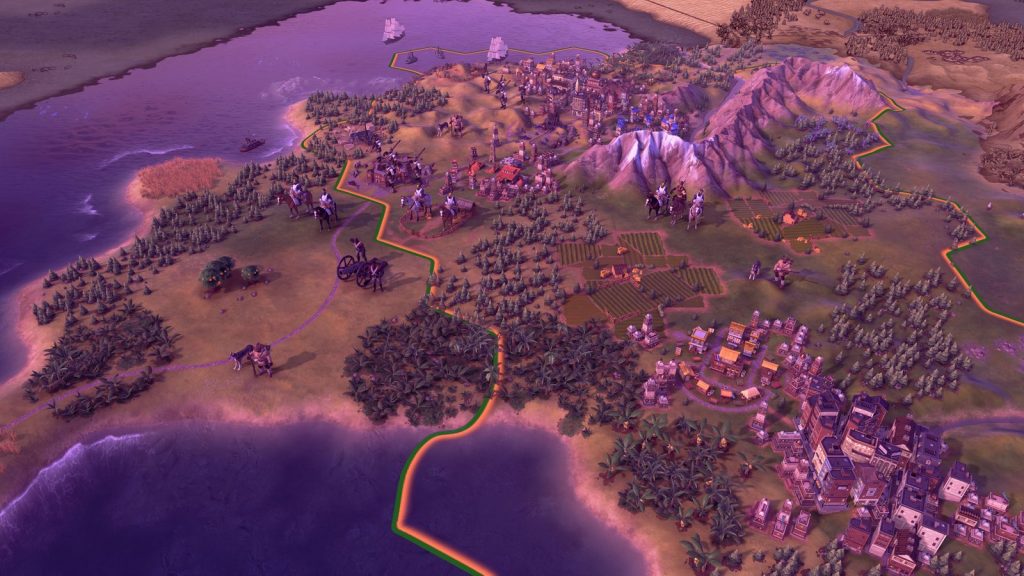
This led to the idea of specialized cities: one city might focus on science, another on production or trade. Civilization VII keeps the principle that buildings occupy tiles around a city, while Civilization V keeps all buildings inside the city itself. Whatever the game, specialization is a powerful concept. Not every city needs every building.
Military Basics: One Unit Per Tile
Civilization V made a landmark change by moving to hexagonal tiles and limiting each hex to one military unit. Armies could no longer pile into a single invincible stack, so positioning, terrain and flanking began to matter. Civilization VI loosened this slightly by allowing limited combinations of certain units. Civilization VII introduces commanders, which let you move a group of units together as one army.
Key military ideas across the series:
- Hills, forests and rivers modify combat, so defending good terrain is cheap protection.
- Ranged units should sit behind melee units.
- Cities have their own defenses and are much harder to take without siege units.
- Upgrading old units is often cheaper than building new ones.
Diplomacy, City-States and Independents
Other civilizations are led by AI leaders with their own agendas. You can trade with them, form friendships or alliances, denounce them or declare war. Paying attention to what each leader likes and dislikes helps you avoid surprise attacks.
Minor powers add another layer. In Civilization V and VI, city-states are minor civilizations that cannot win but can be befriended for bonuses. Civilization VII replaces the “barbarian” idea with independent factions that appear in every age and can evolve into city-states depending on how you treat them.
Victory Types
Civilization offers several ways to win, which is why peaceful and aggressive players can enjoy the same game.
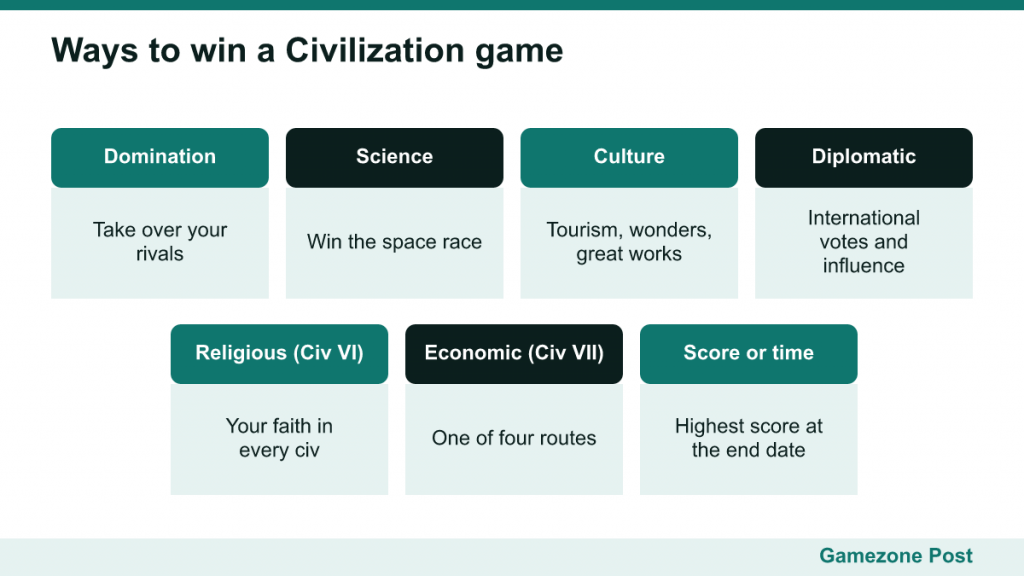
- Domination or military: take over your rivals.
- Science: win the space race or reach a scientific milestone.
- Culture: become the world’s cultural leader through tourism, wonders and great works.
- Diplomatic: win through international votes and influence (Civ V’s United Nations, Civ VI from the Gathering Storm expansion onward).
- Religious (Civ VI): spread your faith to become the majority in every civilization.
- Economic (Civ VII): one of the four routes alongside military, scientific and cultural.
- Score or time: if no one wins before the end date, the highest score usually takes it.
Choose a target early, even if you change it later. It tells you which yields to prioritize and which wonders are worth building.
What Is Different in Civilization VII
Civilization VII keeps the core loop but reorganizes the structure of a campaign. The biggest changes:
- Three ages. A game is divided into Antiquity, Exploration and Modern ages. Near the end of the first two, crisis events simulate societal upheaval, and progress in one age unlocks advantages in the next.
- Leaders separate from civilizations. You choose a leader and a civilization independently and can mix their bonuses. The leader stays with you for the whole game.
- Changing civilizations. When an age ends, you can move to a new civilization for the next age. Later updates also let players keep one civilization throughout a campaign.
- Cities and towns. You can found full cities or more specialized towns.
- Commanders move groups of units as one army.
- Victory routes are organized around military, scientific, cultural and economic paths.
If you are coming from Civ VI, expect the age transitions to be the biggest adjustment. If you are brand new, Civ VII’s structure gives natural break points that make a long game feel more manageable.
Difficulty Settings Explained
Civilization V and VI use a ladder of eight difficulty levels from Settler at the bottom to Deity at the top, with Prince commonly treated as the middle baseline. Higher difficulty mostly works by giving AI opponents extra advantages, such as stronger starts or production and research bonuses, rather than making them dramatically smarter. Lower levels give the player more breathing room.
A sensible approach is to begin at one of the lower settings, win a game, then step up a level at a time. Jumping straight to high difficulty after one game usually teaches frustration rather than strategy.
Common Beginner Mistakes
- Too few cities. Early expansion is one of the strongest investments in most Civ games.
- No defense. AI neighbors notice weak armies. Keep a few units at home, even when playing peacefully.
- Ignoring happiness or amenities. Growth without happiness leads to penalties that can stall your empire.
- Building every wonder. Wonders are great but expensive. Pick the ones that support your victory plan.
- Forgetting tile improvements. Unimproved land wastes your cities’ potential.
- Not reading tooltips. Hovering over yields, combat previews and diplomacy screens explains a lot of hidden math.
Where to Go From Here
Play a full game on a low difficulty with a straightforward civilization, aiming for one victory type. Watch how your choices about city placement, research and diplomacy ripple across hundreds of turns. Once those ideas click, every Civilization game becomes a variation on a theme you already understand, and the series’ famous “one more turn” pull will take care of the rest.