Sid Meier’s Civilization: The History of the Series From 1991 to Civilization VII
Every main Civilization game from 1991 to Civilization VII, the studios behind them, the designers who led them and the key mechanic each one added.

Few strategy series have lasted as long or changed as much while staying recognizably themselves as Sid Meier’s Civilization. Since 1991, each main entry has asked players to guide a people from the ancient world to the future, one turn at a time. Yet every game has rebuilt part of the formula, sometimes dramatically. This history walks through each main entry, the studios and designers behind them, the mechanic each one is best remembered for, and the spin-offs that grew alongside the main line.
Sid Meier himself has described the design approach behind sequels as “one-third old, one-third improved, and one-third new,” and that rule of thumb explains a lot about how the series evolved.
MicroProse and the Original Civilization (1991)
Sid Meier co-founded MicroProse with Bill Stealey in 1982. The company was best known for simulations and strategy games when Meier, together with co-designer Bruce Shelley, created Civilization, released in 1991.
The original game combined ideas from board games such as Risk with computer strategy games like Empire, and added a sweeping theme: the whole of human history. Its core systems set the template for decades:
- A technology tree leading from early discoveries to space flight.
- City management, with cities working surrounding tiles for food, production and trade.
- Conquest and diplomacy with rival civilizations.
- Multiple ways to finish, including conquering the world or launching a spaceship.
Civilization helped define the genre that would later be called 4X. We explain that label in What Is a 4X Game?
Civilization II (1996): Depth and Scenarios
Civilization II was developed and published by MicroProse in 1996, with Brian Reynolds, Douglas Kaufman and Jeff Briggs as designers. It was the first sequel to a Sid Meier game.
Civ II changed the map from a top-down view to an isometric one, added more units, wonders and technologies, improved the AI and gave trade and diplomacy a larger role. It also introduced concepts like diplomatic reputation. Perhaps its longest-lasting contribution was its openness: Civ II supported mods and scenarios that recreated historical or fictional situations, and its expansions, Conflicts in Civilization and Fantastic Worlds, expanded those tools further.
The founding of Firaxis
Also in 1996, Sid Meier, Brian Reynolds and Jeff Briggs left MicroProse and founded Firaxis Games. Firaxis has been the series’ principal developer ever since.
Alpha Centauri and the Spin-Offs
Before Firaxis made a numbered Civilization game, it released Sid Meier’s Alpha Centauri in 1999, published by Electronic Arts. Described as a space-based Civilization-style game, it used an engine similar to Civilization II’s and is still remembered for its writing and factions built around ideologies.
Other spin-offs over the years include:
- Colonization (1994), developed by Meier with Brian Reynolds at MicroProse, focused on colonizing the Americas. It was later remade on the Civilization IV engine.
- Civilization: Call to Power (1999) and Call to Power II (2000), developed by Activision rather than Firaxis, a result of licensing disputes between Avalon Hill and MicroProse over the name.
- Civilization Revolution (2008), a streamlined version from Firaxis aimed at consoles and mobile devices.
- Civilization: Beyond Earth (2014), a science-fiction game from Firaxis inspired by Alpha Centauri.
Civilization III (2001): Culture and Borders
Civilization III was the first numbered entry from Firaxis, released for Windows in North America on October 30, 2001, and published by Infogrames. It was designed by Jeff Briggs, with Soren Johnson as a lead programmer, and was not designed by Sid Meier himself.
Civ III introduced several ideas that became permanent parts of the series:
- Culture, which was not present in earlier games. Each city generated a cultural rating that extended its influence.
- National borders defined by that cultural influence. Strong culture could push borders into rivals’ territory and even cause foreign cities to flip to your side.
- Strategic and luxury resources. Strategic resources such as those needed for certain units, and luxuries that kept citizens happy, made territory matter in a new way.
- Unique civilization abilities and units, such as the Japanese samurai replacing the knight.
- Great Leaders and Armies, which could emerge from victorious elite units.
Civilization IV (2005): Religion, Great People and Modding
Civilization IV launched in North America on October 25, 2005, with Soren Johnson as lead designer. Published by 2K, it was the first fully 3D entry in the series.
Its key additions included:
- Religion, with seven religions that affected civics and diplomacy.
- Civics, letting players build a government from individual choices unlocked through technology.
- Great People such as Great Engineers and Great Scientists, who provided powerful one-time boosts.
- Deep moddability, with game rules stored in editable XML files and a software development kit that let players modify the AI and core code.
Civ IV also became famous for its presentation. Leonard Nimoy narrated technology quotes, and the title theme “Baba Yetu” by Christopher Tin became the first piece of video game music to win a Grammy Award, in 2011. The Warlords and Beyond the Sword expansions extended the game, and it is still regarded by many fans as a high point of the series.
Civilization V (2010): Hexes and One Unit Per Tile
Civilization V released in North America on September 21, 2010. Its lead designer and director was Jon Shafer.
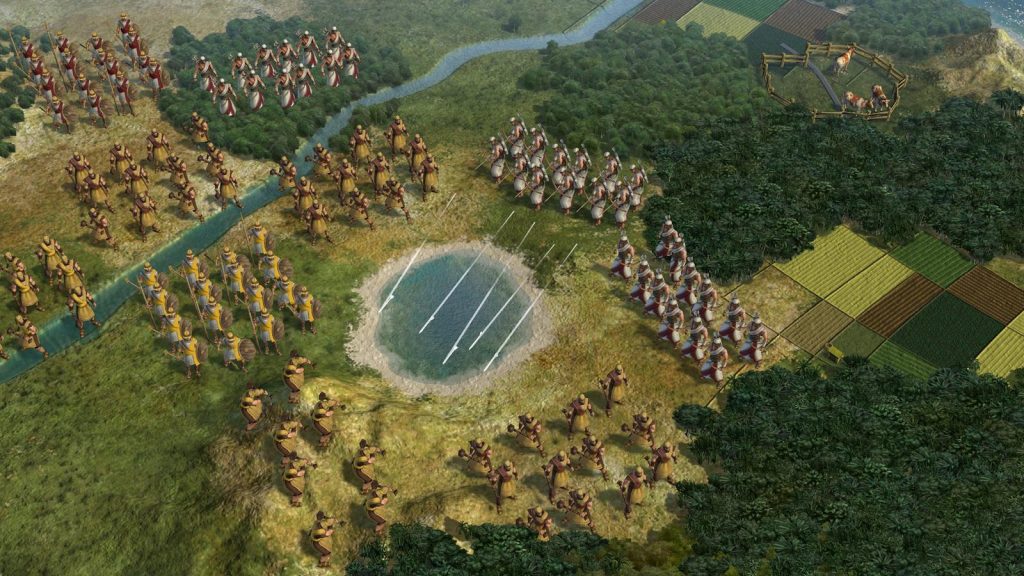
Civ V is defined by one big change: the map moved from square tiles to hexagons, inspired by the 1994 wargame Panzer General, and each hex could hold only one military unit. The infamous “stack of doom,” where huge armies sat on a single square, disappeared. Battles spread out across the land, terrain and positioning became central, and ranged units could fire over front lines.
Civ V also introduced city-states, minor civilizations that cannot win but can be befriended for bonuses, and replaced Civ IV’s civics with social policies bought with culture. Its victory types included science through the space race, diplomacy through the United Nations, culture and domination. Its expansions, Gods & Kings and Brave New World, restored religion and deepened trade and diplomacy.
Civilization VI (2016): Districts
Civilization VI launched for Windows on October 21, 2016, with Ed Beach as lead designer. Its signature idea was districts: instead of stacking every building in the city center, players assigned specific hexes around a city as districts, such as a campus for science buildings. Districts gained bonuses from adjacency, turning city planning into a spatial puzzle.
Civ VI also split progress into two trees: a technology tree and a separate civics tree that unlocks policy cards slotted into military, economic, diplomatic and wildcard categories. “Eureka” moments rewarded specific actions on the map with research boosts. Later, the Gathering Storm expansion reintroduced a diplomatic victory. If you want to know how these concepts play in practice, our Civilization beginner’s guide covers them in detail.
Civilization VII (2025): Ages
Civilization VII, again directed and designed by Ed Beach at Firaxis and published by 2K, released in February 2025 for PC and consoles, including Nintendo Switch, with a Nintendo Switch 2 version following in June 2025.
Its defining change is structural. A campaign is split into three ages, Antiquity, Exploration and Modern, and at the end of each age players can move to a new civilization. Leaders are chosen separately from civilizations, so their bonuses can be mixed and matched. The game also introduced commanders to move groups of units together, replaced “barbarians” with independent factions that can become city-states, and added crisis events near the end of ages.
The age system divided players. Critics and fans praised Civ VII’s visuals and its reworked diplomacy and economy, while criticism focused on the interface and on the ability to switch civilizations. Firaxis responded with updates, including the 2026 “Test of Time” update that lets players keep one civilization throughout a campaign, and further content is planned for 2027.
Thirty-Five Years in One Table
| Game | Year | Developer | Lead designer | Signature addition |
|---|---|---|---|---|
| Civilization | 1991 | MicroProse | Sid Meier (with Bruce Shelley) | Tech tree and history-spanning empire building |
| Civilization II | 1996 | MicroProse | Brian Reynolds, Douglas Kaufman, Jeff Briggs | Isometric map, scenarios and mod support |
| Civilization III | 2001 | Firaxis | Jeff Briggs | Culture and national borders |
| Civilization IV | 2005 | Firaxis | Soren Johnson | Religion, Great People, civics, 3D |
| Civilization V | 2010 | Firaxis | Jon Shafer | Hexes and one unit per tile |
| Civilization VI | 2016 | Firaxis | Ed Beach | Districts and civics tree |
| Civilization VII | 2025 | Firaxis | Ed Beach | Ages and separate leaders |
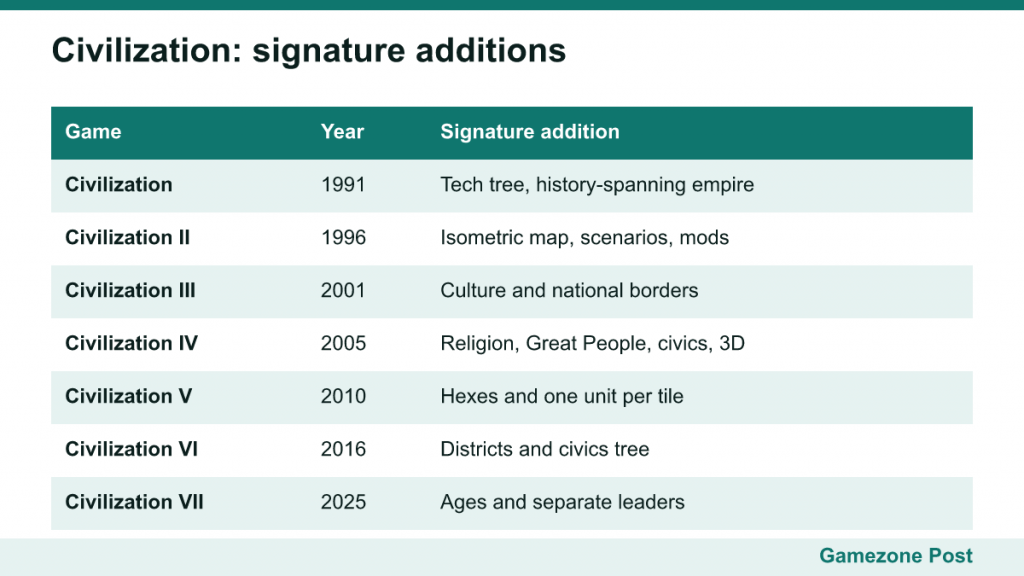
Looking down the table, a pattern emerges: almost every entry reworked how the map itself is used. Civ III gave territory borders, Civ V changed the shape of tiles and how armies occupy them, Civ VI spread cities across the map with districts, and Civ VII changed how time is divided. The map has always been the series’ main stage.
What Has Stayed the Same
Despite the changes, every entry keeps the series’ heart: a turn-based journey from a single settlement to a world-spanning civilization, a research tree that tells the story of human progress, and the famous pull of “one more turn.” The way each game has been supported is also consistent: a base release followed by expansions that often reshape it, so the version players remember is frequently the fully expanded one rather than the launch build. Each designer has taken Meier’s one-third rule seriously, keeping enough of the old to feel familiar while changing enough to make each game its own. That balance is why Civilization remains the reference point for turn-based strategy more than three decades after it began.