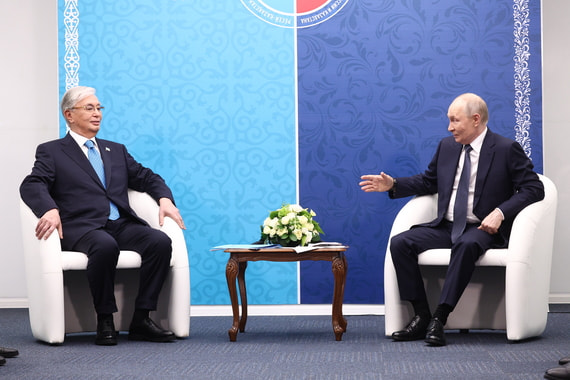
Kazakhstan’s President Kassym-Jomart Tokayev has put forward a significant diplomatic proposal to Russian President Vladimir Putin, suggesting a freeze of the ongoing military conflict in Ukraine. During recent discussions, Tokayev emphasized that the continuation of hostilities serves only to benefit the adversaries of both Russia and Ukraine, making a strong case for an immediate cessation of active combat operations. This proposal marks one of the most direct calls for de-escalation from a leader within Russia’s traditional sphere of influence since the conflict began in February 2022.
The Kazakh president’s statement carries considerable weight given Kazakhstan’s unique position as a close ally of Russia within the Eurasian Economic Union and the Collective Security Treaty Organization, while simultaneously maintaining a carefully balanced foreign policy that has avoided direct endorsement of Russia’s military actions. Tokayev has previously made headlines for his measured stance on the conflict, notably declining to recognize the independence of the self-proclaimed Donetsk and Luhansk People’s Republics during a public forum in St. Petersburg in 2022, where he appeared alongside Putin himself.
Kazakhstan’s Delicate Diplomatic Balance
Kazakhstan’s proposal comes at a time when the Central Asian nation is navigating increasingly complex geopolitical waters. As the largest economy in Central Asia and a country sharing a 7,500-kilometer border with Russia—the longest continuous land border in the world—Kazakhstan must carefully calibrate its relationships with both Moscow and the West. The country has become a crucial transit point for goods entering Russia, as Western sanctions have forced Moscow to seek alternative supply routes. This economic reality has given Nur-Sultan additional leverage in its dealings with the Kremlin while also exposing it to secondary sanctions risks from Western nations.
Tokayev’s diplomatic overture reflects growing concerns among Russia’s traditional allies about the prolonged nature of the conflict and its broader implications for regional stability. The war has disrupted trade patterns, created refugee flows, and raised concerns about potential escalation that could affect neighboring states. Several Central Asian leaders have quietly expressed similar sentiments, though few have been as direct as Tokayev in publicly advocating for a freeze in hostilities.
The Concept of Freezing the Conflict
The idea of freezing the Ukraine conflict rather than seeking a comprehensive peace settlement has been discussed in various diplomatic circles as a pragmatic, if imperfect, solution to end active combat. A frozen conflict would essentially establish a ceasefire along current front lines without resolving underlying territorial disputes—similar to situations seen in Cyprus, Korea, or even the earlier conflict in eastern Ukraine that persisted from 2014 until the full-scale invasion. Critics argue that such arrangements merely postpone inevitable future confrontations while legitimizing territorial gains achieved through military force. However, proponents suggest that stopping the bloodshed should take priority, with political solutions potentially emerging over time.
International analysts note that any conflict freeze would require agreement from multiple parties, including Ukraine itself, which has consistently stated its intention to restore control over all internationally recognized territories, including Crimea. Western allies have largely deferred to Kyiv on peace negotiations, providing military and financial support while allowing Ukraine to determine acceptable terms for ending the conflict. Russia, for its part, has indicated willingness to negotiate but has set conditions that Ukraine and its Western backers have deemed unacceptable, including recognition of annexed territories and limits on Ukraine’s security partnerships.
Implications for Regional and Global Diplomacy
Tokayev’s proposal adds Kazakhstan to a growing list of nations attempting to mediate or influence the trajectory of the Ukraine conflict. China has presented its own peace plan, while countries including Turkey, Saudi Arabia, and various African nations have undertaken diplomatic initiatives. The involvement of a country within Russia’s closest circle of allies may carry particular significance, potentially signaling to Moscow that even friendly nations view the continuation of hostilities as detrimental to shared interests. The coming weeks will likely reveal whether this proposal gains any traction in Moscow or Kyiv, or whether it remains another unrealized diplomatic initiative in a conflict that has defied numerous attempts at resolution over the past three years.
Expert Opinion: Tokayev’s public call for a conflict freeze represents a calculated diplomatic maneuver that tests Moscow’s flexibility while positioning Kazakhstan as a potential mediator. Given the current battlefield dynamics and both parties’ stated positions, an immediate freeze remains unlikely; however, such proposals from allied nations may gradually shift Russia’s calculus by demonstrating the erosion of unqualified support within its traditional sphere of influence. The timing suggests Central Asian leaders are increasingly concerned about the conflict’s long-term economic and security implications for the entire region.