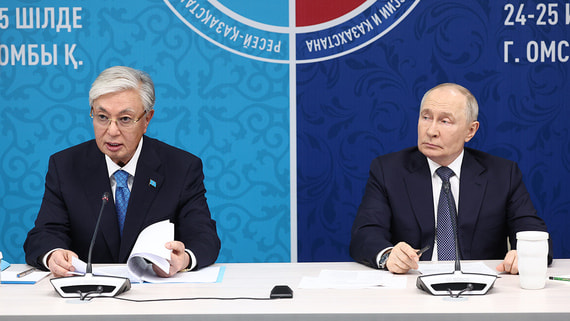
During recent diplomatic exchanges, Kazakh President Kassym-Jomart Tokayev raised the prospect of freezing the ongoing conflict in Ukraine, referencing previous negotiations that took place in Istanbul in the early stages of the war. However, Russian President Vladimir Putin did not embrace this proposal, highlighting the complex diplomatic landscape surrounding any potential resolution to the conflict that has now stretched into its third year. Tokayev’s mention of the Istanbul talks was notably brief, avoiding detailed discussion of the specific terms that were reportedly on the table during those early 2022 negotiations.
The Istanbul negotiations, held in March and April 2022, represented one of the closest moments the two warring nations came to reaching a potential agreement. According to various reports, the draft agreement discussed at that time included provisions for Ukrainian neutrality, limitations on military forces, and security guarantees from multiple nations. However, these talks ultimately collapsed, with both sides offering different explanations for their failure. Russia has consistently blamed Western interference, while Ukraine and its allies point to the discovery of atrocities in Bucha and other occupied territories as a turning point that made continued negotiations impossible.
The Strategic Calculus Behind Russia’s Position
Putin’s reluctance to accept a frozen conflict scenario stems from multiple strategic considerations. From Moscow’s perspective, a simple freeze along current lines of contact would not address Russia’s stated objectives, which have evolved throughout the conflict but consistently include demands for Ukrainian demilitarization, denazification, and recognition of territorial changes. Russian officials have repeatedly emphasized that any settlement must address these core concerns, making a straightforward ceasefire without broader political agreements unlikely to gain Kremlin approval.
Military analysts suggest that Russia currently holds certain tactical advantages in the eastern regions of Ukraine, with incremental territorial gains being made despite significant casualties on both sides. From this position, accepting a freeze could be seen as forfeiting potential future gains while simultaneously allowing Ukraine time to rearm and strengthen its defenses with continued Western support. The historical precedent of the Minsk agreements, which Russia now characterizes as a Western ploy to buy time for Ukraine’s military buildup, has made Moscow deeply skeptical of any arrangement that could be perceived as a temporary pause rather than a definitive resolution.
Kazakhstan’s Delicate Balancing Act
President Tokayev’s diplomatic initiative reflects Kazakhstan’s increasingly nuanced foreign policy position. As a founding member of the Eurasian Economic Union and the Collective Security Treaty Organization, Kazakhstan maintains close economic and security ties with Russia. However, Astana has also sought to maintain relationships with Western nations and has notably refrained from recognizing Russia’s annexation of Ukrainian territories. This balancing act requires careful diplomatic maneuvering, as Kazakhstan seeks to position itself as a potential mediator while avoiding actions that could provoke either Moscow or Western capitals.
Kazakhstan’s interest in conflict resolution is not merely altruistic. The prolonged conflict has disrupted traditional trade routes, complicated economic relationships, and created uncertainty throughout the post-Soviet space. Central Asian nations have experienced both challenges and opportunities as a result of Western sanctions on Russia, with some becoming alternative transit routes for goods while others face pressure to align with one side or another. Tokayev’s peace overtures may thus reflect a genuine desire to restore regional stability as much as any specific vision for Ukraine’s future.
The Broader International Context
The exchange between Putin and Tokayev occurs against a backdrop of intensifying diplomatic activity surrounding the Ukraine conflict. Various nations and international organizations have proposed peace frameworks, ranging from China’s twelve-point position paper to proposals from African leaders, the Vatican, and individual European states. None have gained significant traction, largely because they fail to bridge the fundamental gap between Ukraine’s insistence on territorial integrity and Russia’s demand for recognition of its claimed annexations.
Western nations, particularly the United States and major European powers, have maintained their position that any peace settlement must be acceptable to Ukraine and cannot be imposed from outside. This stance, combined with continued military and economic support for Kyiv, has limited the space for intermediaries seeking to broker a quick resolution. As the conflict continues, the humanitarian toll mounts, with millions displaced, cities devastated, and both economies severely strained. The search for a viable path to peace remains one of the most pressing diplomatic challenges of the current era, with no clear resolution in sight despite numerous initiatives from world leaders.
Expert Opinion: The fundamental impasse between Moscow and Kyiv reflects irreconcilable core demands that no amount of external mediation can bridge without significant shifts in battlefield realities or domestic political calculations. Kazakhstan’s peace overture, while diplomatically valuable for Astana’s international positioning, is unlikely to produce breakthroughs given Russia’s maximalist stance and Ukraine’s Western-backed resistance. Any meaningful negotiations will likely require either military exhaustion on one side or dramatic changes in leadership priorities that are not currently evident.