
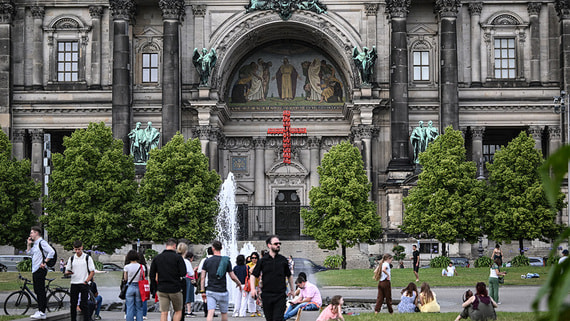
In a seemingly paradoxical economic phenomenon, Germany’s two largest religious institutions — the Roman Catholic Church and the Evangelical Church — continue to report stable or even growing revenues despite experiencing an unprecedented decline in membership. The explanation lies in a uniquely German system of religious taxation combined with broader economic trends that have allowed church coffers to remain full even as pews grow increasingly empty. This financial resilience raises important questions about the future sustainability of organized religion in one of Europe’s most economically powerful nations.
The German Church Tax System Explained
Germany operates one of the most distinctive religious financing systems in the world, known as the Kirchensteuer or church tax. This mandatory levy, which typically amounts to 8-9% of an individual’s income tax liability depending on the federal state, is automatically collected by the government on behalf of registered religious organizations. The system traces its roots back to the early 19th century, when it was established as compensation after the state secularized church properties during the Napoleonic era. Today, any German citizen who is formally registered as a member of a recognized religious community — primarily the Catholic and Protestant churches — must pay this tax unless they officially declare their departure from the church through a formal bureaucratic process.
This arrangement creates a significant financial buffer for religious institutions. Even as hundreds of thousands of Germans formally leave their churches each year — a process that requires visiting a civil registry office and paying an administrative fee — the economic mathematics have worked in the churches’ favor. The key factor is nominal wage growth across the German economy. As salaries increase due to inflation adjustments, collective bargaining agreements, and general economic expansion, the tax base from remaining members expands proportionally, often offsetting the loss of contributors entirely.
Record Departures Meet Rising Incomes
The numbers tell a striking story. In 2022, the Catholic Church in Germany lost approximately 523,000 members — the highest annual figure ever recorded. The Protestant Church experienced similar hemorrhaging, with over 380,000 departures. These exits were driven by multiple factors, including ongoing abuse scandals that have plagued the Catholic Church, growing secularization among younger generations, and practical financial motivations as rising inflation made the church tax feel increasingly burdensome. Yet despite this mass exodus, combined church tax revenues have remained remarkably stable, hovering around 12-13 billion euros annually for both major denominations combined.
Economic analysts point to Germany’s robust labor market and successive rounds of wage increases as the primary counterbalancing force. Minimum wage hikes, negotiated pay raises in key sectors like manufacturing and healthcare, and inflation-driven salary adjustments have all contributed to higher nominal incomes for those who remain church members. Since the church tax is calculated as a percentage of income tax paid, these wage increases automatically translate into larger individual contributions without any change in the tax rate itself.
Long-Term Sustainability Questions Emerge
Despite the current financial stability, church leaders and demographic experts express serious concerns about long-term sustainability. The age profile of remaining church members skews heavily toward older Germans, who tend to be more religiously observant and less likely to formally exit. As this generation passes, the churches face a demographic cliff that nominal wage growth alone may not be able to overcome. Projections suggest that by 2060, both major churches could lose half of their current membership, fundamentally altering their financial landscape and societal influence.
The churches have begun adapting to this new reality, consolidating parishes, selling properties, and reducing clergy numbers. Some dioceses have implemented hiring freezes, while others have merged administrative functions to cut costs. The wealth accumulated during decades of reliable tax revenue provides a cushion, but the trajectory is clear. Germany’s unique church tax system, once seen as a guarantee of institutional stability, may ultimately only delay rather than prevent a fundamental transformation of organized religion in one of Christianity’s historic heartlands.
Expert Opinion: The German church tax model represents a fascinating case study in how institutional financing can temporarily decouple from actual participation and belief. However, this disconnect cannot persist indefinitely. Within the next two decades, we anticipate a critical inflection point where demographic decline will overwhelm wage-driven revenue growth, forcing both major churches to fundamentally restructure their operations, property holdings, and social service provision — changes that will reshape Germany’s religious and social landscape for generations.