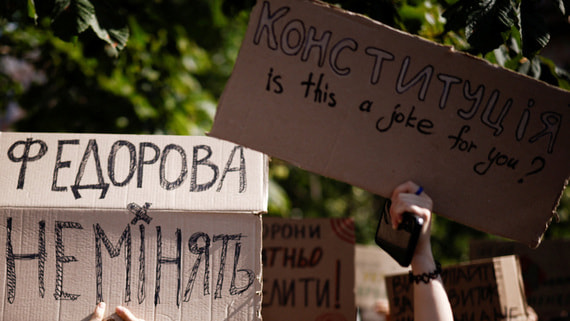
Protests demanding the reinstatement of former Defense Minister Mykhailo Fedorov have erupted across Ukraine, with demonstrations reported in approximately ten cities. The unusual nature of these rallies has caught public attention, as participants have been spotted holding identical pre-printed signs and cardboard placards, leading critics to question the authenticity of the grassroots movement. The protests come in the wake of recent government reshuffling that saw several high-profile officials removed from their positions amid ongoing wartime governance challenges.
The Nature of the Demonstrations
The protests, which began appearing in major Ukrainian cities including Kyiv, Lviv, Odesa, and Kharkiv, feature a striking uniformity that has raised eyebrows among political observers. Participants have been photographed holding nearly identical cardboard signs with printed slogans calling for Fedorov’s return to government. This visual consistency has sparked debate on social media, with some commentators suggesting the demonstrations may be orchestrated rather than spontaneous expressions of public sentiment. The term “cardboard protest” has emerged as a descriptor for these rallies, highlighting the manufactured appearance of the placards used by demonstrators.
Political analysts have noted that such coordinated protest activities are not uncommon in post-Soviet states, where organized demonstrations can serve various political purposes. The timing of these protests, coming shortly after ministerial changes, suggests a possible connection to political factions seeking to influence government composition. Independent observers have pointed out that genuine grassroots movements typically display more diversity in their messaging and visual presentation, while these rallies show remarkable coordination in their approach.
Background on Ministerial Changes
Mykhailo Fedorov served as Minister of Digital Transformation before reportedly being considered for the Defense Ministry portfolio. His tenure in government was marked by efforts to digitize Ukrainian services and leverage technology during the ongoing conflict with Russia. The 33-year-old politician gained international recognition for his use of social media and technology platforms to garner support for Ukraine’s defense efforts. His departure from the government has created a vacuum that various political forces appear eager to fill or exploit for their own purposes.
Ukraine’s political landscape has been characterized by frequent governmental changes even during peacetime, but the current wartime situation adds additional complexity to ministerial appointments. The country’s leadership must balance domestic political considerations with the practical demands of managing an ongoing military conflict. Defense ministry positions are particularly sensitive, as they involve not only military strategy but also the management of substantial international military aid and coordination with NATO allies. Any changes in this portfolio inevitably attract significant attention both domestically and internationally.
Public Response and Skepticism
The Ukrainian public has responded to these protests with a mixture of curiosity and skepticism. Social media users have shared images comparing the identical signs held by protesters in different cities, questioning how such uniformity could emerge organically. Some commentators have suggested that the protests may be part of a broader political campaign, possibly funded by business interests or political groups aligned with the former minister. Others have defended the demonstrators, arguing that organized protests are a legitimate form of political expression regardless of their coordination level.
Independent journalists investigating the protests have attempted to interview participants about their motivations and the origins of their signs. Some protesters reportedly declined to comment or provided vague answers about their reasons for attending. This reluctance to engage with media has further fueled suspicions about the nature of the demonstrations. Meanwhile, government officials have largely refrained from commenting on the protests, focusing instead on the ongoing challenges of wartime governance and the practical aspects of ministerial transitions.
Implications for Ukrainian Democracy
The “cardboard protests” phenomenon raises broader questions about political expression and civil society in wartime Ukraine. While the country has maintained democratic institutions and processes despite the ongoing conflict, the war has inevitably affected the normal functioning of political opposition and public discourse. The government has implemented certain restrictions on political activities citing security concerns, which has limited traditional avenues for political expression. In this context, organized demonstrations—whether genuine or manufactured—take on additional significance as indicators of political dynamics.
International observers monitoring Ukraine’s democratic development have emphasized the importance of maintaining space for legitimate political opposition even during wartime. The challenge lies in distinguishing between authentic public sentiment and orchestrated political campaigns that may serve narrow interests. As Ukraine continues to navigate the dual challenges of military defense and democratic governance, incidents like the cardboard protests serve as reminders of the complex political landscape that exists beneath the surface of unified wartime messaging. The ultimate resolution of ministerial appointments will likely depend more on political negotiations behind closed doors than on public demonstrations, regardless of their scale or appearance of spontaneity.
Expert Opinion: These coordinated demonstrations with identical signage bear hallmarks of astroturfing—manufactured grassroots campaigns designed to create an illusion of widespread public support. In wartime conditions, such political maneuvering becomes particularly concerning as it can distract from genuine defense priorities and potentially serve factional interests over national unity. Observers should monitor whether these protests gain organic momentum or fade quickly, which will reveal their true nature and impact on Ukraine’s political trajectory.