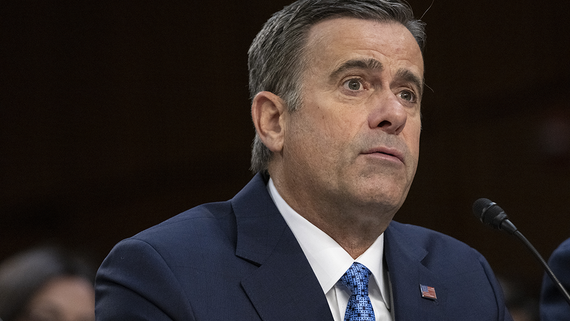
Recent reports indicate that CIA Director John Ratcliffe has traveled to Russia for high-level negotiations, marking a significant diplomatic development in US-Russian relations. The visit by America’s top intelligence chief comes at a particularly tense moment in international affairs, with ongoing conflicts and geopolitical rivalries shaping the global landscape. But who exactly is the man now representing American intelligence interests in Moscow? John Ratcliffe’s journey from small-town Texas attorney to the head of the world’s most powerful intelligence agency is a story of political ambition, legal expertise, and unwavering loyalty to conservative principles.
John Lee Ratcliffe was born on October 20, 1965, in Mount Prospect, Illinois, a suburb of Chicago. He later moved to Texas, where he would build his political career and establish himself as a prominent figure in Republican politics. Ratcliffe earned his law degree from Southern Methodist University’s Dedman School of Law and began his career as an attorney, eventually becoming a federal prosecutor. During his time as a prosecutor in the Eastern District of Texas, he worked on cases involving terrorism, public corruption, and other federal crimes, building a reputation as a tough, no-nonsense legal professional who took national security matters seriously.
From Mayor to Congress: Building Political Credentials
Before entering federal politics, Ratcliffe served as the mayor of Heath, Texas, a small city in the Dallas-Fort Worth metropolitan area, from 2004 to 2012. This local government experience provided him with executive leadership skills and a platform for engaging with constituents on everyday issues. In 2014, Ratcliffe successfully ran for the U.S. House of Representatives, defeating incumbent Ralph Hall in the Republican primary before winning the general election in Texas’s heavily conservative Fourth Congressional District. During his time in Congress, Ratcliffe sat on several key committees, including the House Intelligence Committee and the House Judiciary Committee, where he became known for his aggressive questioning of witnesses and his staunch defense of Republican positions.
Ratcliffe gained national prominence during the Trump administration’s various political battles, particularly during the investigations into alleged Russian interference in the 2016 presidential election. He was a vocal critic of Special Counsel Robert Mueller’s investigation and frequently appeared on conservative media outlets defending President Trump. His combative style during congressional hearings, particularly his questioning of Mueller himself in July 2019, caught the attention of the White House and cemented his reputation as a fierce partisan warrior willing to challenge what he perceived as biased investigations targeting the administration.
Director of National Intelligence: A Controversial Appointment
In May 2020, President Trump nominated Ratcliffe to serve as Director of National Intelligence, the position overseeing all 18 U.S. intelligence agencies. This was actually Trump’s second attempt to appoint Ratcliffe to the role, after an initial nomination in 2019 was withdrawn amid bipartisan concerns about his qualifications and questions about whether he had exaggerated his prosecutorial experience. Despite these concerns, Ratcliffe was confirmed by the Senate in a largely party-line vote of 49-44, becoming the sixth person to hold the position since its creation following the September 11, 2001, terrorist attacks. During his tenure as DNI, which lasted from May 2020 until January 2021, Ratcliffe was criticized by some intelligence professionals for what they viewed as politicizing intelligence assessments, while supporters praised him for challenging what they considered a biased intelligence establishment.
After leaving government service following the end of the first Trump administration, Ratcliffe remained active in conservative circles, working as a legal commentator and maintaining his connections within Republican political networks. When Donald Trump won the 2024 presidential election, Ratcliffe was nominated to serve as Director of the Central Intelligence Agency, a position that represents a significant elevation from his previous role. The CIA directorship places him in charge of America’s primary foreign intelligence service, responsible for gathering intelligence abroad, conducting covert operations, and providing critical analysis to policymakers. His confirmation to this role reflected both Trump’s trust in his loyalty and the Republican-controlled Senate’s willingness to approve the president’s national security team.
Leading American Intelligence in Turbulent Times
As CIA Director, Ratcliffe now oversees an agency with approximately 21,000 employees and a classified budget estimated in the billions of dollars. The CIA’s mission encompasses human intelligence gathering, analysis of foreign governments and organizations, and covert action programs authorized by the president. Ratcliffe’s visit to Russia for negotiations represents a departure from typical intelligence community operations, as such direct diplomatic engagement by a CIA director is relatively rare and signals the importance the administration places on direct channels of communication with Moscow. The specific agenda of these talks remains classified, though analysts speculate they may involve discussions about ongoing conflicts, prisoner exchanges, or efforts to establish new frameworks for managing the complex US-Russia relationship in an era of renewed great power competition.
Expert Opinion: Ratcliffe’s direct engagement with Russian officials represents a significant shift in how the Trump administration approaches intelligence diplomacy. His background as a prosecutor and his experience navigating Washington’s political battles may prove valuable in high-stakes negotiations, though his partisan reputation could complicate efforts to build trust with foreign counterparts. The coming months will reveal whether this unconventional approach yields tangible results or further complicates already strained relations.