
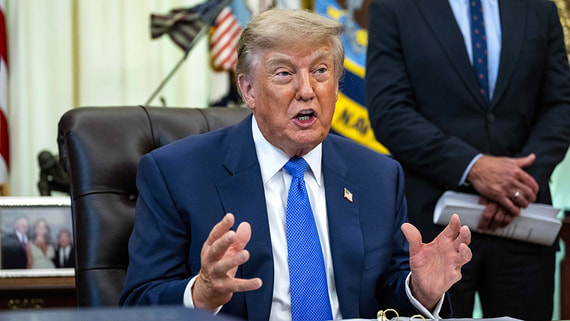
In a move that has sent shockwaves through international diplomatic circles, President Donald Trump has signaled that he does not see the need to maintain the current international status of the Strait of Hormuz, one of the world’s most strategically vital waterways. This unprecedented stance raises profound questions about American foreign policy, global energy security, and the future of international maritime law. The suggestion that the United States might seek to alter or even annex control of this critical chokepoint represents a dramatic departure from decades of American support for freedom of navigation principles.
The Strategic Importance of the Strait of Hormuz
The Strait of Hormuz, a narrow passage connecting the Persian Gulf to the Gulf of Oman and the Arabian Sea, represents arguably the most important oil transit chokepoint in the world. Approximately 21 million barrels of oil pass through this 33-kilometer-wide waterway daily, accounting for roughly 21 percent of global petroleum consumption. The strait separates Iran to the north from Oman and the United Arab Emirates to the south, making it a geopolitical flashpoint where competing interests of major world powers converge. Any disruption to shipping through this corridor would immediately impact global energy markets, potentially causing oil prices to spike dramatically and triggering economic turmoil across industrialized nations.
Historically, the United States has maintained a significant naval presence in the region through the Fifth Fleet, based in Bahrain, with the primary mission of ensuring freedom of navigation and protecting the flow of oil to global markets. This commitment has cost American taxpayers billions of dollars annually and has involved numerous confrontations with Iran, which has periodically threatened to close the strait in response to international sanctions and diplomatic pressure. The strategic calculus has always been clear: maintaining open sea lanes benefits not just American interests but the entire global economy.
International Law and Freedom of Navigation
Under the United Nations Convention on the Law of the Sea (UNCLOS), the Strait of Hormuz is classified as an international strait, meaning that all vessels have the right of transit passage regardless of their flag state. This legal framework, established in 1982, has been the cornerstone of international maritime commerce and has generally been respected by all parties despite regional tensions. The United States, while not a signatory to UNCLOS, has traditionally upheld and defended these principles as customary international law, sending naval vessels through disputed waters worldwide to reinforce freedom of navigation rights.
Trump’s apparent questioning of this international framework represents a significant philosophical shift in American foreign policy thinking. Critics argue that undermining established international maritime law could set dangerous precedents, potentially encouraging other nations to make similar territorial claims over strategic waterways. China’s expansive claims in the South China Sea have already tested these principles, and any American retreat from supporting international norms could embolden further challenges to the rules-based international order that has governed global commerce since World War II.
Regional Implications and Iranian Response
Any attempt by the United States to assert greater control over the Strait of Hormuz would inevitably provoke a strong response from Iran, which views the waterway as integral to its national security and economic survival. Tehran has repeatedly warned that it would close the strait if its oil exports were completely blocked by international sanctions. The Islamic Revolutionary Guard Corps Navy regularly conducts exercises in these waters and has occasionally harassed commercial shipping and US naval vessels. An American move to challenge the international status of the strait could transform these periodic tensions into a more sustained confrontation with potentially catastrophic consequences for regional stability and global energy markets.
Gulf Arab states, including Saudi Arabia, the UAE, Kuwait, and Qatar, depend heavily on the strait for their oil exports and would be directly affected by any change in its status. While these nations are American allies, they also maintain complex relationships with Iran and might view any escalation with deep concern. The geopolitical ramifications extend beyond the immediate region, as major oil importers including China, Japan, South Korea, and European nations have vital interests in maintaining stable access to Gulf petroleum resources.
Economic and Global Market Consequences
Financial markets and energy analysts are closely monitoring these developments, recognizing that any significant change in the status of the Strait of Hormuz could trigger unprecedented volatility in oil prices. The mere suggestion of American intervention or annexation has the potential to add a substantial risk premium to crude oil futures. Economists note that sustained uncertainty about the strait’s status could accelerate efforts by major importing nations to diversify their energy supplies and reduce dependence on Gulf oil, potentially hastening the global transition to renewable energy sources while simultaneously creating short-term economic disruption.
Expert Opinion: This potential shift in US policy toward the Strait of Hormuz signals a broader reconfiguration of American engagement with international institutions and maritime law. If pursued, such a strategy would likely face significant opposition from traditional allies and could paradoxically strengthen Iran’s diplomatic position by allowing it to present itself as a defender of international norms. The long-term consequences for global energy security and American credibility in upholding rules-based international order could far outweigh any perceived short-term strategic gains.