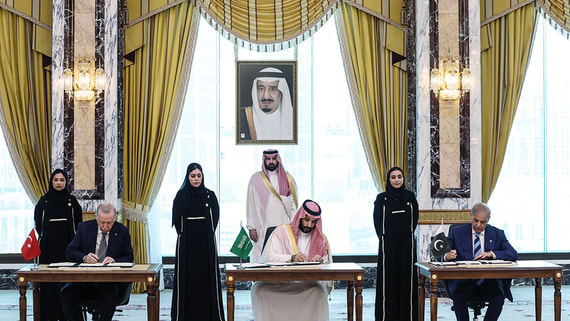
A new geopolitical alignment is taking shape in the Middle East and South Asia that could fundamentally alter the balance of power across a vast region stretching from the Mediterranean to the Indian subcontinent. Turkey, Saudi Arabia, and Pakistan are reportedly exploring the formation of a strategic alliance that some analysts are already comparing to a potential “NATO of the East.” The ambitious initiative aims to create a powerful bloc of Sunni-majority nations capable of projecting military, economic, and political influence independent of both Western powers and rival regional actors.
The three nations bring complementary strengths to any potential partnership. Turkey possesses NATO’s second-largest standing army, a sophisticated defense industry capable of producing advanced drones and military equipment, and strategic control over the Bosphorus Strait. Saudi Arabia contributes enormous financial resources derived from its petroleum wealth, significant regional influence within the Gulf Cooperation Council, and substantial military spending that has made it one of the world’s top arms importers. Pakistan offers nuclear capability, a battle-hardened military with experience in counterterrorism operations, and a population of over 230 million people representing a vast human resource pool.
Historical Context and Previous Cooperation Attempts
This is not the first time these three nations have explored closer cooperation. The concept of a Sunni Muslim alliance has been discussed periodically since the Cold War era, when Pakistan’s founder Muhammad Ali Jinnah envisioned a bloc of Islamic nations working together on common interests. In the 1960s and 1970s, similar proposals emerged but never materialized into formal structures due to competing national interests and the complex web of Cold War allegiances. Saudi Arabia and Pakistan have maintained particularly close ties, with the Kingdom providing financial support during Pakistan’s nuclear weapons development and Islamabad reportedly offering security guarantees to Riyadh in return.
The relationship between Turkey and Saudi Arabia has been more complicated, especially following the 2018 murder of journalist Jamal Khashoggi at the Saudi consulate in Istanbul. However, recent diplomatic efforts have sought to repair these ties, with Turkish President Recep Tayyip Erdogan visiting Riyadh in 2022 and the two nations agreeing to turn a new page in bilateral relations. Economic pressures facing Turkey, including high inflation and currency depreciation, have made Gulf investment increasingly attractive to Ankara, providing additional incentive for rapprochement.
Strategic Motivations Driving the Alliance
Several factors are pushing these nations toward closer alignment. All three countries share concerns about Iranian influence in the region, from Tehran’s support for Houthi rebels in Yemen to its backing of Hezbollah in Lebanon and various militias in Iraq and Syria. The gradual American disengagement from the Middle East, particularly visible in the chaotic Afghanistan withdrawal of 2021, has convinced regional powers that they can no longer rely solely on Washington for security guarantees. Additionally, the Abraham Accords between Israel and several Arab states have created a new dynamic that Saudi Arabia is still navigating, while Turkey has maintained its own complex relationship with Israel.
Participants in this emerging bloc are reportedly looking to expand its membership to include other nations. Potential candidates might include the United Arab Emirates, Egypt, Malaysia, Indonesia, and Azerbaijan, each of which could add valuable capabilities or strategic geography to the alliance. Indonesia and Malaysia would extend the bloc’s reach into Southeast Asia and add significant Muslim populations, while Azerbaijan could provide energy resources and a foothold in the Caucasus region. Such expansion would represent a dramatic reconfiguration of international alignments not seen since the end of the Cold War.
Challenges and Skepticism
Despite the potential benefits, numerous obstacles stand in the way of a functional Eastern NATO. Unlike the original NATO, which was built on shared democratic values and a common threat perception regarding the Soviet Union, this proposed alliance would unite nations with different political systems ranging from absolute monarchy to parliamentary democracy. Internal rivalries could prove difficult to manage, particularly given the historical competition between Turkey and Saudi Arabia for leadership of the Sunni Muslim world. Pakistan’s economic instability and political turbulence add further uncertainty, while each nation maintains important relationships with major powers that could complicate bloc politics.
Military analysts also question whether such an alliance could achieve the level of interoperability and joint command structures that make NATO effective. Decades of standardized equipment, joint exercises, and integrated command would be difficult to replicate quickly. Furthermore, the response from existing powers, including the United States, China, Russia, and India, would likely shape whether this initiative can advance beyond preliminary discussions.
Expert Opinion: While the strategic logic for a Turkey-Saudi Arabia-Pakistan alliance is compelling, the practical challenges of building genuine military integration across such diverse political systems should not be underestimated. The initiative is more likely to evolve into a flexible partnership framework for selective cooperation rather than a formal mutual defense pact comparable to NATO. Nevertheless, even loose coordination among these three powers would represent a significant shift in regional dynamics that Western policymakers cannot afford to ignore.