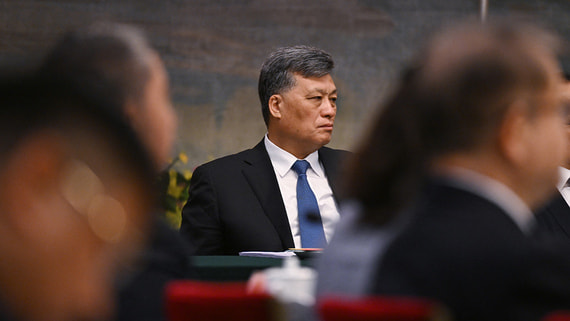
Ma Xingrui, once a rising star in China’s political hierarchy and a former key figure in the nation’s ambitious space program, has become the third member of the Politburo of the Communist Party of China (CPC) Central Committee to face investigation within a single year. The dramatic downfall of this high-ranking official sends a powerful signal about President Xi Jinping’s continuing anti-corruption campaign, which has now reached into the uppermost echelons of Chinese political power. Ma’s case represents one of the most significant political scandals to emerge from China’s space industry, an sector that has been central to the country’s aspirations for global technological supremacy.
The investigation into Ma Xingrui comes at a particularly sensitive time for China’s Communist Party, as it continues to position itself as a force for clean governance and national rejuvenation. Ma, who previously served as the governor of Guangdong Province and held crucial positions overseeing China’s space industrial complex, now faces serious allegations of corruption and moral degradation. His arrest underscores the vulnerability of even the most powerful officials when suspected of betraying public trust, regardless of their previous contributions to national strategic programs.
A Career Built on Aerospace Achievements
Ma Xingrui’s career trajectory was nothing short of remarkable before his fall from grace. As a trained aerospace engineer, he played instrumental roles in developing China’s space capabilities during a period of unprecedented expansion. He served as the general manager of China Aerospace Science and Technology Corporation (CASC), the primary contractor for China’s space program, and later became the director of China’s National Space Administration. Under his leadership, China achieved numerous milestones, including lunar exploration missions and the development of the Shenzhou crewed spacecraft program. His technical expertise and administrative success appeared to position him for continued political advancement within the party hierarchy.
The space industry in China has long been considered a crown jewel of the nation’s scientific and military capabilities. With billions of dollars in investment and thousands of engineers working on projects ranging from satellite systems to deep space exploration, the sector represents both national pride and strategic importance. Ma’s oversight of this critical industry gave him tremendous influence and access to vast resources, factors that investigators now believe may have contributed to opportunities for corrupt practices. The charges against him suggest a pattern of behavior that allegedly included accepting bribes and engaging in activities inconsistent with party discipline.
Xi Jinping’s Relentless Anti-Corruption Drive
Since assuming power in 2012, President Xi Jinping has made the fight against corruption a cornerstone of his governance philosophy. His campaign has resulted in the investigation and punishment of hundreds of thousands of officials at various levels, from local bureaucrats to senior military officers and members of the party’s highest decision-making bodies. The term often used in official communications, describing corruption and “moral degradation” or “lifestyle decay,” typically refers to allegations that extend beyond financial misconduct to include personal improprieties that violate party standards. Ma being the third Politburo member investigated in just one year demonstrates that Xi’s campaign shows no signs of abating, even as some observers question whether these investigations serve both anti-corruption and political consolidation purposes.
The Politburo, consisting of the Communist Party’s top twenty-four leaders, represents the pinnacle of political power in China. Investigations at this level are extraordinarily rare and carry profound implications for the individuals involved, typically resulting in expulsion from the party, criminal prosecution, and lengthy prison sentences. Historical precedents include the cases of Bo Xilai and Zhou Yongkang, both of whom received life sentences following their dramatic falls from power. Ma Xingrui now joins this unfortunate roster of once-powerful figures whose careers ended in disgrace, serving as a cautionary tale for others in positions of authority.
Implications for China’s Strategic Industries
The investigation into Ma Xingrui raises important questions about governance and oversight within China’s strategically sensitive industries. The space sector, closely linked to military applications and national security, operates with significant opacity and limited external scrutiny. Critics have long argued that such conditions create environments where corruption can flourish unchecked. As China continues to expand its space capabilities, including plans for a permanent space station and potential crewed missions to the Moon, ensuring clean governance within these programs becomes increasingly critical. The Ma case may prompt renewed efforts to strengthen oversight mechanisms and prevent similar abuses in the future, though the inherently secretive nature of these industries makes comprehensive reform challenging.
Expert Opinion: Ma Xingrui’s downfall represents more than just another corruption case—it signals that Xi Jinping’s political consolidation continues unabated even within technically critical sectors. The timing suggests that no industry, regardless of its strategic importance, provides immunity from investigation. Moving forward, we can expect heightened scrutiny of officials who transitioned from technical to political roles, particularly in defense-related industries.