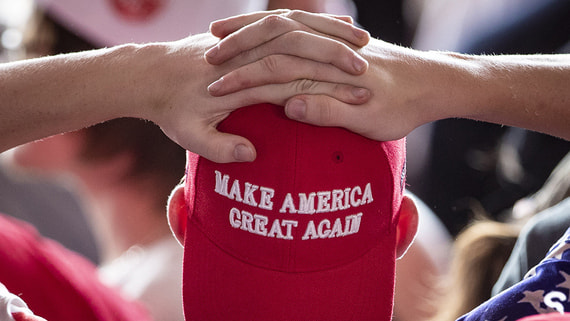
The political coalition that propelled Donald Trump to unprecedented influence in American politics appears to be showing significant cracks, with foreign policy disagreements over Iran emerging as a major fault line. What was once a seemingly monolithic movement united behind the former president’s America First doctrine is now experiencing internal tensions that threaten to reshape the Republican Party’s future direction. The prospect of military conflict with Iran has exposed deep divisions between isolationist and interventionist factions within the MAGA base, raising questions about whether the movement can maintain its cohesion without a unified foreign policy vision.
The fracturing comes at a particularly delicate moment for Trump’s political influence. Having built his brand on promises to end forever wars and bring American troops home, the former president now finds himself navigating treacherous political waters where any move toward military engagement with Tehran risks alienating core supporters who took those anti-war pledges seriously. Meanwhile, more hawkish elements within his coalition, including influential donors and certain media personalities, have been pushing for a more confrontational approach toward the Islamic Republic.
The Historical Roots of MAGA’s Foreign Policy Contradictions
The tension between isolationism and interventionism within the Republican Party predates Trump by decades, but his political movement attempted an unusual synthesis of these competing impulses. During his first term, Trump simultaneously withdrew from the Iran nuclear deal, ordered the assassination of Iranian General Qasem Soleimani, and yet resisted calls for broader military action when Iran shot down an American drone in 2019. This delicate balancing act kept both wings of his coalition relatively satisfied, but it was always an unstable equilibrium waiting to be disrupted.
The America First ideology that became synonymous with Trumpism drew heavily from earlier non-interventionist traditions in American politics, including the pre-World War II movement of the same name. Trump’s promise to prioritize domestic concerns over foreign entanglements resonated with a war-weary public exhausted by two decades of military involvement in the Middle East and Afghanistan. Veterans and their families, who formed a significant portion of Trump’s base, were particularly receptive to messages about bringing troops home and avoiding new conflicts. However, this rhetoric existed in tension with the Republican Party’s traditional alignment with defense contractors, neoconservative intellectuals, and pro-Israel advocacy groups who viewed Iran as an existential threat requiring American military pressure.
The Current Fracture Lines and Key Players
The current discord within MAGA circles has been amplified by prominent voices taking opposing positions on potential Iran policy. Some of Trump’s most visible supporters in conservative media have advocated for maintaining the maximum pressure campaign while avoiding military confrontation, arguing that economic sanctions alone can achieve American objectives. Others, particularly those with closer ties to certain donor networks, have pushed for more aggressive postures, including potential military strikes against Iranian nuclear facilities. This disagreement has spilled into public view through social media disputes, competing opinion pieces, and contradictory statements from figures who all claim to represent authentic Trumpism.
The situation is further complicated by Trump’s own ambiguous positioning. His public statements have oscillated between bellicose threats and offers of negotiation, leaving supporters unsure of what policy direction to champion. This uncertainty has created space for competing interpretations of what loyalty to Trump actually means in practical policy terms. Some argue that true MAGA supporters should oppose any military engagement that could lead to another prolonged Middle Eastern conflict, while others contend that projecting American strength against adversaries is central to the movement’s identity. The absence of a clear, consistent message from Trump himself has empowered various factions to claim the mantle of authentic representation.
Implications for American Politics and Presidential Influence
The fracturing of the MAGA coalition over Iran policy carries significant implications for the broader American political landscape. Trump’s influence within the Republican Party has depended partly on his ability to command unified support from his base, using this loyalty as leverage over elected officials and party leadership. If his supporters become divided on major policy questions, this leverage necessarily diminishes. Republican politicians who previously calculated that crossing Trump meant political suicide may find more room to maneuver if the MAGA base itself is split.
Furthermore, the Iran question exposes a fundamental challenge facing any populist movement as it matures: the difficulty of maintaining ideological coherence while accommodating diverse interests within a coalition. The America First vision was sufficiently vague to attract both non-interventionists who wanted to withdraw from global commitments and nationalists who wanted to assert American dominance more aggressively. As concrete policy decisions force choices between these competing visions, the coalition’s unity becomes harder to maintain. This dynamic suggests that Trumpism, regardless of Trump’s personal political fortunes, may be entering a new phase characterized by internal competition rather than external expansion.
Expert Opinion: The Iran policy debate within MAGA circles represents more than a simple foreign policy disagreement—it signals a potential inflection point for American populist conservatism. As the movement struggles to reconcile its anti-establishment rhetoric with the practical demands of governance, we may be witnessing the beginning of its transformation from a unified insurgency into competing factions with distinct policy priorities. The coming months will likely determine whether Trumpism can evolve into a durable political philosophy or fragment into irreconcilable tendencies.